
Yes—a fractional marketing leader can improve demand generation performance by aligning your target audience, campaign priorities, sales follow-up, and measurement under one accountable decision-maker. The improvement depends on authority and implementation capacity: a part-time executive cannot compensate for an offer buyers reject, unanswered inquiries, or a team without time to execute.
TL;DR- Can a fractional marketing leader improve demand generation performance? Yes, when leadership includes decision authority and implementation accountability.
- Choose fractional CMO leadership for strategic coordination, not as a substitute for campaign production.
- Measure qualified demand, completed sales conversations, and customer acquisition—not traffic alone.
- Carey Kidd Group provides fractional CMO and strategic marketing consulting for hospitality, events, health/medical, and fitness businesses.
Can a fractional marketing leader boost demand generation?
Yes, when the constraint is fragmented decision-making rather than a shortage of campaign production. A fractional leader should connect marketing activity to a defined commercial outcome and establish who owns each transition from interest to revenue.
Use this diagnostic before adding another campaign to your 2026 marketing plan:
| Current problem | Leadership responsibility | What leadership alone cannot fix |
|---|---|---|
| Campaigns target different buyers | Establish audience and positioning priorities | An offer that does not meet buyer needs |
| Reports emphasize clicks and inquiries | Define qualification and revenue reporting | Missing or inaccurate customer records |
| Inquiries stall after submission | Assign follow-up ownership and escalation | A team that does not complete follow-up |
| Vendors pursue disconnected objectives | Set a shared brief and review process | Production work outside the agreed scope |
Carey Kidd Group provides fractional CMO and strategic marketing consulting around Raleigh, North Carolina. The relevant buying question is whether your business needs that leadership function—not simply another supplier of marketing activity.
Why this matters
Demand generation involves both creating interest and helping interested buyers take a meaningful next step. Your advertising, website, referral activity, and sales process should support the same audience and offer.
A hospitality business might need qualified event inquiries rather than general website visits. A fitness studio might need attended introductory sessions rather than unqualified form submissions. These are different operating goals, and they require different campaign decisions.
Set the commercial objective before selecting the channel. Otherwise, a campaign can meet its activity target while failing to address the business problem you hired marketing to solve.
What should a fractional marketing leader change first?
Start with the path from audience selection to customer acquisition. The following sequence is a recommended operating process, not a promise of results within a fixed period.
Establish the baseline
Document your current sources of inquiries, qualification rules, follow-up process, and customer outcomes. For your 2026 baseline, distinguish between activity you can count and revenue you can substantiate.
Ask the person responsible for sales or bookings to review the records alongside marketing. An inquiry marked as qualified in a campaign report is not necessarily an opportunity your business can serve.
Record where information stops. If you can identify the campaign that generated an inquiry but cannot connect that inquiry to a booking, measurement needs attention before you judge campaign profitability.
Select the constraint
Choose the problem that prevents existing demand from progressing. That might be unclear positioning, poorly matched inquiries, an inconvenient booking process, or inconsistent follow-up.
Avoid treating every weakness as an equal priority. If qualified prospects abandon the same booking step, sending more traffic into that step does not resolve the underlying problem.
The leader's responsibility is to explain the priority and the trade-off. Your team should understand what receives attention now, what waits, and what evidence would change that decision.
Assign implementation
Give each approved initiative 1 accountable owner. Contributors can share the work, but responsibility for completion should not sit ambiguously between your employee, agency, and executive.
Define the deliverable, approval responsibility, dependencies, and completion criteria. A recommendation to improve conversion is not an executable assignment; a specified change to the inquiry form with a named approver is.
This is where strategic consulting and operating leadership differ. Require clarity about whether the engagement includes directing implementation or ends with recommendations.
Review the outcome
Use a recurring review to compare completed work with the intended business result. Separate an implementation failure from an unsuccessful campaign hypothesis.
If the agreed change never launched, you have not tested its effectiveness. If it launched correctly but attracted unsuitable inquiries, revisit the audience, message, or offer rather than reporting activity as success.
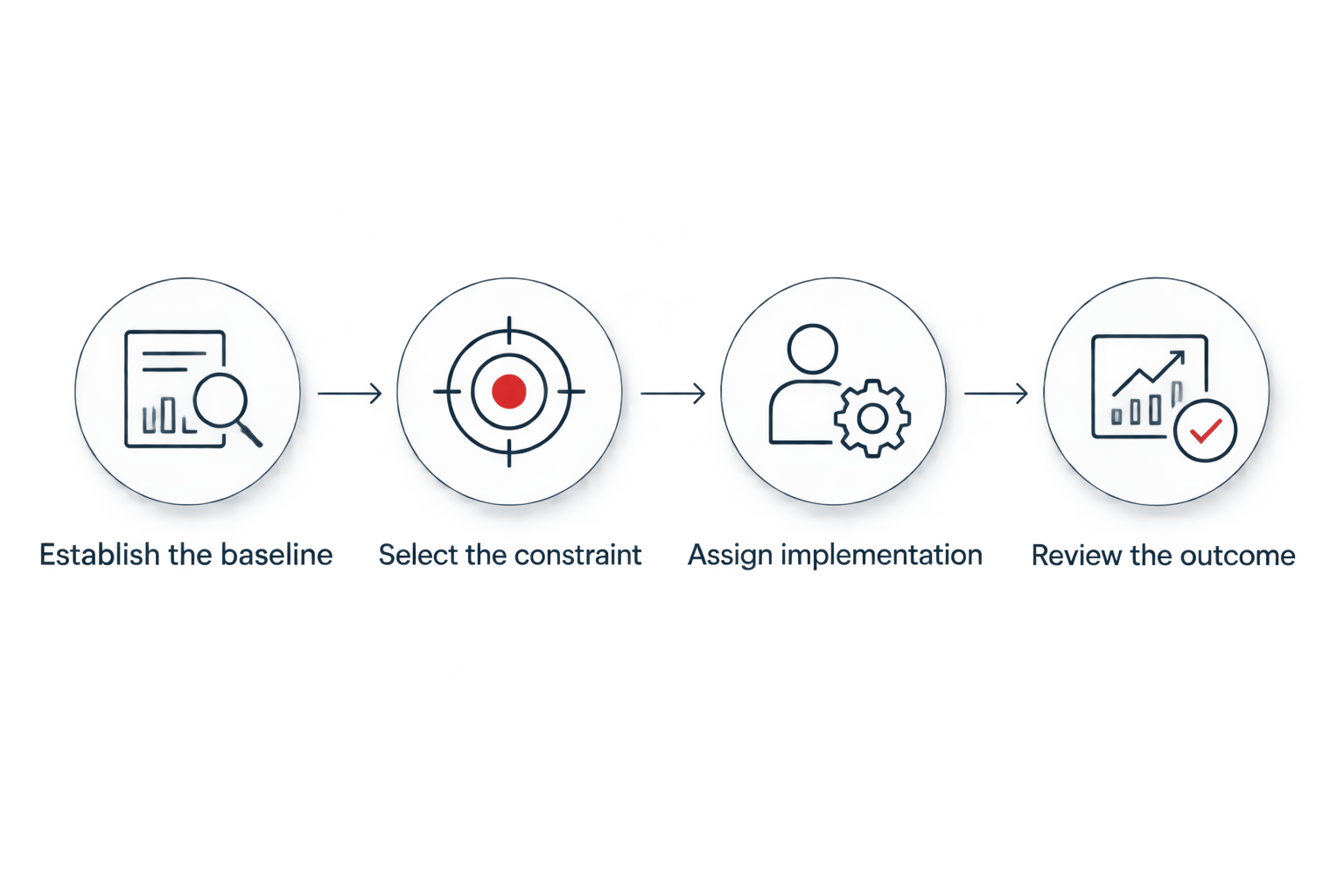 Agree on the constraint before assigning more campaign work.
Which marketing leadership model fits your demand problem?
A fractional CMO, an agency, and an internal marketing director serve different purposes. Compare the responsibility you need rather than treating the titles as interchangeable.
| Model | Best for | Principal advantage | Limitation to address |
|---|---|---|---|
| Fractional CMO | Businesses needing senior direction across existing resources | Connects strategy, priorities, and accountability | Part-time capacity requires explicit scope and decision access |
| Marketing agency | Businesses with a clear strategy that need specialist execution | Provides contracted production or channel expertise | Cross-business leadership must be explicitly included or retained internally |
| Internal marketing director | Businesses needing continuous internal marketing management | Keeps management responsibility inside the business | Available expertise depends on the person and supporting team |
Choose fractional leadership for a leadership gap; choose execution support for an execution gap. A business with a capable strategic owner and an unfinished production backlog needs a different solution from one whose vendors receive conflicting instructions.
The models can coexist. Define who owns strategy, who manages delivery, and who approves changes before combining them.
Why demand generation performance varies
The engagement model does not determine the result by itself. Evaluate these operating conditions before setting expectations:
- Decision authority: Specify which audience, messaging, channel, and budget decisions the leader can make and which require approval.
- Offer fit: Establish why the intended buyer should act and whether the offer addresses a clear need.
- Execution capacity: Identify the employees or suppliers responsible for production, technical changes, and campaign management.
- Follow-up ownership: Assign responsibility for responding to inquiries and recording their outcomes.
- Measurement quality: Confirm that reporting distinguishes inquiries, qualified prospects, customers, and repeat business.
- Service capacity: Check whether your business can deliver the appointments, events, stays, or memberships marketing promotes.
These factors belong in the engagement brief. They should not emerge as explanations after a campaign misses its objective.
What should your demand generation scorecard measure?
Build your 2026 scorecard around progression through the buying process. Use the same definitions across marketing and the people responsible for closing business.
Start with these 5 measures, adapting the conversion event to your business:
| Measure | What it answers | Reporting safeguard |
|---|---|---|
| Qualified inquiries | Are relevant buyers responding? | Write the qualification criteria before counting |
| Completed next steps | Do prospects attend, consult, or tour? | Separate scheduled activity from completed activity |
| New customers | Does interest become business? | Connect the customer record to the inquiry where possible |
| Acquisition efficiency | What resources produce customer acquisition? | State which expenses the calculation includes |
| Repeat business | Does acquisition lead to further purchases or visits? | Separate new acquisition from returning customers |
Do not combine these into a single success claim. More inquiries with fewer completed consultations calls for a different response from fewer inquiries with more customers.
Use 1 shared definition for a qualified inquiry. Include buyer fit, relevant intent, and any practical conditions your team uses to accept the opportunity.
For health/medical businesses, define reporting access and patient-information handling with the appropriate internal owner. Marketing measurement should not become a reason to distribute sensitive information unnecessarily.
How quickly should you expect a better pipeline?
There is no defensible universal deadline for improved demand generation. Separate operational milestones from commercial outcomes when discussing how quickly fractional CMOs build pipeline: installing qualification rules and reporting is not the same as producing completed sales.
Your starting point matters. Repairing a broken inquiry handoff is a different assignment from building awareness among buyers who do not yet know the business.
Ask for milestones tied to completed work, followed by evaluation against your actual buying cycle. Your 2026 engagement should distinguish what the leader controls, what the implementation team controls, and what requires a buyer's decision.
A launch date is a delivery commitment, not a revenue guarantee. Reject proposals that blur the distinction.
What does this look like in hospitality, events, and wellness?
Use your business model to define the conversion—not a generic marketing dashboard. The following are suggested measurement paths, not reported client results.
- Hospitality: Follow relevant inquiries through reservation or event-booking completion. Separate general interest from the booking type the campaign is designed to generate.
- Events: Connect qualified inquiries to completed conversations, venue tours where relevant, proposals, and signed business. Identify where responsibility transfers from marketing to sales.
- Health/medical: Distinguish appointment requests from attended appointments. Establish how the practice records patient acquisition without treating every contact as an appropriate new patient.
- Fitness: Follow inquiries through attended introductory activity and membership decisions. Keep acquisition reporting separate from ongoing member retention.
The fractional leader should make these definitions usable by your staff. If the reporting requires constant interpretation before anyone can act, simplify it.
When is fractional leadership the right choice?
Carey Kidd Group is best suited to hospitality, events, health/medical, and fitness businesses seeking fractional CMO or strategic marketing consulting. That fit follows the stated service focus; it is not a claim of guaranteed demand growth.
The fractional model suits a business prepared to give a senior leader access to decision-makers, performance records, and the people implementing the plan. Its limitation is capacity: fractional leadership does not automatically include every specialist or production task.
Before discussing fractional CMO and strategic marketing consulting services, write down the decisions your business currently struggles to make. Include unresolved priorities, conflicting vendor recommendations, and gaps in accountability.
Use that list to evaluate scope. A proposal should explain which problems the engagement addresses and which remain your responsibility.
What should the engagement agreement make explicit?
Your 2026 brief should define authority and accountability before it lists channels. Use these questions to test whether the working relationship is sufficiently clear:
- Who decides? Name the person who approves positioning, campaign priorities, and material changes to the plan.
- Who delivers? Distinguish executive direction from copywriting, design, advertising operations, website development, and sales follow-up.
- Who supplies information? Assign responsibility for customer records, financial inputs, and operational feedback.
- What gets reviewed? Specify the scorecard, qualification definitions, and process for investigating weak performance.
- What remains after the engagement? Require documented decisions, reporting definitions, and ownership of ongoing work.
Ask the prospective leader to describe how disagreements get resolved. A strategic role without a workable approval process leaves the founder managing the same unresolved choices.
Accountability requires both responsibility and permission to act. Do not hire an executive to own an outcome while withholding access to the decisions that shape it.
Do I need a fractional CMO or more campaign execution?
You need fractional leadership when strategic decisions, coordination, and accountability are missing. You need additional execution when the strategy is clear but approved work remains unfinished because the team lacks capacity or specialist skills.
Can a fractional leader work with my existing agency?
Yes, a fractional leader can direct an existing agency when responsibilities and authority are explicit. Keep the agency accountable for its contracted work and the leader accountable for priorities, integration, and performance review.
Can a fractional marketing leader guarantee more qualified leads?
No—a fractional marketing leader cannot guarantee buyer response or qualified lead growth. Evaluate the diagnosis, implementation responsibilities, measurement plan, and decision process instead of accepting an unsupported outcome promise.
FAQ
Can a fractional marketing leader improve demand generation performance?
Yes, a fractional marketing leader can improve demand generation performance by aligning targeting, campaign priorities, follow-up, and measurement. Results depend on decision authority, implementation capacity, and buyer response.
What's the difference between demand generation and lead generation?
Demand generation builds interest and preference, while lead generation captures identifiable prospects. Connect both to qualification and customer outcomes rather than treating contact volume as the final objective.
Is a fractional CMO better than a marketing agency?
A fractional CMO fits a leadership gap; a marketing agency fits a defined execution need. Compare actual responsibilities because either engagement can include additional services only when explicitly agreed.
What should I measure before hiring a fractional marketing leader?
Measure qualified inquiries, completed next steps, new customers, acquisition efficiency, and repeat business. Document how each measure is defined and where its underlying records come from.
How long does a fractional CMO take to improve demand generation?
There is no universal timeline for demand generation improvement. Set implementation milestones separately from commercial outcomes and assess results against your actual buying cycle.
Will I still need employees or contractors?
You need someone assigned to implementation, whether that is an employee, contractor, agency, or explicitly included service. Fractional executive leadership does not automatically include campaign production.
Does Carey Kidd Group serve businesses outside a single industry?
Carey Kidd Group provides fractional CMO and strategic marketing consulting for hospitality, events, health/medical, and fitness businesses around Raleigh, North Carolina. Evaluate the engagement against your specific leadership and implementation needs.
One last thing
Before authorizing another campaign, trace a recent inquiry from its source to its final disposition. Ask who received it, what happened next, and where the outcome was recorded.
If nobody can complete that account, make the handoff visible before increasing acquisition activity. The next useful marketing decision might concern ownership, not a new channel. A fractional leader's value should show up in clearer decisions and accountable implementation—not just an additional strategy presentation.