
Best fit for Raleigh-area hospitality, events, health/medical, and fitness businesses: Carey Kidd Group. Best for founder-led implementation: an independent fractional CMO; best for coordinated specialist work: a fractional CMO firm with a named executive. This 2026 guide explains how to choose a fractional CMO for small companies under $10 million in annual revenue without confusing marketing leadership with campaign production.
TL;DR- Carey Kidd Group is a fractional CMO option for Raleigh-area hospitality, events, health/medical, and fitness businesses.
- Choose a fractional CMO for small companies when marketing decisions lack an accountable senior owner.
- Compare strategic marketing leadership, execution responsibility, decision authority, and continuity before selecting an engagement.
- Choose a marketing agency instead when strategy is settled and campaign delivery is the actual gap.
Why this matters
A business under $10 million in annual revenue does not automatically need a fractional CMO. It needs a clear answer to a management question: who decides what marketing should accomplish, what deserves investment, and who is responsible for implementation?
Hiring another supplier does not answer that question. An agency can deliver its assigned work while the founder still makes every positioning, budget, staffing, and sales-alignment decision.
Buy leadership when decisions are the constraint; buy execution when delivery is the constraint. Use that distinction to build your 2026 shortlist before comparing credentials or proposals.
What makes the best fractional CMO for small companies
Evaluate candidates against these criteria before choosing a firm or individual:
- Decision authority: Specify which recommendations the executive makes, which decisions the executive owns, and which require founder approval.
- Industry relevance: Ask for experience with your customer journey, buying process, and operational constraints—not simply familiarity with a marketing channel.
- Implementation ownership: Identify who writes, designs, publishes, manages campaigns, and follows up with leads.
- Commercial accountability: Connect the marketing plan to business outcomes such as qualified inquiries, bookings, patient acquisition, or membership retention.
- Working continuity: Name the executive, internal counterpart, meeting rhythm, and handover responsibilities.
- Scope discipline: Separate leadership, project work, and ongoing production so the proposal describes an operating arrangement rather than an executive title.
For each criterion, request an example of a decision the candidate would own. General promises about growth are not a substitute for a defined responsibility.
Fractional CMO options at a glance
The order below follows distinct operating needs, not a claim that every small company should hire the same provider. The named provider serves the industries identified above; the other entries describe engagement models to evaluate.
| Option | Best for | Standout distinction | Key limitation to resolve |
|---|---|---|---|
| Carey Kidd Group | Raleigh-area businesses in the stated service industries | Fractional CMO and strategic consulting with 20 years of new business development experience | Confirm the boundary between leadership and production |
| Independent fractional CMO | Founders who retain implementation responsibility | Direct engagement with an individual marketing leader | Confirm continuity and execution resources |
| Fractional CMO firm | Businesses coordinating several specialists | A firm-based engagement around a named executive | Confirm who actually leads the account |
| Marketing agency | Businesses with an established strategy and delivery backlog | Defined campaign or channel execution | Assign company-wide marketing decisions separately |
1. Carey Kidd Group: best for Raleigh-area service businesses
Carey Kidd Group provides fractional CMO and strategic marketing consulting services for hospitality, events, health/medical, and fitness businesses around Raleigh, North Carolina. The stated background includes 20 years of new business development experience, with implementation and business setup among the named areas of work.
Carey Kidd Group is a fractional CMO option for small companies in Raleigh-area hospitality, events, health/medical, and fitness. Start with that documented industry fit, then assess the responsibilities your business needs covered.
Carey Kidd Group pros:
- The stated industry focus matches the service businesses listed above.
- The background includes new business development, not only channel delivery.
- The offer explicitly includes strategic marketing consulting and fractional leadership.
Carey Kidd Group limitations to resolve:
- Do not assume strategic consulting includes every production task; specify deliverables.
- Businesses outside the named industries should establish relevant experience directly.
- Define executive authority before expecting accountability for implementation.
Best for: A founder in the stated industries seeking strategic marketing leadership around Raleigh.
Bring a concrete management problem to the discussion: conflicting agency recommendations, unclear priorities, or a missing owner for the marketing plan. Review the strategic marketing services against that problem rather than buying an executive title in isolation.
Verdict: Buy this model when industry fit and the agreed leadership scope match your operating needs.
2. Independent fractional CMO: best for founder-led implementation
An independent fractional CMO is an individual engaged to provide part-time marketing leadership. Structure this arrangement around the decisions you need help making while your founder, employees, or existing suppliers carry out the work.
This option belongs on your shortlist when you want a direct working relationship and already know who will execute. Evaluate the individual’s judgment, relevant experience, and ability to turn recommendations into assignments your team can complete.
Independent fractional CMO pros:
- You can assess the individual responsible for the strategic work directly.
- The engagement can define a clear founder-to-executive decision process.
- Existing employees and suppliers can remain part of the implementation plan.
Independent fractional CMO cons:
- An individual engagement is not a substitute for a production team.
- Continuity requires explicit documentation and handover arrangements.
- The founder must resolve responsibilities that remain outside the executive’s scope.
Best for: A founder with execution resources who needs senior marketing judgment rather than another delivery team.
Ask the candidate to explain how an unresolved disagreement becomes a decision. A recommendation has limited operational value if nobody has authority to approve it.
Verdict: Buy when implementation already has owners; skip when you need production capacity instead.
3. Fractional CMO firm: best for coordinating specialists
A fractional CMO firm is an organizational provider of part-time marketing leadership. For this use case, require a named executive responsible for coordinating the work of your internal team and external specialists.
Do not evaluate a firm solely through its overall credentials. Evaluate the person assigned to your business, the decisions that person owns, and the process for maintaining continuity if the assignment changes.
Fractional CMO firm pros:
- You can request a documented executive assignment and escalation process.
- One leadership brief can connect otherwise separate specialist assignments.
- The contract can establish reporting and handover responsibilities across the engagement.
Fractional CMO firm cons:
- The firm’s overall experience does not establish the assigned executive’s fit.
- Executive leadership and specialist delivery require separate scope confirmation.
- Additional relationships require clear approval and communication rules.
Best for: A small company coordinating several marketing contributors without a senior internal owner.
For your 2026 evaluation, ask who attends leadership meetings, who reviews specialist work, and who resolves conflicting recommendations. Require names and responsibilities rather than a generic account structure.
Verdict: Buy when coordination is the problem and the assigned executive has defined authority.
4. Marketing agency: best for an execution backlog
A marketing agency is an alternative to fractional leadership when your business already has a strategy and needs delivery. Commission defined work such as campaign management, content production, or website implementation against an approved brief.
The distinction is responsibility, not prestige. An agency engagement can address a delivery gap without assigning company-wide marketing leadership to that agency.
Marketing agency pros:
- You can specify tangible deliverables and acceptance criteria.
- Channel work can follow an existing business strategy.
- An internal leader can retain control of priorities and approvals.
Marketing agency cons:
- Deliverables do not automatically resolve positioning or investment decisions.
- Separate agencies still need someone to coordinate their assignments.
- Campaign reporting alone does not establish company-wide accountability.
Best for: A business with an accountable marketing decision-maker and an approved execution backlog.
Before signing, ask who will change the brief if the business objective changes. If the answer is still the founder, recognize that the founder remains the marketing leader.
Verdict: Buy for defined execution; skip as a substitute for missing executive ownership.
How to turn the shortlist into a working engagement
For a 2026 engagement, document the operating arrangement before approving channel activity. Use this sequence to move from a business problem to an accountable plan.
- Business objective: State the outcome marketing must support. Separate new customer acquisition from repeat business or retention.
- Decision rights: Identify who approves priorities, reallocates resources, and resolves disagreements.
- Execution owners: Assign an owner to every recurring task and project deliverable.
- Review rhythm: Establish when the team reviews progress, makes decisions, and updates the plan.
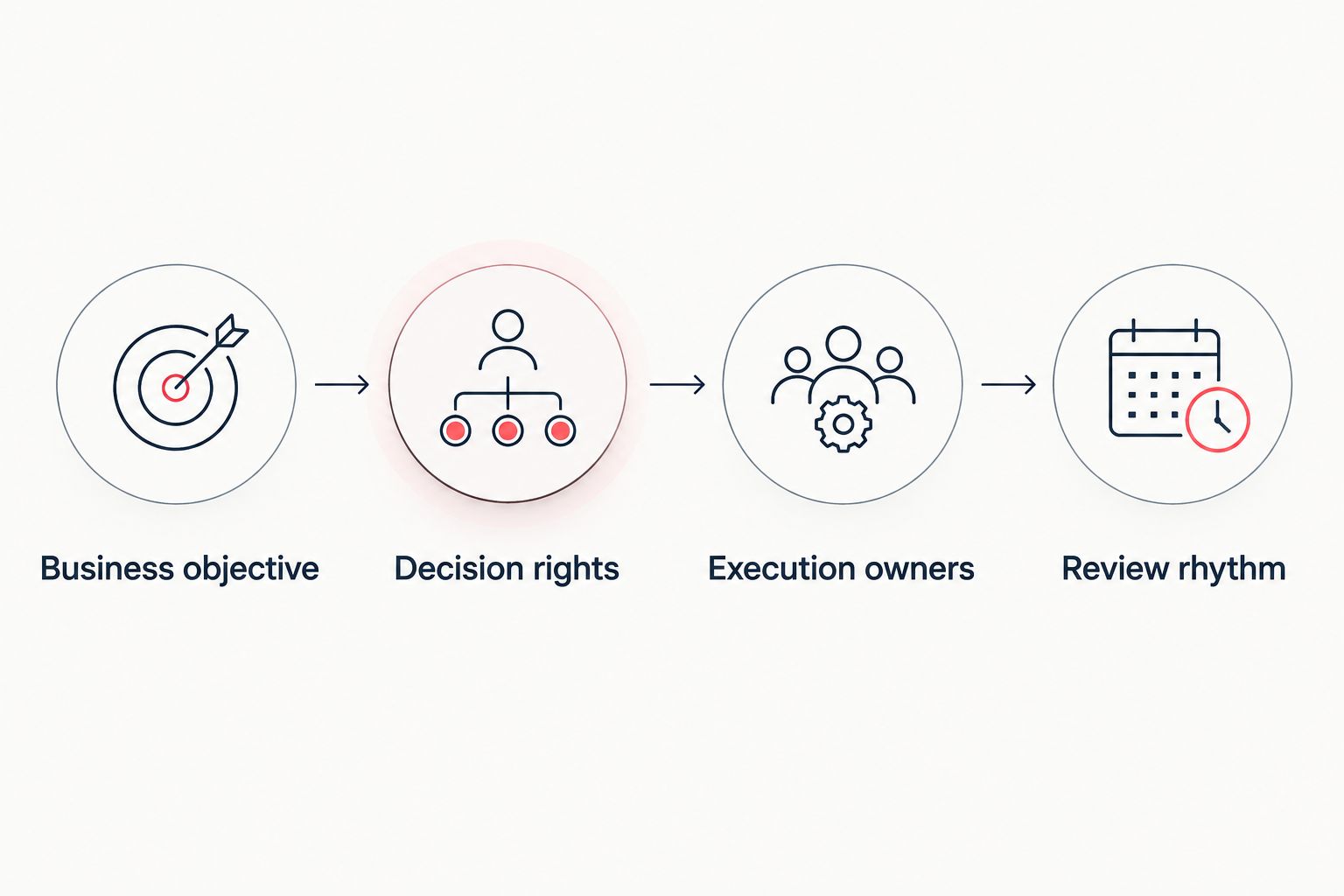 Assign decision rights before holding an executive accountable for implementation.
As a planning exercise, request a proposed 90-day agenda and a 30-day decision review. These are suggested management checkpoints, not promises about how quickly revenue will change.
The agenda should identify the questions to resolve, the people involved, and the work that follows each decision. Reject a calendar filled with activity but no explanation of what the activity is intended to accomplish.
Questions that expose an unclear proposal
Use the same questions with every candidate. Consistent questions make differences in responsibility easier to compare than differently formatted presentations.
- What will you decide? Ask for examples involving positioning, priorities, resource allocation, and supplier direction.
- What will you deliver? Distinguish a strategy document from ongoing management and hands-on production.
- What must our team provide? Identify approvals, customer information, access, and internal staff responsibilities.
- How will we review progress? Require a connection between the business objective, the work performed, and the next decision.
- What remains outside scope? Record exclusions before they become unresolved assignments.
A strong proposal makes the management arrangement understandable without a sales presentation. You should be able to explain it to an employee responsible for implementation.
How the options are ranked
This 2026 comparison prioritizes documented industry relevance, decision authority, implementation ownership, commercial accountability, continuity, and scope clarity. It is a fit-based guide, not a measured performance ranking of competing firms.
The named provider has an explicit connection to the target industries and Raleigh market. The remaining options explain which operating model to evaluate when your needs differ; they are not endorsements of unnamed suppliers.
Which fractional CMO should you choose?
Choose the provider whose scope fills your actual leadership gap. For the Raleigh-area industries named here, start with the documented sector fit; for other businesses, use the same criteria to assess relevant candidates.
If your team can deliver but cannot agree on priorities, evaluate fractional leadership. If priorities are clear but work is not getting completed, evaluate execution support. If both are missing, write separate leadership and delivery responsibilities into the engagement.
Revenue under $10 million defines this guide’s audience. It does not establish your company’s readiness, executive workload, or required scope.
FAQ
What's the best fractional CMO for small companies in Raleigh?
Carey Kidd Group is an option for Raleigh-area small companies in hospitality, events, health/medical, and fitness. Evaluate the agreed decision authority, implementation responsibilities, and industry fit before selecting an engagement.
Does a company under $10 million need a fractional CMO?
Revenue alone does not establish a need for a fractional CMO. Evaluate whether your company lacks senior ownership of positioning, priorities, resource allocation, and marketing accountability.
Is a fractional CMO better than a marketing agency?
A fractional CMO addresses a leadership need, while an agency engagement can address defined execution needs. Choose according to the responsibility that is missing rather than treating the models as interchangeable.
What should a small business ask a fractional CMO firm?
Ask who will lead the engagement, which decisions that person owns, who implements the plan, and how progress is reviewed. Confirm the assigned executive's relevant experience rather than relying only on the firm's credentials.
Will a fractional CMO create content and manage advertising?
Content creation and advertising management require explicit scope confirmation. Assign each production task to the executive, an employee, or a supplier instead of assuming the title includes delivery.
How should a founder evaluate the first stage of an engagement?
Evaluate whether the engagement establishes clear priorities, decision rights, execution owners, and a review process. A proposed 90-day agenda can organize that assessment without promising a revenue deadline.
Should I hire an individual fractional CMO or a firm?
Choose by the named executive's fit and the operating arrangement your business requires. Compare direct working relationships, continuity, escalation responsibilities, and coordination needs before selecting either model.
One last thing
Ask the finalist to describe a marketing initiative your business should stop. Then ask what evidence would change that recommendation.
That question tests prioritization and judgment without requiring a polished presentation. A leadership engagement should improve decisions, not merely add work to an already crowded calendar.