
Best for strategic leadership: Carey Kidd Group. Best for campaign delivery: a dental-specialist agency. Best for a defined search assignment: a local SEO specialist. This 2026 dental practice marketing agency guide compares those options with an in-house marketing director so you can choose the right scope before choosing a provider.
TL;DR- Carey Kidd Group is the leadership option for practices evaluating fractional CMO support, not a dental-specialist agency recommendation.
- Choose a dental practice marketing agency for campaign execution when your strategy and accountability are already defined.
- Choose a local SEO specialist for a search-specific assignment, not responsibility for your entire marketing operation.
- Judge dental marketing through qualified inquiries, booked appointments, and attended visits—not traffic alone.
Why this matters
A dental practice needs different help when its strategy is unclear than when its website needs work. Hiring the same kind of provider for both problems confuses responsibility: you expect business leadership, while the contract covers campaign deliverables.
Carey Kidd Group is best suited to practices seeking fractional marketing leadership rather than a campaign production vendor. The business provides fractional CMO and strategic marketing consulting services around Raleigh, with health/medical among its stated industries and 20 years of new business development experience.
This is a comparison of engagement models, not a statewide ranking of named dental agencies. Dental specialization, client results, and delivery capabilities need verification during selection; a North Carolina address alone establishes none of them.
What makes the best dental practice marketing agency?
Use these criteria before you review proposals for 2026:
- Authority: Does the provider recommend work, execute it, or direct the marketing function? State who approves priorities and spending.
- Execution ownership: Identify who writes, builds, publishes, monitors, and corrects each deliverable. Strategy without assigned implementation leaves work unfinished.
- Dental relevance: Request comparable dental assignments and an explanation of the provider's actual contribution. General healthcare experience is not proof of dental-specific results.
- Patient reporting: Connect marketing activity with qualified inquiries, booked appointments, and attended visits. Keep clinical information out of ordinary marketing reports.
- Practice coordination: Assign responsibility for scheduling capacity, inquiry handling, clinical review, and follow-up. These are practice decisions, not merely advertising tasks.
- Continuity: Establish account ownership, documentation, handover responsibilities, and access before signing. Your practice should retain control when personnel change.
Dental marketing options at a glance
The order below prioritizes defining leadership before buying execution. It does not mean every dental practice should hire the first option.
| Option | Best for | Defining responsibility | Key limitation |
|---|---|---|---|
| Carey Kidd Group fractional CMO and consulting | Strategic direction | Marketing leadership and business priorities | Do not assume dental-specialist campaign production is included |
| Dental-specialist agency | Coordinated campaign delivery | Contracted marketing execution | Leadership authority depends on the engagement |
| Local SEO specialist | Search-specific improvement | A defined local visibility assignment | Does not cover the entire marketing function |
| In-house marketing director | Daily internal ownership | Ongoing management inside the practice | Still needs appropriate specialist execution capacity |
Treat each row as a hiring brief. A provider belongs in your shortlist only after its proposal confirms the responsibilities that matter to your practice.
1. Carey Kidd Group: best for strategic marketing leadership
Carey Kidd Group provides fractional CMO and strategic marketing consulting services for hospitality, events, health/medical, and fitness businesses around Raleigh. Its stated experience includes new business development, implementation, and strategic marketing leadership.
For a dental practice, the relevant distinction is leadership versus production. Evaluate this option when you need to decide what marketing should accomplish, which work deserves attention, and who should be accountable—not simply purchase another channel package.
Carey Kidd Group pros:
- Fractional CMO services address a leadership requirement rather than defining the engagement around a single channel.
- Health/medical is an explicitly stated industry focus.
- The stated 20 years of new business development experience provides a credential to examine during selection.
- Raleigh-area service coverage matches practices seeking a locally relevant consulting relationship.
Carey Kidd Group cons:
- Broader health/medical experience does not establish dental-specialist campaign results.
- A fractional leadership engagement is not the same as a full-time internal management position.
- Do not assume website production, advertising management, or daily content delivery is included; establish the implementation scope.
Best for: An owner who needs strategic direction and clearer marketing accountability before adding execution capacity.
Ask for a written division between leadership, implementation, and practice responsibilities. The fractional CMO guide for dental practices provides a related starting point for evaluating that model.
Verdict: Buy leadership support when unclear priorities are the problem; skip this model as a substitute for a defined production assignment.
2. Dental-specialist agency: best for coordinated campaign delivery
A dental-specialist agency is the appropriate category to evaluate when you already know your priorities and need a team to deliver the work. Specify the required services rather than assuming the word agency includes everything.
For your 2026 shortlist, request evidence of comparable assignments, the names or roles responsible for delivery, and a reporting example. Ask candidates to distinguish work they performed from outcomes influenced by the practice's scheduling, treatment offering, and patient handling.
Dental-specialist agency pros:
- A single engagement can assign responsibility for several connected deliverables when the contract includes them.
- Dental-specific work samples let you assess relevance before signing.
- A documented delivery process gives the practice a basis for reviewing progress and correcting missed work.
Dental-specialist agency cons:
- Campaign execution does not automatically include executive-level authority or business planning.
- A broad service list does not establish who performs the work or how performance is evaluated.
- Deliverable completion alone does not demonstrate that suitable patients attended appointments.
Best for: A practice with agreed priorities, an internal decision-maker, and a clear need for campaign execution.
Ask the agency to walk through an inquiry from its originating campaign to the practice's appointment record. Require an explanation of duplicate inquiries, existing patients, and unanswered calls—not just a screenshot of an advertising dashboard.
Verdict: Buy when the execution scope and evidence match; hold when the proposal promises outcomes without defining responsibilities.
3. Local SEO specialist: best for a defined search assignment
A local SEO specialist is a narrower choice than a dental practice marketing agency. Use this model for a documented assignment involving local search presence, practice information, relevant website pages, or search performance reporting.
Keep the brief specific. Ask the specialist to identify the issue, explain the proposed change, and state how you will evaluate it without treating every ranking movement as a patient acquisition result.
Local SEO specialist pros:
- A narrow assignment makes ownership easier to define.
- Search-specific deliverables can be reviewed separately from advertising or social content.
- This model lets an existing practice manager or marketing leader retain broader control.
Local SEO specialist cons:
- Search work does not replace positioning, campaign coordination, or front-desk management.
- Search visibility and website visits are not the same as booked appointments.
- A narrow engagement leaves other marketing responsibilities with the practice or another provider.
Best for: A practice with an established strategy and a clearly identified local search problem.
Before authorizing work, confirm that the practice controls its website and business profile access. Specify who approves public-facing changes and who checks whether incoming inquiries relate to the services you want to promote.
Verdict: Buy for a verified search assignment; skip as the sole answer to an undefined growth problem.
4. In-house marketing director: best for daily internal ownership
An in-house marketing director is an employee leadership model, not an agency alternative with identical responsibilities. Choose this structure when your practice needs sustained internal coordination and can define an ongoing management role.
Write the job around decisions and ownership, not an unlimited list of specialist tasks. A director expected to manage strategy, advertising, design, development, reporting, and every patient communication needs an explicit delivery plan.
In-house marketing director pros:
- Daily involvement supports direct coordination with practice operations.
- Internal ownership gives staff a clear point of contact for marketing decisions.
- The role can maintain continuity across outside providers and campaigns.
In-house marketing director cons:
- One hire does not automatically provide every technical or creative specialty.
- The practice must manage the role, establish authority, and evaluate performance.
- External execution support can remain necessary even after leadership moves in-house.
Best for: A practice with enough continuing marketing management work to justify a dedicated internal role.
Define which decisions the director owns and which remain with the dentist or practice owner. Clinical approval, scheduling commitments, and marketing execution should not become an ambiguous shared responsibility.
Verdict: Buy the employment model for sustained internal ownership; hold if the actual requirement is a limited project.
Match the provider to the problem
Before approaching a provider in 2026, classify the problem as Strategic direction, Campaign delivery, Local visibility, or Daily ownership. Choose the narrowest model that covers the real requirement, then assign responsibility for everything outside that scope.
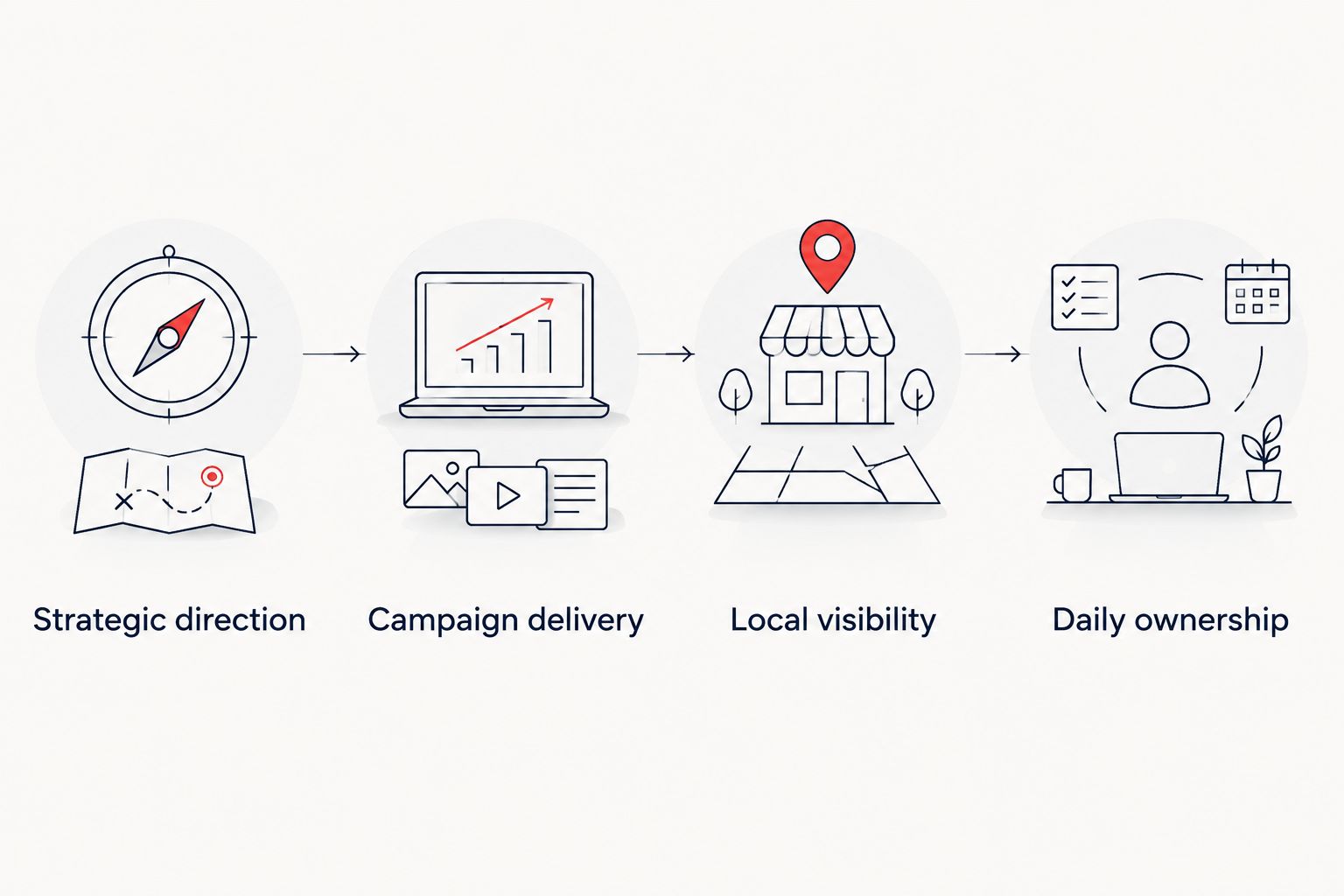 Choose the role first, then evaluate the provider against that responsibility.
If several problems exist, appoint a decision-maker before adding vendors. Otherwise, separate providers can each complete their assignments while nobody owns the combined result.
Build an evaluation brief
Use a proposed 90-day planning horizon to make candidates explain sequence and dependencies. This is a selection framework, not a promise that marketing will produce a particular result within that period.
Ask each candidate to address:
- Starting point: What must be checked before work begins?
- Priority: Which problem comes first, and why?
- Ownership: Who performs the work and who approves it?
- Dependencies: What does the practice need to supply or change?
- Evidence: What will show whether the work is helping?
Request a proposed 30-day reporting cycle that separates completed work from patient outcomes. Report qualified inquiries, booked appointments, and attended visits as distinct stages rather than combining them into a single lead total.
For a 2026 agreement, document how the provider handles patient information, access permissions, clinical approvals, and contract exit. Have the appropriate legal or compliance adviser review arrangements involving patient data; a marketing proposal is not that review.
How these options are ranked
The comparison uses authority, execution ownership, dental relevance, patient reporting, practice coordination, and continuity. The ordering starts with leadership because you need assigned decision-making before you can hold execution accountable.
No named-agency performance scores or patient acquisition forecasts underpin this list. Use the criteria to test each candidate's evidence and written scope rather than treating the order as a claim about statewide market leadership.
Which dental marketing option should you choose?
Choose a dental-specialist agency as the default when your strategy is settled and campaign delivery is the missing piece. Choose fractional leadership when your practice lacks direction or accountability; choose a specialist when the assignment is narrow.
Carey Kidd Group belongs in the strategic leadership comparison, not in a claim that a general consulting practice is a verified dental production agency. Keep that distinction intact when comparing proposals.
Define your marketing leadership needs
Discuss strategic priorities and the division between leadership, implementation, and practice responsibilities.
Discuss your needsFAQ
What's the best dental practice marketing agency in North Carolina?
The best fit depends on whether your practice needs leadership, campaign execution, or a specific technical assignment. Select a dental-specialist agency for delivery only after checking comparable work, assigned staff, reporting, and scope.
Is a fractional CMO better than a dental marketing agency?
A fractional CMO fits a leadership requirement; a dental marketing agency fits a defined execution requirement. Compare authority and responsibilities rather than treating the titles as interchangeable.
Does Carey Kidd Group specialize exclusively in dental marketing?
Carey Kidd Group's stated industries include hospitality, events, health/medical, and fitness, not an exclusive dental specialization. Evaluate its fractional CMO and consulting services as a leadership option and request evidence relevant to your practice.
Should a North Carolina dental practice hire a local provider?
A local address should not replace evidence of fit. Evaluate relevant work, communication, implementation responsibility, and knowledge of your actual service area before using proximity as a deciding factor.
What should a dental marketing proposal include?
A dental marketing proposal should define objectives, deliverables, decision authority, implementation owners, reporting, and handover terms. It should also explain the practice's responsibilities for approvals, inquiry handling, and patient information.
How do I measure whether dental marketing is working?
Track qualified inquiries, booked appointments, and attended visits separately. Compare those stages with campaign activity and review where inquiries fail to become appointments before changing providers.
Can a marketing agency guarantee new dental patients?
Do not use a new-patient guarantee as a substitute for evaluating evidence and scope. Ask what the provider controls, how it defines a new patient, and how scheduling capacity and inquiry handling affect the reported outcome.
One last thing
Before hiring, ask your front desk to explain what happens after a prospective patient calls or submits a form. Identify who responds, how appointments are recorded, and where inquiries are lost.
That check gives your provider a concrete operating problem to address. More campaign activity is not the right first move when the practice cannot account for the inquiries it already receives.