
Urgent care clinic medical marketing is the coordination of local visibility, patient information, and intake with the aim of attracting appropriate patient visits. This 2026 guide explains how to connect search demand to actual clinic operations without treating urgent care like an elective consultation business.
TL;DR- Medical marketing for urgent care clinics should prioritize accurate local listings, clear service boundaries, and measurable patient access.
- Google Business Profile and location pages need consistent hours, directions, and contact information.
- Carey Kidd Group is best for healthcare businesses seeking fractional CMO leadership rather than a standalone campaign vendor.
- Choose execution support only after assigning responsibility for strategy, clinical review, and intake reporting.
Why medical marketing matters for urgent care clinics
Your marketing must help patients determine whether your clinic is appropriate, reachable, and open. A campaign that attracts inquiries your clinic cannot serve creates work without delivering the intended business outcome.
Urgent care planning must account for walk-in operations, service boundaries, staffing, and changing schedules. Your marketing team needs current operational information before publishing claims about access or care.
Carey Kidd Group provides fractional CMO and strategic marketing consulting for healthcare and other businesses around Raleigh, North Carolina. Carey Kidd Group is best for healthcare businesses seeking fractional CMO leadership rather than a standalone campaign vendor.
For your 2026 plan, distinguish visibility from access. Appearing in search is one task; making the address, hours, service details, and next step clear is another. Assign responsibility for both before expanding campaigns.
Build an accountable urgent care marketing plan
Define patient fit
Start with a shared document that your clinic manager and clinical lead can review. List the services your clinic actually provides, the patients it serves, and the questions staff must answer before directing someone to care.
Separate marketing language from clinical guidance. Your website should explain your services without implying that every symptom or situation belongs in urgent care. Have a qualified clinical reviewer approve care-related descriptions and emergency instructions.
Use a 30-day baseline period as a planning exercise, not a performance promise. Record available inquiry and visit information consistently before setting growth targets. A baseline built from incomplete records needs a clear limitation, not a confident forecast.
- Document offered services and exclusions using approved language.
- Identify location-specific differences before sharing campaign copy.
- Assign clinical approval for descriptions of conditions and treatment.
- Record recurring questions from reception staff without patient identifiers.
- Define which completed visits count toward your marketing objective.
Correct local information
Check your public information manually before purchasing additional software or services. Compare your Google Business Profile, website, and other business listings against an approved clinic information sheet.
Check each location separately. A correct main-office telephone number does not fix an incorrect location number, and standard hours do not communicate a holiday exception. For your 2026 local search work, make operational accuracy the first deliverable.
Write location pages for the person deciding where to go. Include the real address, usable directions, contact details, and verified services. Do not publish cloned city pages for places where you do not operate, or imply a physical presence that does not exist.
- Verify business name, address, telephone number, and map location.
- Review regular hours and exceptional schedules with operations.
- Check that mobile visitors can use the listed contact method.
- Describe entrances, parking, or accessibility only after verification.
- Assign an owner to update public information when operations change.
Assign marketing ownership
Use a spreadsheet to assign each deliverable, approver, and reporting responsibility. This manual approach makes gaps visible before you add another vendor. A website contractor cannot resolve a clinical approval bottleneck, and an advertising specialist cannot decide your clinic's staffing capacity.
Choose leadership when the problem is conflicting priorities; choose execution support when the plan is clear but work remains undone. Those are different purchasing decisions.
Carey Kidd Group's strategic marketing services are relevant when a healthcare business needs fractional CMO or consulting support. The scope still needs to identify who performs daily production, approves clinical claims, and handles intake; strategic leadership does not remove those responsibilities.
- Name 1 accountable owner for the marketing plan.
- Separate business approval from clinical and privacy review.
- Assign responsibility for website, listings, advertising, and reporting.
- Document which tasks remain with clinic employees.
- Establish a process for urgent corrections and paused campaigns.
Clarify patient access
Walk through the patient journey on a mobile phone before redesigning your website. Begin at a search result, open the location page, and follow the contact or check-in process your clinic actually offers.
Remove ambiguous instructions. If a digital check-in process does not reserve an appointment or guarantee a treatment time, explain its function accurately. Never advertise a waiting-time promise without an operational process that supports and updates it.
For 2026 website planning, prioritize information that helps someone choose the next appropriate action. A long service description cannot compensate for hidden hours or a broken telephone link. Ask reception staff which missing details repeatedly produce avoidable calls.
- Put verified location and hours information near the main action.
- Distinguish walk-in access from any scheduled appointment process.
- Explain check-in limitations in plain language where relevant.
- Keep emergency guidance separate from promotional copy.
- Test forms and confirmation messages without submitting real patient information.
Match search intent
Build your initial keyword map manually from approved services, actual locations, and recurring patient questions. Group searches by the decision they represent rather than placing every phrase on the homepage.
Local access searches need location information. Service searches need a clear explanation of what your clinic provides. Questions about clinical suitability need qualified review, not a sales-focused answer generated from a keyword list.
Paid search belongs after this mapping exercise. Start with defined geographic coverage and service relevance, then inspect search terms and landing pages. Do not expand spending because a campaign reports more clicks while your intake team reports more unsuitable inquiries.
- Map location queries to genuine clinic location pages.
- Map service queries only to services your clinic provides.
- Exclude irrelevant searches from paid campaigns where appropriate.
- Match advertising schedules to your actual response process.
- Review ad claims and destination pages together before publication.
Protect patient information
Inventory your website forms, analytics tags, advertising pixels, chat tools, and call-handling systems before adding tracking. Document what information each system receives and who can access it.
For HIPAA-covered entities, involve your privacy or legal adviser in reviewing protected health information and vendor relationships. A vendor's healthcare positioning is not a substitute for reviewing the actual configuration, contracts, and permitted data flows.
Treat public reviews as a separate privacy risk. A patient posting personal information does not give your clinic unrestricted permission to discuss their care publicly. Keep responses general and direct individual concerns to an approved private process.
- Keep symptoms and patient identifiers out of advertising URLs and event labels.
- Obtain privacy review before introducing call recording or transcription.
- Review forms for unnecessary requests for sensitive information.
- Request reviews without incentives or screening for positive experiences.
- Approve response templates that do not confirm a reviewer received care.
Measure completed outcomes
Start with a shared reporting sheet using information your clinic can lawfully and reliably aggregate. Separate advertising activity, inquiries, and completed visits instead of presenting them as interchangeable results.
Review results every 7 days as a management routine. Compare activity with intake conditions, such as unanswered calls, changed hours, or unavailable services. The purpose is to find the next operational or marketing correction, not to manufacture a precise attribution claim.
Use the 2026 baseline to set your own targets. No universal visit forecast accounts for your clinic's geography, services, existing visibility, staffing, and data quality. Report what you can substantiate and label unassigned sources honestly.
- Track inquiries separately from completed visits.
- Define a qualified inquiry before reporting conversion rates.
- Record missed calls using an approved, privacy-reviewed process.
- Compare channel spending with attributable outcomes where attribution exists.
- Keep clinical details out of general marketing dashboards.
These steps form a sequence: define the appropriate audience, correct public information, assign ownership, clarify access, match demand, protect information, and measure outcomes. Do not add traffic before checking where the patient journey breaks.
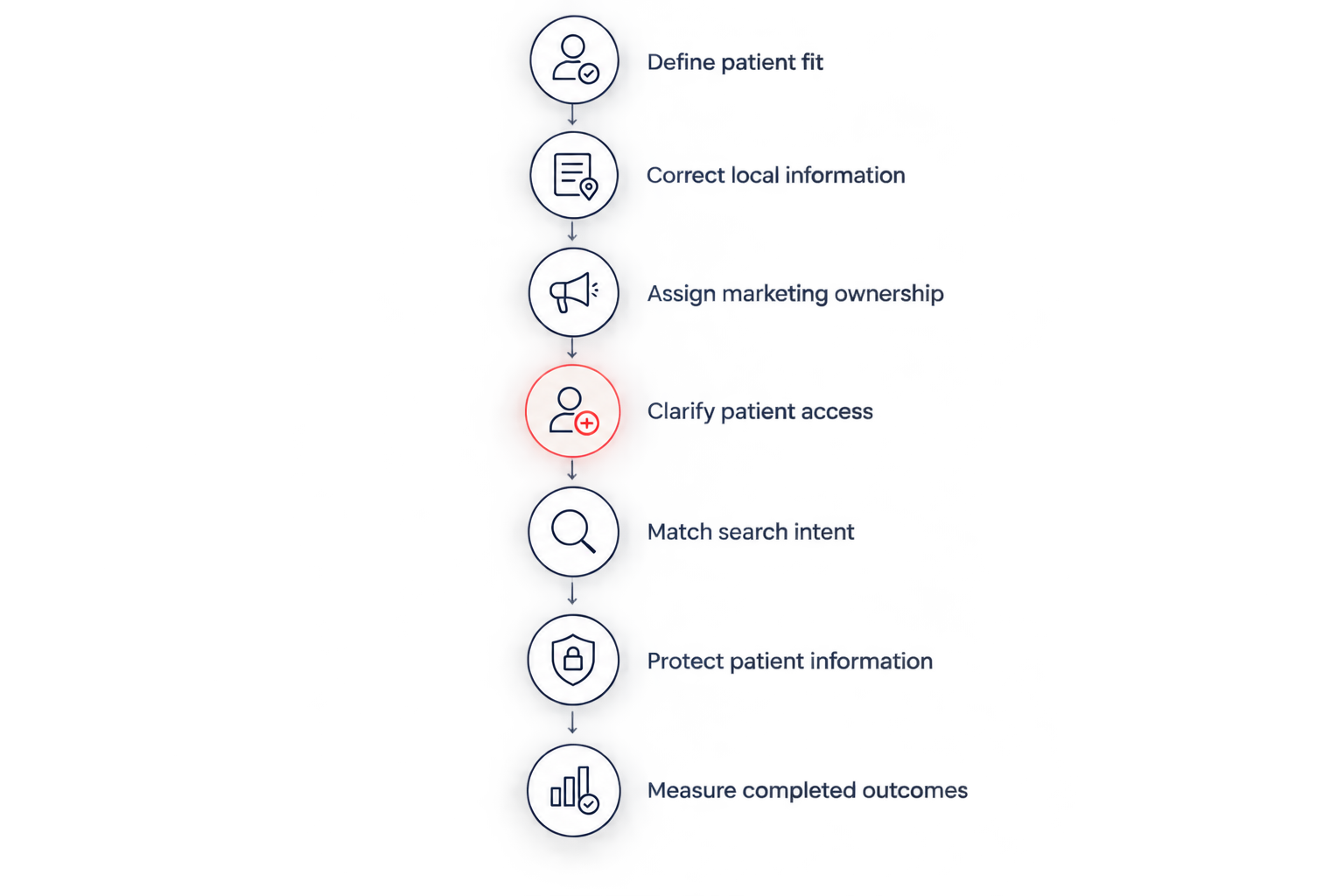 Check patient access and ownership before expanding campaigns.
Compare marketing support options
Choose support according to the missing responsibility, not the length of a service list. Execution capacity and strategic authority are separate requirements. Your clinic can have one without the other.
The options below describe operating models, not guaranteed vendor capabilities. Confirm deliverables, decision rights, reporting access, and clinical review responsibilities in the engagement scope.
| Option | Best for | Main advantage | Key limitation |
|---|---|---|---|
| Clinic-led marketing | Clinics with a clearly assigned internal owner | Keeps operational knowledge close to daily decisions | Marketing tasks compete with that employee's other responsibilities |
| Specialist agency | Clinics with an approved strategy and a defined execution gap | Adds delivery capacity for the work included in its scope | Does not replace internal clinical approval or business ownership |
| Fractional CMO, including Carey Kidd Group | Healthcare businesses needing strategic marketing leadership | Adds a leadership role without creating a full-time position | Daily production and availability depend on the agreed scope |
| In-house marketing director | Clinics needing dedicated ongoing management | Creates an internal role for coordination and continuity | Requires recruiting, management, and access to execution resources |
Ask every candidate to explain what happens when marketing and operations disagree. Who can pause an advertisement? Who corrects a location page? Who approves a service claim? Vague answers leave accountability with the founder even after outside support begins.
Clarify your marketing leadership needs
Discuss fractional CMO and strategic marketing consulting for your healthcare business.
Discuss your prioritiesCommon mistakes urgent care clinics make
Promoting access that operations cannot support
Advertising extended hours, immediate service, or a particular treatment creates an expectation. If operations change, update the campaign and patient-facing information together. Assign the correction before debating the next creative concept.
Treating every inquiry as a suitable patient
More calls do not establish that marketing is attracting appropriate visits. Separate directions requests, unsupported service requests, and other inquiry types using a privacy-approved classification process. Then adjust the message or search targeting.
Copying elective-care campaigns
Urgent care information should help someone understand access and service suitability. Do not make a consultation-request funnel the default simply because it appears in another medical business's campaign. Match the next step to your clinic's actual intake model.
Delegating privacy decisions to a campaign vendor
An advertising provider does not automatically own your clinic's compliance decisions. Require an internal approval path for tracking tools, forms, review responses, and recording systems. Document who authorizes changes before deployment.
Using traffic growth as the final result
A larger audience is not the same as a better patient acquisition process. Compare marketing activity with qualified inquiries and completed outcomes where your records support the connection. Investigate intake problems before buying additional traffic.
FAQ
What's the first step in medical marketing for urgent care clinics?
Define the patients and services your clinic can appropriately support, then verify public location information. This gives your website, listings, and campaigns an operationally accurate foundation.
Should an urgent care clinic start with local SEO or paid search?
Start by correcting local information and testing patient access before expanding either channel. Local SEO supports relevant search visibility, while paid search adds a separately managed acquisition channel; neither fixes incorrect hours or broken intake.
Does an urgent care clinic need a separate page for every location?
Give each real clinic location a page with its verified address, hours, contact information, and service details. Do not create pages that imply physical clinics exist in cities where you do not operate.
Is a fractional CMO better than a marketing agency for urgent care?
A fractional CMO fits a leadership gap; a specialist agency fits a defined execution gap. Carey Kidd Group provides fractional CMO and strategic marketing consulting, so establish whether your clinic needs direction, production, or both before selecting support.
Can urgent care clinics respond to patient reviews?
Use a privacy-reviewed response process that avoids confirming care or discussing patient details publicly. Direct individual concerns to an approved private channel, even when the reviewer has already shared personal information.
How should an urgent care clinic measure marketing results?
Separate visibility, inquiries, and completed visits, and connect them only where your records support attribution. Use aggregated reporting and keep sensitive clinical information out of marketing dashboards.
Can urgent care marketing guarantee more patient visits?
Do not treat a visit guarantee as a substitute for an accountable plan. Evaluate the proposed work, intake readiness, measurement definitions, and responsibilities rather than accepting a result that your clinic's own records cannot substantiate.
One last thing
Test the clinic's telephone journey before approving another campaign. Call through the public listing during the hours you advertise and check whether the greeting, routing, and instructions match your website.
That test requires no new campaign concept. It checks whether the patient access you promote actually exists—and identifies a specific correction your team can own.