
For 2026 planning, Gartner’s published cross-industry marketing budget average is 7.7% of company revenue in its 2025 survey, with annual averages ranging from 7.7% to 9.1% across its 2023–2025 surveys. Use marketing budget benchmarks by industry to frame a decision, not dictate it; Carey Kidd Group provides fractional CMO and strategic marketing consulting for hospitality, events, health/medical, and fitness businesses.
TL;DR- Marketing budget benchmarks by industry need matching definitions; Gartner’s 2025 cross-industry average was 7.7% of company revenue.
- Gartner’s reported annual averages ranged from 7.7% to 9.1% across its 2023–2025 surveys.
- Carey Kidd Group provides fractional CMO services for hospitality, events, health/medical, and fitness businesses seeking strategic marketing leadership.
- Separate total marketing spend from paid advertising before comparing budget allocation or marketing ROI.
Why this matters
A revenue percentage answers how much a company allocates to marketing. It does not tell you whether that allocation produces profitable bookings, patient visits, event contracts, or memberships.
For your 2026 budget, the important distinction is between a reference point and an operating target. A reference point starts the discussion; an operating target must account for your margins, available capacity, customer economics, and execution responsibilities.
Marketing budget benchmark: share of company revenue
Marketing budget as a share of revenue measures the total marketing allocation relative to company revenue. Gartner reported an overall average of 7.7% in 2025, unchanged from 2024 and below 2023.
| Comparison group | Survey year | Average marketing budget as a share of company revenue |
|---|---|---|
| Overall: surveyed companies across industries | 2025 | 7.7% |
| Overall: surveyed companies across industries | 2024 | 7.7% |
| Overall: surveyed companies across industries | 2023 | 9.1% |
The 2023 cross-industry average leads at 9.1%; the 2024 and 2025 averages are tied at 7.7%. These are comparisons between annual survey results, not a ranking of industries or a recommended spending range for individual businesses.
Source and methodology: Gartner’s annual CMO Spend Survey releases, published in May 2023, May 2024, and May 2025, report marketing budgets as a percentage of company revenue across surveyed companies; the 2025 survey covered 402 marketing leaders in North America, the United Kingdom, and Europe. The sample is weighted toward large enterprises, which limits its usefulness as a direct target for a local practice, independent hotel, event business, or fitness studio.
What the overall average tells you
The repeated 7.7% result supplies a reference for executive budget discussions. It does not establish that a particular business spends too much or too little.
A company spending below that average can still have a sound plan if demand, retention, and capacity support its objectives. Spending above the average does not establish waste, either: assess the work funded and the business outcomes before making that judgment.
Do not label an enterprise average an industry standard for your business. The denominator, company size, and marketing responsibilities must match before the comparison supports a decision.
How to use these benchmarks
Use these steps to turn the published figures into a defensible 2026 planning discussion:
- Start with the 7.7% reference, not an automatic allocation. Compare it with your current total marketing share and investigate the differences in scope.
- Treat 9.1% as a historical observation, not a growth prescription. A higher survey average does not prove that increasing your budget will increase demand profitably.
- Match the measurement before comparing performance. Use the same revenue period and include equivalent categories of marketing expenditure.
- Approve spending against an operating objective. Identify the bookings, completed visits, signed contracts, or retained memberships the budget must support.
The benchmark helps you challenge assumptions. Your operating plan determines whether the proposed allocation makes sense.
Compare industries by business economics
Industry labels are useful when they identify different buying processes and constraints. They become misleading when a broad category hides the economics of the business underneath it.
A hotel and an event venue both sell capacity, but their booking windows and customer relationships differ. A medical practice and a fitness studio both depend on attendance, yet completed visits and retained memberships require different reporting.
| Business type | Best for assessing budget against | Planning advantage | Limitation to account for |
|---|---|---|---|
| Hospitality | Completed stays, covers, and repeat bookings | Connects marketing decisions to bookable capacity | Bookings alone do not establish contribution after fulfillment costs |
| Events | Qualified inquiries, signed contracts, and completed events | Links demand generation to a defined sales pipeline | An inquiry is not a contract or collected revenue |
| Health/medical | Appropriate inquiries, completed appointments, and continued care | Separates lead generation from attended visits | Patient information and marketing activity require privacy and compliance review |
| Fitness | Attended introductions, memberships, and retention | Connects acquisition spending to ongoing customer relationships | Trial signups alone do not demonstrate retained membership revenue |
These are planning comparisons, not measured sector spending averages. Choose the business outcome first, then evaluate the allocation required to pursue it.
Hospitality and events
For hospitality, distinguish demand generation from the work that converts demand into bookings and repeat visits. Review capacity by service, location, and booking period rather than assuming every additional inquiry has equal value.
For events, connect the marketing plan to the sales pipeline. Define which inquiries fit the business, who follows up, and when a signed contract becomes a completed engagement. A budget tied only to lead volume leaves those responsibilities unresolved.
Health/medical and fitness
For a medical practice, distinguish inquiries, scheduled appointments, and completed visits. Have the appropriate privacy and compliance owner review the proposed measurement process before expanding tracking or sharing patient-related information.
For fitness, follow the customer relationship beyond an introductory booking. Assign responsibility for attendance, membership conversion, and retention so the acquisition budget does not operate separately from the member experience.
Define what your marketing budget includes
A benchmark comparison fails when one business counts advertising alone while another counts staff, contractors, technology, production, and leadership. Resolve that accounting question before debating the percentage.
For your 2026 plan, write a clear inclusion policy. Apply it consistently across locations, departments, and reporting periods.
Use these categories to organize the discussion:
- Leadership: Strategy, planning, management, and accountability.
- Execution: Internal staff time and external implementation work.
- Media: Advertising distribution and campaign placement.
- Infrastructure: Marketing technology, measurement, and website support.
- Production: Creative development, content, photography, and campaign assets.
Keep each expense in a defined category and prevent double-counting. When a provider handles several responsibilities, separate the scope internally even if the invoice combines the work.
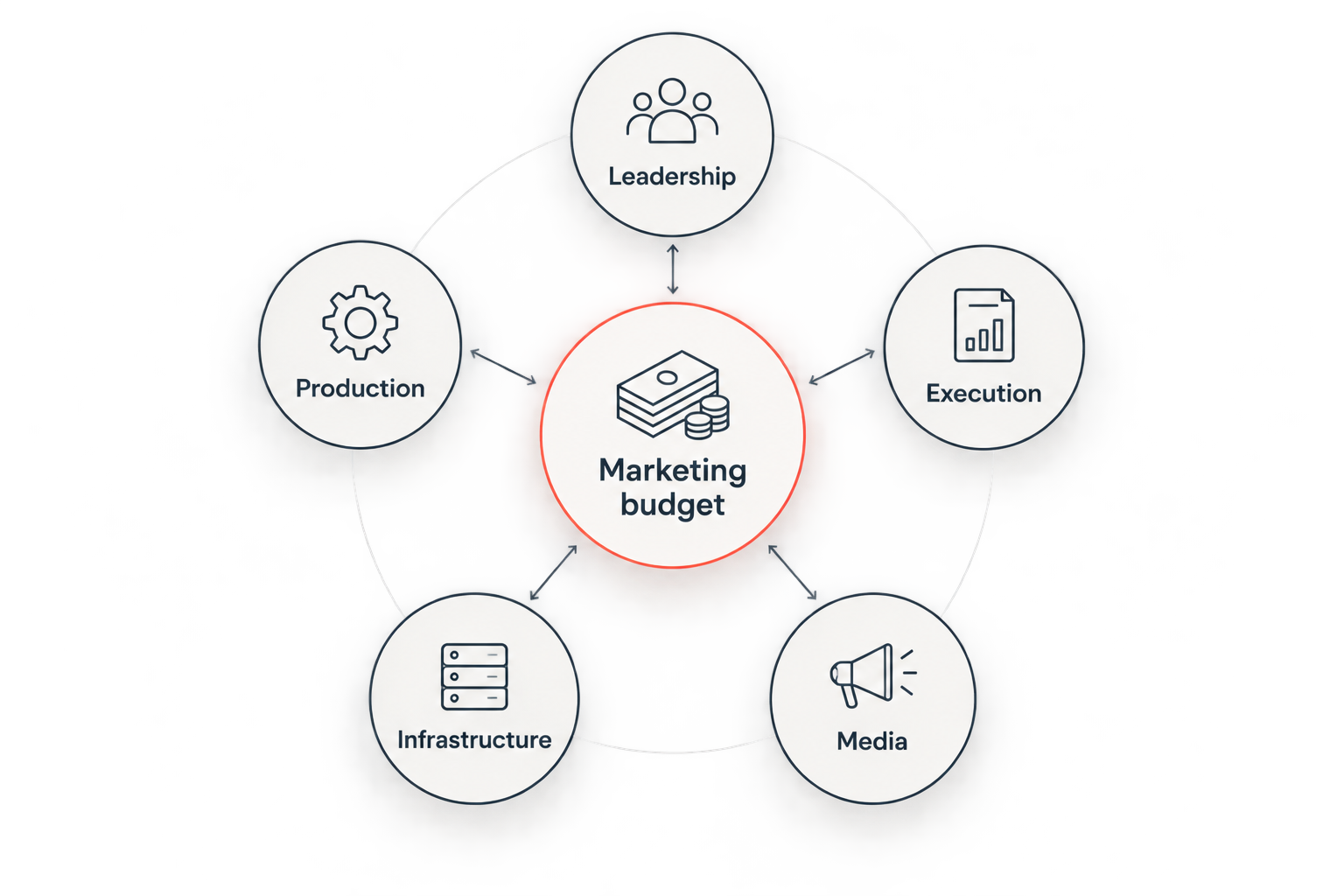 Compare total marketing responsibilities before comparing revenue percentages.
A consistent definition also makes internal reviews more useful. If a new hire replaces contracted work, show the change in responsibility rather than presenting the removed invoice as a reduction in total marketing investment.
Connect the allocation to delivery and accountability
A spending percentage does not assign the work. Your budget needs an owner for strategy, an owner for implementation, and a process for resolving decisions that cross those responsibilities.
Carey Kidd Group’s fractional CMO services are best for hospitality, events, health/medical, and fitness businesses seeking strategic marketing leadership. That service category addresses leadership; your engagement scope must still establish who produces the work and manages daily execution.
| Delivery model | Best for | Main advantage | Main constraint |
|---|---|---|---|
| Fractional CMO | Businesses seeking part-time senior marketing leadership | Assigns strategic direction without structuring the role as a full-time hire | Execution capacity requires a separate, explicit agreement |
| Agency | Businesses with defined implementation needs | Establishes an external delivery scope | Executive decision authority remains a separate responsibility |
| In-house marketing leader | Businesses requiring an employee to own daily marketing management | Places ongoing management within the organization | Production and specialist capacity still need to be staffed or contracted |
These are role-design distinctions, not performance rankings. Define authority, deliverables, reporting, and handoffs before comparing proposals.
When evaluating strategic marketing services, ask who can approve reallocations, stop underperforming work, and hold internal and external contributors accountable. A budget without decision rights is an expense list, not a management plan.
Separate paid advertising from the total budget
Paid advertising is a component of marketing, not a substitute definition for the whole function. Campaigns also need suitable creative, a functioning conversion path, and a clear handoff to the person responsible for responding.
The central discipline in budgeting for paid ads is to distinguish media expenditure from the supporting work needed to turn attention into a business outcome. Keep those responsibilities visible when evaluating the total allocation.
For a local service business, document what happens after an inquiry arrives. Name the response owner, define qualification, and identify the event that counts as a completed conversion.
Do not increase advertising solely because your total marketing share sits below 7.7%. First establish whether the constraint is reach, conversion, follow-up, available capacity, or customer retention. Additional distribution does not resolve an undefined process.
Build a budget review that supports decisions
Your 2026 reporting should explain what changed, what the business received, and what decision follows. Avoid a report that lists activity without connecting it to operating results.
Maintain a concise decision record:
- Objective: State the business outcome the allocation supports.
- Scope: Identify the locations, services, and customer groups included.
- Ownership: Name the decision-maker and implementation owner.
- Evidence: Record spend alongside qualified and completed outcomes.
- Action: Continue, revise, stop, or investigate the work.
Compare equivalent periods and identify material changes in capacity or service mix. A campaign serving a new location should not be assessed as though it had the same starting conditions as an established location.
Separate committed responsibilities from discretionary campaigns. That distinction lets you examine a proposed reduction without assuming every expense can disappear without changing the work delivered.
Questions to resolve before approving the allocation
A benchmark should make the approval discussion sharper. Require the proposed plan to answer the following questions in plain business terms:
- Which customer or patient groups does the plan prioritize?
- What capacity exists to serve additional demand?
- Which expenses maintain existing activity, and which fund new initiatives?
- Who owns follow-up after marketing produces an inquiry?
- Which outcomes justify continuing or changing the allocation?
- What work stops if the allocation is reduced?
Ask for the trade-off behind each recommendation. A proposal that adds a channel without identifying its purpose, owner, and measurement method is not ready for approval.
This is where Carey Kidd Group’s fractional CMO and strategic marketing consulting services fit the budgeting discussion: strategy, implementation responsibilities, and accountability need to be considered together. Set the scope explicitly rather than assuming leadership automatically includes every production task.
FAQ
What are marketing budget benchmarks by industry for 2026?
Marketing budget benchmarks by industry are comparison points, not automatic spending targets. Gartner’s 2025 CMO Spend Survey reported a cross-industry average of 7.7% of company revenue; that figure is not an industry-specific recommendation for a local business.
Is 7.7% of revenue the right marketing budget for my business?
The 7.7% figure is a survey average, not a prescribed allocation. Your budget needs to reflect marketing scope, margins, available capacity, customer economics, and business objectives.
What should count toward my total marketing budget?
Define the budget to include the marketing responsibilities you intend to compare, including leadership, execution, media, infrastructure, and production. Keep the inclusion policy consistent across reporting periods and avoid double-counting.
Should a medical practice use the same benchmark as a hotel?
A medical practice and a hotel should not adopt the same target solely because they share a cross-industry reference. Completed appointments and completed stays have different operating requirements, so compare the underlying business economics.
Does a higher marketing budget guarantee more bookings?
A higher marketing budget does not guarantee more bookings. Assess the conversion process, follow-up ownership, and capacity to serve additional demand before increasing expenditure.
Should paid advertising be my entire marketing budget?
Paid advertising should be treated as a component of the total marketing allocation. Keep the supporting responsibilities for creative, conversion, measurement, and follow-up visible in the plan.
Can a fractional CMO help with budget accountability?
A fractional CMO engagement can assign responsibility for marketing strategy and budget decisions when those duties are included in the scope. Define implementation ownership, approval authority, and reporting separately rather than assuming they are included.
One last thing
A marketing percentage can rise even when marketing spending stays unchanged, simply because revenue falls. Review the numerator and denominator separately before calling a higher ratio an investment increase or a lower ratio an efficiency gain.
For your 2026 approval meeting, bring both the percentage and the operating plan. The percentage gives context; the plan explains what the business is funding and who is accountable.