
Google Ads is worth it for medical spas in 2026 when completed treatments generate enough contribution to cover acquisition costs and your team can convert inquiries into attended appointments. Advertising spend alone excludes campaign management, landing-page work, tracking, and staff follow-up. Judge the channel by acquired patients and treatment contribution—not clicks, form submissions, or booked consultations alone.
TL;DR- Is Google Ads worth it for medical spas? Yes, when acquired patients generate contribution above the full acquisition cost.
- Google Ads suits treatment-specific searches; weak booking processes undermine otherwise relevant traffic.
- Separate new patients from existing patients and brand searches from treatment searches.
- Carey Kidd Group provides fractional CMO services for businesses that need strategic marketing leadership rather than another execution vendor.
Is Google Ads worth it for medical spas in 2026?
Yes—if you can connect paid searches to completed treatments and evaluate the resulting financial contribution. A medical spa with open appointment capacity and reliable follow-up has a clearer reason to advertise than a practice that cannot accommodate new patients.
Your first decision is whether the problem is insufficient demand, weak conversion, or unclear accountability. The guide to fractional CMO for medical spas addresses the leadership side of that decision.
Compare acquisition channels by the job you need them to perform, not by which platform produces the largest activity report.
| Channel | Best for | Principal advantage | Principal limitation |
|---|---|---|---|
| Google Search ads | Reaching people searching for a relevant treatment locally | Connects your offer with expressed search intent | Each paid visit creates an acquisition expense; traffic does not establish treatment suitability |
| Local SEO | Building visibility for nearby searches | Supports discovery through organic search and local listings | Visibility requires ongoing work and is not guaranteed |
| Organic social content | Explaining treatments and helping prospective patients evaluate your practice | Gives you space to explain your approach and answer questions | Engagement does not establish appointment intent |
These channels are not interchangeable. Search ads address an expressed query, while educational content helps someone understand a treatment or practice before making contact. Choose a primary role for each channel so the same patient is not counted as a separate acquisition by every report.
Why this matters
A medical spa does not need more leads if its actual constraint is appointment handling, treatment capacity, or unsuitable inquiries. Buying additional traffic leaves those problems intact and adds expense.
For your 2026 marketing plan, connect the advertising decision to a business objective: filling appropriate treatment capacity, attracting new patients, or supporting a specific service. Keep existing-patient demand separate from new-patient acquisition so you can see what the campaign contributes.
Carey Kidd Group brings 20 years of new business development expertise across hospitality, events, health/medical, and fitness. That strategic marketing perspective is relevant when you need to connect channel decisions with implementation and accountability—not simply commission another campaign.
When Google Ads earns a place in your plan
Treatment-specific demand: best for a defined service
Google Search ads fit a campaign built around a treatment you provide, a service area you serve, and a landing page that addresses that search. The benefit is alignment: the query, advertisement, page, and appointment request can describe the same service.
The limitation is that a relevant search does not establish clinical suitability or readiness to proceed. Your intake process still needs to distinguish an information request from an appropriate consultation. Use treatment-specific campaigns when the service, capacity, and intake process are ready.
Brand protection: best for measuring named demand separately
A brand-search campaign responds to people searching for your practice by name. Keep that activity separate from searches for treatments because a person already looking for your business represents a different acquisition question.
Brand campaigns can help you control the paid message shown for your name, but their results do not prove you created new demand. Some searchers already know your practice through referrals, previous visits, or other marketing. Report brand performance separately before claiming new-patient growth.
Broader discovery: best for a separate learning objective
Broader awareness activity addresses a different audience from someone actively searching for a local treatment. Its purpose should be explicit rather than folded into a search campaign's booking target.
The benefit is room to introduce your practice and explain services. The limitation is weaker evidence of immediate appointment intent. Do not judge discovery activity and treatment-search campaigns as though they perform the same job.
Why Google Ads results vary between medical spas
Your 2026 decision should account for these operating factors before you approve a campaign:
- Search intent. A query about treatment education differs from a query seeking a nearby provider. Match the advertisement and page to that intent.
- Service geography. Align targeting and messaging with the area your practice actually serves. Review location settings rather than assuming every click represents a nearby prospective patient.
- Landing-page relevance. A treatment-specific advertisement needs a page that explains the relevant service and offers a clear next step.
- Appointment handling. Assign responsibility for calls, forms, scheduling, and follow-up. A submitted form is not a completed appointment.
- Treatment economics. Evaluate contribution after the direct costs of delivering treatment, not revenue alone. Different services need separate financial assessment.
- Capacity and suitability. Confirm that providers can accommodate appropriate new patients. Marketing cannot determine clinical suitability or create appointment capacity.
These are management decisions as much as campaign settings. If no one owns the connection between advertising, reception, and treatment delivery, the performance report stops short of the business outcome.
How to decide whether your campaign is paying off
Use 5 stages to connect advertising activity with patient acquisition. Keep definitions consistent across your advertising reports, scheduling records, and financial review.
1. Define the outcome
Choose the event that represents a genuine acquisition: a new patient completing an appropriate treatment. Track inquiries and consultations as intermediate steps, not interchangeable successes.
Record whether the patient is new or returning. Otherwise, an existing patient searching for your telephone number can be mistaken for an acquisition.
2. Record acquisition costs
Include advertising spend and the attributable work needed to operate the campaign. Campaign management, landing-page production, tracking, and intake effort belong in the evaluation when they support acquisition.
Keep the scope consistent. Comparing one campaign's advertising spend with another campaign's full operating cost produces a misleading result.
3. Connect inquiries to appointments
Use an internal process that follows an inquiry through booking, attendance, and treatment completion. Track missed calls, unanswered forms, cancellations, and unsuitable inquiries as distinct outcomes.
Protect patient information throughout this process. Do not place treatment details, medical histories, or other sensitive information into advertising systems merely to improve attribution; involve the people responsible for privacy and compliance before configuring data transfers.
4. Calculate treatment contribution
Calculate contribution by subtracting the direct costs of providing the acquired treatment from the revenue collected for it. Keep that calculation separate from total business profit, which also reflects overhead and other expenses.
For repeat treatment, count observed revenue and contribution rather than assuming every new patient will return. An expected lifetime value is a forecast, not money already earned.
5. Make a documented decision
Choose whether to continue, correct, or pause the campaign based on the complete acquisition path. Document the reason so the next review assesses the same business objective.
Keep a profitable campaign under review rather than expanding it automatically. Additional demand is useful only while appointment capacity, service quality, and acquisition economics remain acceptable.
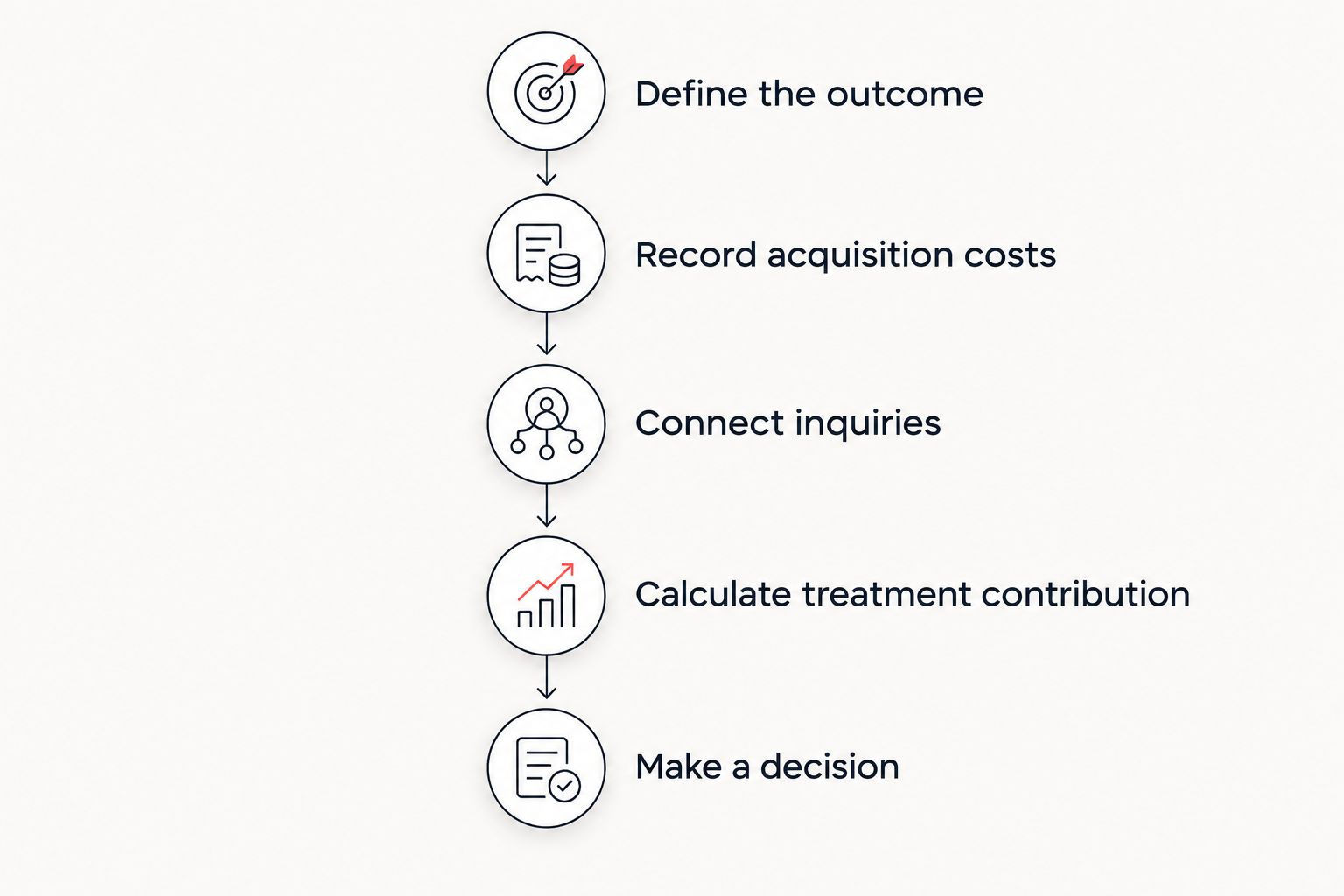 Evaluate completed treatments and contribution before deciding to expand advertising.
Which numbers should a medical spa track?
Your 2026 dashboard should distinguish activity from outcomes. Impressions and clicks explain exposure and traffic; they do not establish whether the practice acquired a patient.
Use these definitions consistently:
- Cost per inquiry: attributable acquisition costs divided by recorded inquiries.
- Cost per acquired patient: attributable acquisition costs divided by new patients who complete treatment.
- Attendance rate: attended consultations divided by booked consultations.
- Treatment conversion rate: new patients completing treatment divided by attended consultations, using a consistent patient group.
- Acquisition contribution: contribution from acquired treatments minus attributable acquisition costs.
The 2 rates—attendance and treatment conversion—identify different breakdowns. Poor attendance calls for a scheduling and follow-up review; poor treatment conversion calls for a review of inquiry quality, expectations, and consultation outcomes without pressuring unsuitable patients to proceed.
Use matching reporting periods and account for the time between inquiry and treatment. A recent campaign can have unresolved appointments, so comparing its unfinished patient group with a fully completed group distorts the decision.
Should you increase spend, fix the process, or pause?
Use 3 decisions rather than a blanket instruction to spend more:
| Decision | Best for | Supporting evidence | Trade-off |
|---|---|---|---|
| Continue or expand | A campaign producing acceptable acquisition contribution with treatment capacity | Completed treatments, documented costs, and available appointments | Expansion still requires fresh monitoring; past results do not establish future results |
| Correct before expanding | Relevant inquiries that stall during booking or attendance | Unanswered inquiries, scheduling problems, or a mismatch between the advertisement and page | Process changes require operational ownership, not just advertising edits |
| Pause and reassess | An offer with unresolved tracking, capacity, or contribution problems | No dependable outcome record or no capacity to serve suitable patients | Pausing also stops that source of paid traffic |
Do not increase spend to compensate for an unresolved booking problem. First identify where the patient journey breaks, assign an owner, and confirm that the correction works.
The same discipline applies to changing agencies. Replacing an execution provider does not resolve an unclear offer, missing financial definitions, or conflicting responsibilities inside the practice.
Do you need an agency or marketing leadership?
An agency engagement fits a defined execution requirement: campaign setup, ongoing management, or landing-page work within an agreed scope. Fractional marketing leadership addresses priorities, allocation, vendor management, and accountability across the wider business.
Carey Kidd Group is best for health/medical businesses seeking fractional CMO and strategic marketing leadership. That is a different requirement from hiring someone solely to manage advertisements. Review the scope of strategic marketing services against the work your practice actually needs.
The limitation of fractional leadership is equally important: strategy does not replace the people responsible for daily campaign execution, reception, clinical assessment, or treatment delivery. Name those owners before approving the plan.
FAQ
Is Google Ads worth it for medical spas in 2026?
Google Ads is worth it for medical spas in 2026 when acquired patients generate treatment contribution above attributable acquisition costs. Evaluate completed treatments, not just inquiries or booked consultations.
Is Google Ads better than local SEO for a medical spa?
Google Ads is better suited to paid visibility for selected searches, while local SEO supports organic and local discovery. Choose according to your objective, and measure each channel without counting the same patient twice.
Should my medical spa advertise before fixing its booking process?
Fix the booking process before expanding advertising when inquiries go unanswered or suitable patients cannot schedule. More traffic does not correct intake failures.
What should count as a Google Ads conversion for a medical spa?
Track inquiries and appointments as intermediate conversions, but evaluate patient acquisition through completed treatments. Keep new patients separate from returning patients.
Can Google Ads guarantee more medical spa bookings?
Google Ads cannot guarantee bookings. Search relevance, landing pages, appointment handling, patient suitability, and capacity all affect the path from an advertisement to treatment.
Should I include repeat treatments when judging advertising results?
Include repeat treatments when they have occurred and their contribution is recorded. Keep projected future treatment value separate from realized results.
Can Carey Kidd Group help with a medical spa's marketing strategy?
Carey Kidd Group provides fractional CMO and strategic marketing consulting services for health/medical businesses around Raleigh, North Carolina. Confirm the engagement scope against your needs for leadership, implementation, and accountability.
One last thing
Before you approve your next 2026 campaign expansion, trace a recent inquiry from its search source to its final appointment outcome. Check whether the advertising report, scheduling record, and financial review tell the same story.
If they disagree, resolve the definitions before debating the channel. The useful question is not whether Google Ads produces activity; it is whether your practice can demonstrate valuable patient acquisition.