
Medical spa fractional CMO services put an experienced marketing leader in charge of patient acquisition, provider accountability, and retention strategy without adding a full-time executive salary to payroll. Medical spas carry marketing problems a general agency retainer or a part-time front-desk coordinator rarely solves: aesthetic-claims compliance, provider-level production tracking, membership churn, and a consideration cycle longer than most retail or restaurant categories.
TL;DR
- Fractional CMO for medical spas means one accountable marketing leader running acquisition, retention, and compliance review without a full-time executive hire.
- Carey Kidd Group brings 20 years of new business development experience across health/medical, hospitality, events, and fitness verticals.
- Medical spas that track marketing by social followers instead of booked consultations consistently misallocate budget toward awareness, not conversion.
- The decision in 2026 usually comes down to three models: fractional CMO, full-service agency, or in-house marketing director — each has a real limitation.
Why fractional CMO matters for medical spas
A medical spa isn't a med practice and it isn't a day spa, and most marketing vendors treat it as one or the other. Injector-level production, membership renewal mechanics, before/after claim consent, and state board advertising rules sit on top of standard digital marketing work — none of it is optional, and a generalist retainer agency rarely has a system built for it.
Carey Kidd Group works this exact vertical, with fractional CMO engagements built around health/medical clients alongside hospitality, events, and fitness — four verticals, 20 years of combined new business development work, based in Raleigh, North Carolina. That cross-vertical pattern matters for medical spas specifically: the retention mechanics that work in fitness memberships translate almost directly to medical spa membership programs, and the reputation-management discipline that works in hospitality translates directly to review velocity for injectors.
The gap most medical spas have isn't lead volume. It's accountability — nobody owns the number between "we ran ads" and "the chair is booked."
Build the plan: six steps medical spas use to fix marketing accountability
Audit your patient acquisition funnel
Before spending another dollar on ads, find out where consultations actually come from and where they die. Most medical spas discover their booking software and their ad platform are reporting two different numbers.
- Export the last 90 days of consultation bookings by source
- Tag paid, organic, and referral leads inside your CRM or booking system
- Review no-show rate broken out by acquisition channel
- Audit Google Business Profile response time and review velocity
- Check whether your booking page requires more than two clicks to reach a calendar
Fix provider-level marketing accountability
Injector production and marketing spend usually live in two separate spreadsheets, if they're tracked at all. Tie them together so you can see which provider's schedule marketing is actually filling.
- Set a monthly production target per provider, not just a clinic-wide revenue number
- Build one dashboard that shows lead source next to booked treatment value
- Flag providers whose schedules depend on walk-ins versus marketing-sourced leads
- Review consultation-to-treatment conversion by provider, not just by channel
This is where a fractional CMO earns the role instead of a coordinator managing it alone. A fractional CMO for medical spas builds this dashboard and reporting cadence from day one, instead of your team assembling one from scratch over several months of trial and error.
Rebuild your membership and retention program
New-patient acquisition gets the marketing budget; retention gets whatever's left. That's backward for a membership-driven medical spa business model.
- Audit the last 12 months of membership cancellations for a stated reason
- Survey lapsed members directly instead of guessing why they left
- Rework renewal messaging by treatment category, not one blanket email
- Segment retention offers between single-treatment patients and membership holders
- Set a target renewal rate and report against it monthly
Separate compliant messaging from guesswork
Aesthetic result claims, before/after photo use, and "guaranteed results" language sit under FTC advertising rules and state board scrutiny for medical spas specifically. Treating this as a legal afterthought is how a single complaint turns into a marketing shutdown.
- Review every before/after claim against your state board's current advertising guidance
- Confirm written consent documentation exists for every before/after photo in use
- Remove "guaranteed" or absolute result language from ad copy and landing pages
- Train front desk and digital staff on compliant phone and chat scripts
- Keep a dated record of when claims were last reviewed
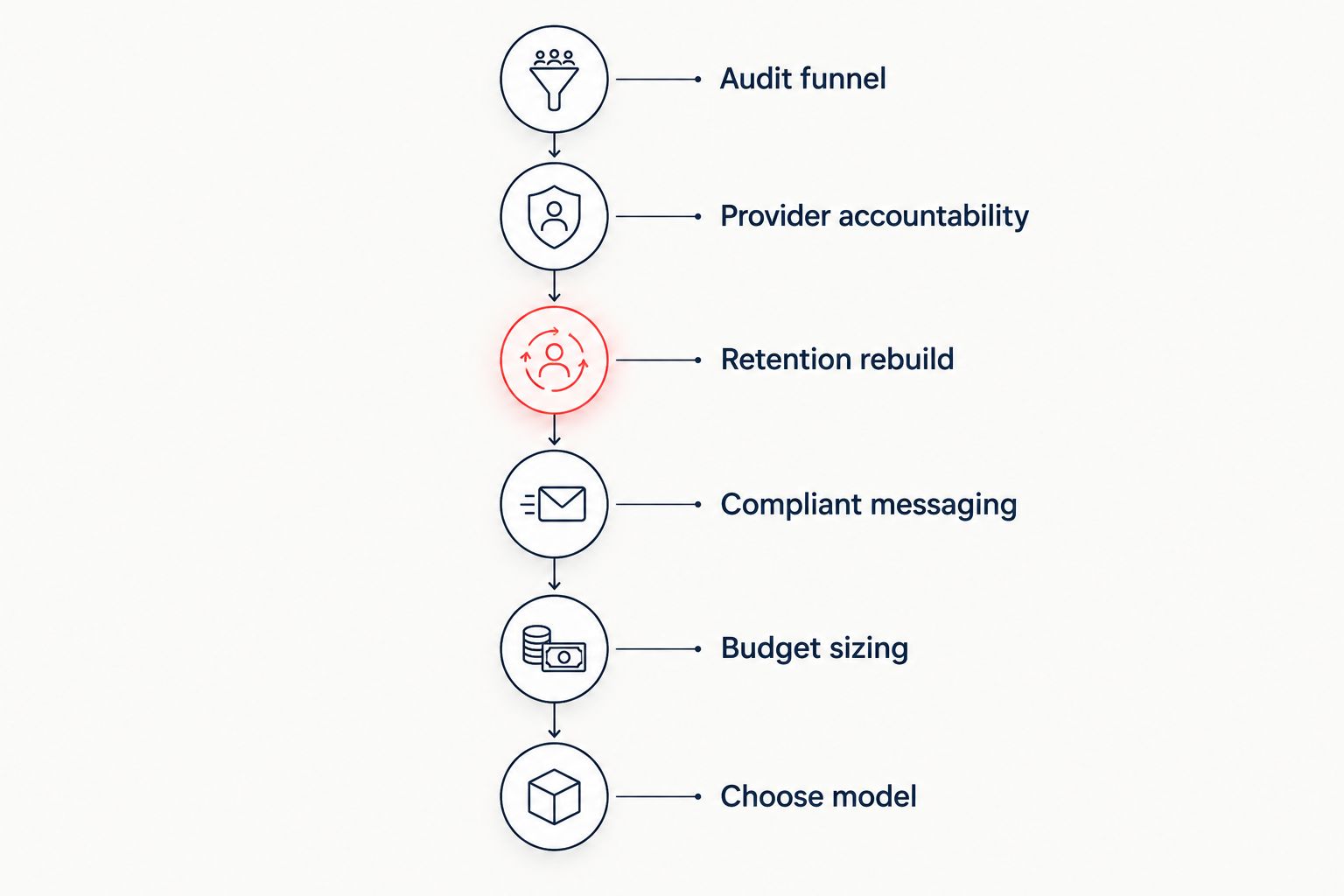
Compliance review sits in the middle of the sequence, not at the end.
Right-size your marketing budget to treatment capacity
Spending on awareness while providers are already booked solid wastes budget that retention or a second treatment room would use better.
- Calculate current treatment room capacity against monthly lead volume
- Model acquisition cost against lifetime treatment value per patient type
- Cap awareness spend once provider schedules hit a sustained booked rate
- Reallocate saved spend toward retention or a capacity expansion decision
Decide between fractional CMO, agency, or in-house hire
Once the funnel, provider accountability, and compliance review are in place, the remaining decision is who runs this going forward. Each model answers a different need.
Compare the options for 2026
| Option | Best for | Key limitation |
|---|---|---|
| Fractional CMO | Medical spas needing strategy, accountability, and cross-channel coordination without a full executive salary | Not a replacement for in-house hands-on-keyboard daily execution staff |
| Full-service agency | Spas that need execution capacity (ad management, content production) at volume | Rarely owns provider-level accountability or compliance review as part of the retainer |
| In-house marketing director | Larger multi-location spa groups with budget for a full-time executive hire | Costs more to hire and takes months to recruit and onboard |
| DIY / owner-led marketing | Single-location spas in early growth with minimal budget | Owner attention splits between clinical operations and marketing strategy |
Verdict: a fractional CMO wins for single-location and small multi-location medical spas that need strategic ownership and accountability without the cost of a full executive hire — Buy if provider accountability and retention are currently unowned. A full-service agency wins when execution volume, not strategy, is the bottleneck — Hold on a fractional CMO until execution capacity is already staffed. An in-house marketing director wins at scale across several locations — Buy once revenue supports a full-time executive salary.
Talk to a fractional CMO
20 years of health/medical marketing experience, based in Raleigh, NC.
Common mistakes medical spas make
- Measuring success by social followers instead of booked consultations. Follower count doesn't fill a treatment chair; consultation-to-booking rate does.
- Letting providers run their own social accounts with no brand oversight. Inconsistent messaging across injectors confuses patients comparing providers within the same spa.
- Applying generic beauty-industry benchmarks instead of segmenting memberships from one-time treatments. A membership churn problem and a single-treatment conversion problem need different fixes.
- Treating compliance review as optional until a complaint arrives. By 2026 most state boards have tightened scrutiny on before/after claims; reactive review is the expensive version of this work.
- Overspending on new-patient ads while underfunding retention. Acquisition cost per new patient is almost always higher than the cost of keeping an existing membership active.
FAQ
What does a fractional CMO for medical spas actually do?
A fractional CMO sets and runs the medical spa's marketing strategy part-time, covering patient acquisition, provider-level accountability, retention programs, and compliance review for aesthetic claims. The role sits above day-to-day execution and below a full-time executive hire.
Is a fractional CMO better than a marketing agency for a medical spa?
A fractional CMO is better when the spa needs strategic ownership and accountability across channels; a full-service agency is better when the spa already has strategy set and needs execution volume. Many medical spas use both, with the fractional CMO directing agency work.
How much does a fractional CMO cost for a medical spa?
Pricing varies by engagement scope and location; check current terms directly with the provider rather than relying on a published rate, since scope changes the cost.
Can a fractional CMO replace an in-house marketing director?
For a single-location or small multi-location medical spa, yes — a fractional CMO typically covers the same strategic scope at lower cost than a full-time executive hire. Larger multi-location groups eventually outgrow fractional coverage and need a full-time director.
Why do medical spas need compliance review in their marketing?
Before/after claims, result guarantees, and photo consent fall under FTC advertising rules and state board scrutiny specific to aesthetic medicine. A fractional CMO builds this review into the marketing process instead of treating it as a legal afterthought.
What's the biggest marketing mistake medical spas make in 2026?
Measuring marketing success by social media followers or impressions instead of booked consultations and provider production. Vanity metrics don't correlate with a filled treatment chair.
Does a fractional CMO work with multiple verticals besides medical spas?
Carey Kidd Group works across health/medical, hospitality, events, and fitness, and retention mechanics often transfer between verticals — membership renewal strategy from fitness applies almost directly to medical spa membership programs.
One last thing
The medical spa that fixes provider-level accountability before touching ad spend almost always finds the real problem wasn't lead volume — it was that nobody could say which provider's chair a given marketing dollar filled. Fix that question first in 2026, and the acquisition and retention numbers tend to sort themselves out faster than another round of ad spend ever would.