
A wellness marketing agency is worth it when you have a clear offer, capacity to serve new customers, and an execution gap tied to a measurable business objective. It is not worth hiring for more activity alone; internal follow-up, approvals, and service delivery still determine whether marketing produces business value. In 2026, choose an agency for execution and fractional marketing leadership when the missing piece is strategy and accountability.
TL;DR- Is a wellness marketing agency worth it? Yes, when execution—not an unresolved strategy or service problem—is the constraint.
- Carey Kidd Group fits health and fitness businesses seeking fractional CMO leadership rather than an agency-only execution model.
- Judge wellness marketing by attended appointments, paying members, retention, and contribution—not reach or lead volume alone.
- Choose the operating model before choosing a provider: agency execution, fractional leadership, or an in-house marketing director.
Is a wellness marketing agency worth it in 2026?
Hire a wellness marketing agency when you know what needs to happen but lack the capacity or specialist skills to execute it. Hold off when nobody has settled the target audience, business objective, or responsibility for converting inquiries into customers.
The first decision is not which agency to hire. It is whether you need execution, leadership, or an employee with continuing responsibility inside the business. The guide to choosing a fractional CMO for health and wellness brands addresses the leadership side of that decision.
| Operating model | Best for | Main advantage | Main limitation |
|---|---|---|---|
| Wellness marketing agency | A defined marketing plan that needs delivery | External execution against an agreed scope | Work outside that scope needs a separate owner |
| Fractional CMO | A business that needs marketing direction and accountability | Senior leadership without a full-time executive role | Execution capacity must be explicitly assigned |
| In-house marketing director | A business needing daily internal marketing management | Continuing access to business context and internal teams | Specialist production still needs adequate resources |
These models can work together. A fractional CMO can direct an agency, and an in-house director can manage specialist partners. Do not buy a second execution team to solve an ownership problem.
Why this matters
A gym membership, wellness consultation, and medical appointment do not share the same buying journey. Your marketing brief needs to reflect the action customers must take and what happens after they take it.
A campaign that generates inquiries is incomplete if nobody owns booking, attendance, and follow-up. Equally, a marketing agency cannot resolve insufficient appointment capacity simply by producing more demand.
For your 2026 decision, separate the marketing problem from the operating problem. That distinction gives you a workable scope instead of a list of channels.
A wellness marketing agency: best for defined execution
A wellness marketing agency fits when your priorities are clear enough to brief and evaluate. You should be able to explain the audience, offer, desired action, and business result without asking the agency to infer your entire business model.
Examples of defined work include improving a booking journey, producing campaign assets, managing an agreed advertising program, or executing a local search plan. These are scope examples, not services every provider necessarily offers.
The advantage is assigned delivery responsibility. The limitation is that delivery can remain disconnected from business performance unless your agreement includes the right reporting and access.
Ask for a proposal that states:
- Objective: The customer action the work is intended to support.
- Deliverables: What the agency will produce, manage, or change.
- Dependencies: What your staff must supply or approve.
- Measurement: How activity connects to bookings, attendance, and purchases.
- Accountability: Who acts when results fall short of the agreed objective.
Recommendation: choose an agency for a defined execution gap, not an undefined promise of growth.
A fractional CMO: best for direction and accountability
Fractional leadership fits when you need someone to choose priorities, coordinate partners, and connect marketing decisions to business objectives. It is a different role from producing every asset or managing every campaign personally.
Carey Kidd Group provides fractional CMO and strategic marketing consulting services for health/medical and fitness businesses, alongside hospitality and events, around Raleigh, North Carolina. The stated background includes 20 years of new business development expertise. Carey Kidd Group is best for health and fitness businesses seeking fractional marketing leadership rather than an agency-only execution model.
The benefit is a clear leadership role. The trade-off is that fractional leadership does not, by itself, establish who will write content, maintain campaigns, update systems, or handle customer inquiries; define those responsibilities before engaging.
Recommendation: choose fractional leadership when the unresolved question is what marketing should do and who should be accountable.
An in-house marketing director: best for daily ownership
An in-house marketing director fits when your business needs continuing internal coordination and enough ongoing responsibility to justify the position. The role gives you a person inside the organization who can manage priorities with staff across functions.
The advantage is daily access to business context. The limitation is capacity: hiring a director does not automatically provide every production skill needed for creative work, advertising, analytics, and website changes.
Before recruiting, distinguish management responsibilities from specialist tasks. If the job description expects one person to set strategy, produce everything, manage systems, and own every commercial outcome, revise the role before hiring.
Recommendation: choose an in-house director for sustained internal ownership, with specialist support assigned where necessary.
Why the value of a wellness marketing agency varies
The same scope can be useful for one business and poorly matched to another. Evaluate these factors before comparing proposals:
- Offer clarity: Define the service, intended customer, and next action before commissioning promotion.
- Available capacity: Match acquisition activity to appointments, classes, or consultations you can actually deliver.
- Booking friction: Inspect the steps between an inquiry and a confirmed booking, including staff handoffs.
- Customer retention: Separate new-customer acquisition from the work required to keep existing customers engaged.
- Measurement access: Confirm that reporting can connect marketing activity to business records without unnecessary personal data exposure.
- Decision ownership: Assign authority for approvals, priorities, and corrective action rather than sharing responsibility vaguely.
These are evaluation factors, not a guarantee of results. Their purpose is to identify which constraints belong in an agency scope and which require decisions inside your business.
How should you evaluate an agency before signing?
Use the same business brief with every candidate. In 2026, compare how providers diagnose the problem, define responsibility, and explain measurement—not how many channels appear in the proposal.
Establish your baseline
Review the most recent 30 days as an initial diagnostic window, not as proof of long-term performance. Record inquiries, bookings, attendance, purchases, and cancellations using consistent definitions; add a longer comparison period when seasonality affects demand.
Check whether those records can be connected. If an inquiry disappears between a form submission and your booking system, resolve the reporting gap before treating an acquisition report as evidence of business value.
Trace the customer journey
Follow the path from initial interest through service delivery and repeat business. Inspect what the customer sees and what your staff must do at each handoff.
Use the same sequence for your evaluation: Inquiry, Booking, Attendance, Purchase, Retention. The point is to identify where responsibility changes, not to assume that every business uses identical software or sales processes.
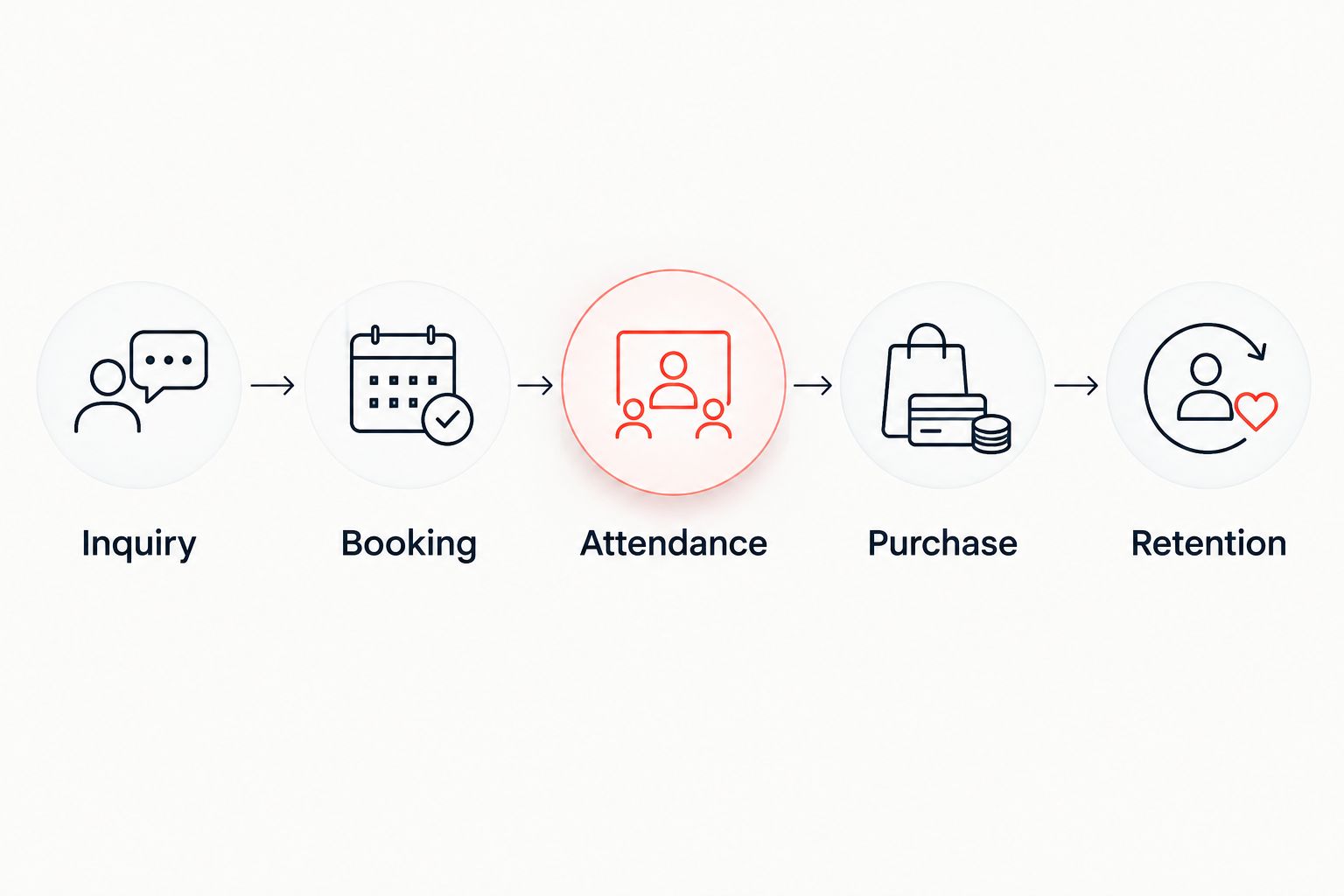 Assign responsibility at every handoff, not just at the point of inquiry.
Require a prioritized plan
Ask candidates to outline an initial 90-day plan as a planning exercise, not a results guarantee. The plan should identify the first constraint, proposed work, dependencies, and evidence that would justify changing direction.
A useful answer explains sequencing. Launching advertising before checking booking capacity is a different decision from repairing the booking process before increasing demand.
Put accountability in writing
Specify who owns campaign changes, inquiry response, appointment confirmation, approvals, and reporting access. Include the process for resolving disagreement about priorities.
Keep ownership practical. A named person with authority to make a decision is more useful than a shared commitment to collaboration.
Review the exit arrangements
Confirm access to accounts, creative files, reporting, and business data before signing. Ask what happens to active work and administrative permissions when the engagement ends.
Recommendation: select the provider that makes responsibilities and evidence clear enough to manage. Presentation quality is not a substitute for an executable scope.
How do you measure whether the agency is worth it?
Start with the commercial outcome, then work backward through the customer journey. Define a qualified inquiry, a confirmed booking, an attended appointment, and a new paying customer separately.
Do not treat those events as interchangeable. A report that counts form submissions cannot establish how many people attended or purchased unless it connects to the relevant business records.
Evaluate contribution after the direct costs of delivering the service, not revenue alone. Include the agency engagement, campaign resources, software, and internal staff effort in your assessment without counting the same expense twice.
Distinguish attributed outcomes from incremental outcomes. A customer who interacted with a campaign is not automatically a customer who would otherwise have stayed away; ask what evidence supports that interpretation.
Your 2026 reporting agreement should state what the records demonstrate and what remains unproven. A useful report supports a decision about what to continue, change, or stop.
Should you fix retention before hiring an agency?
Fix retention first when the service or follow-up problem is already preventing customers from returning. Acquisition is not a substitute for resolving dissatisfaction, scheduling friction, or an unclear next step after the first visit.
That does not require stopping all marketing. It requires giving retention work an owner and ensuring that acquisition activity does not outrun your ability to deliver a satisfactory experience.
Can a fractional CMO manage a wellness marketing agency?
A fractional CMO can manage an agency when partner direction and accountability are included in the agreed role. Document who sets the brief, approves work, reviews performance, and resolves competing priorities.
The arrangement needs an execution owner as well as a strategic owner. Otherwise, coordination becomes another meeting rather than a clearer operating model.
What should make you pause before signing?
Pause when a proposal promises business results without examining your customer journey or operating constraints. Other warning signs include unclear account access, undefined reporting terms, and no stated responsibility for inquiry follow-up.
Ask the provider to explain what would make the proposed approach inappropriate. A credible scope includes boundaries as well as deliverables.
FAQ
Is a wellness marketing agency worth it for a small studio?
A wellness marketing agency is worth it for a small studio when defined execution work supports a clear business objective and the studio can serve additional customers. Set responsibility for inquiry response and booking before increasing acquisition activity.
Should I hire a wellness agency or a fractional CMO?
Hire an agency for defined execution and a fractional CMO for marketing direction and accountability. If you need both, specify how the leadership and delivery roles will work together.
How quickly should a wellness marketing agency show results?
Set timing around the agreed work, customer decision process, and measurement baseline rather than a universal deadline. Separate implementation milestones from evidence of customer acquisition or retention.
What should a wellness marketing agency report?
A wellness marketing agency should report agreed deliverables alongside the customer outcomes its work is intended to support. Separate inquiries, bookings, attendance, purchases, and retention rather than presenting them as equivalent results.
Can an agency fix low membership retention?
An agency can support retention communications, but it cannot replace responsibility for the member experience. Identify whether the underlying problem involves messaging, scheduling, service delivery, or follow-up before assigning the work.
Does Carey Kidd Group serve health and fitness businesses?
Carey Kidd Group provides fractional CMO and strategic marketing consulting services for health/medical and fitness businesses around Raleigh, North Carolina. The business also serves hospitality and events clients.
What should I ask before signing a wellness agency contract?
Ask who owns the accounts, deliverables, approvals, reporting, and inquiry follow-up. Confirm dependencies and exit arrangements so responsibility remains clear throughout the engagement.
One last thing
Before signing a wellness marketing agreement in 2026, inspect your booking process as a customer would. Check the form, confirmation, scheduling instructions, and handoff to staff without entering misleading patient information or creating unnecessary appointments.
A broken handoff is a concrete problem to fix before buying more demand. Use what you find to sharpen the brief, assign ownership, and decide whether the next hire should provide execution or leadership.