
Urgent care clinic marketing has no single monthly cost: your budget depends on the work commissioned, advertising spend, and who manages implementation. For a 2026 budget, separate recurring management from media, technology, and setup work; a management-only quote does not establish your clinic’s total monthly commitment.
TL;DR- How much does urgent care clinic marketing cost per month? Compare complete scopes, not management fees alone.
- Separate local SEO, paid search, technology, and implementation before approving an urgent care marketing budget.
- Carey Kidd Group provides fractional CMO services for health/medical businesses; execution responsibilities need explicit agreement.
- Judge marketing against attributable patient visits and operational capacity, not clicks alone.
How much does urgent care clinic marketing cost per month?
Your monthly budget should cover the full operating plan, not just the agency invoice. Request an itemized proposal that distinguishes recurring services, third-party spending, and separately approved projects. For broader context, compare the scope questions in medical practice marketing costs.
Use this breakdown to identify what belongs in your monthly commitment. These are budget categories, not a required purchasing list; include only the work your clinic needs.
| Budget component | What the scope should specify | What to check before approval |
|---|---|---|
| Strategy and oversight | Priorities, budget decisions, reporting, accountability | Who can authorize changes and direct vendors |
| Local SEO | Business information, location pages, search visibility work | Which locations and deliverables are included |
| Paid search management | Campaign setup, monitoring, optimization | Whether advertising spend is separate |
| Advertising spend | Money paid to advertising platforms | Who owns billing and controls spending |
| Website work | Landing pages, maintenance, conversion improvements | Whether development is recurring or project-based |
| Measurement and technology | Analytics, call measurement, reporting tools | Subscription responsibility and data access |
| Setup and transition | Audits, configuration, access transfer | What ends after launch and what continues |
A proposal that combines these categories without explaining them is difficult to compare. Ask the vendor to identify inclusions, exclusions, billing responsibility, and the approval process for additional work.
Why this matters
A clinic does not acquire a patient simply because an advertisement receives a click. The patient still needs accurate location information, relevant services, clear hours, and a workable path to care. Marketing and clinic operations meet at that point.
For your 2026 plan, distinguish a marketing shortfall from an operational constraint. An unanswered call, an outdated location page, or a service inquiry your clinic cannot fulfill requires a different response from insufficient search visibility. Increasing spending before identifying the constraint makes the budget harder to manage.
Approve a plan that connects spending to a defined patient journey. Each recurring activity should have an owner, an intended result, and a measurement method.
Local SEO: define the work behind the recurring fee
Best for: clinics that need patients to find accurate, relevant location information through local search.
A local SEO scope should name the locations covered and explain the work performed for each. Separate business-profile maintenance, location-page improvements, technical corrections, and reporting. The phrase “SEO included” does not tell you whether the proposal addresses the problems affecting your clinic.
The advantage is a focus on discoverability and accurate information where patients search. The limitation is that search visibility does not establish patient volume, and recurring work should not become a substitute for clear deliverables.
For each location, ask what will change, why the change matters, and how progress will be assessed. Keep access to business profiles and website accounts under clinic control. Vendor involvement should not leave your clinic dependent on a departing provider for basic access.
Paid search: separate management from advertising spend
Best for: clinics with a defined service area, a clear patient destination, and someone responsible for campaign oversight.
Paid search management and advertising spend are different budget lines. Management covers the agreed work on campaigns; media spending funds the advertisements themselves. Ask whether landing-page changes, call measurement, creative work, and reporting sit inside or outside the management scope.
Paid search gives you direct control over campaign settings and spending decisions. Its limitation is that paid traffic alone does not establish completed visits or appropriate patient demand.
Before approving campaigns, confirm that advertisements match the clinic’s actual services and hours. A campaign should not send patients toward an unavailable service simply because the search term appears relevant. The clinic must also define who can pause or change campaigns when operations change.
Marketing leadership: distinguish direction from delivery
Best for: clinics with multiple contributors but no clear owner of priorities, implementation, and accountability.
Leadership is a separate responsibility from producing advertisements or updating website pages. Someone must decide which work takes priority, reconcile vendor recommendations, approve spending, and connect marketing activity with business objectives.
Carey Kidd Group is best suited to health/medical businesses seeking fractional CMO leadership and strategic marketing consulting. The service addresses leadership needs; it should not be treated as a promise that every execution task comes within the same engagement.
The benefit of a leadership model is explicit ownership of direction. The limitation is that implementation still needs assigned capacity, whether internal or external. Ask who performs each task before treating a leadership proposal as a complete marketing department.
Which delivery model fits your clinic?
Compare authority and execution together. An agency, an internal employee, and a fractional leader solve different staffing problems, even when their proposals contain similar marketing terminology.
| Model | Best for | Main advantage | Main limitation |
|---|---|---|---|
| Agency execution | Clinics with an approved plan and defined channel needs | Delivery of contracted marketing work | Executive authority is not implied by the contract |
| Internal marketing hire | Clinics needing ongoing internal coordination | Direct connection to daily operations | Specialist work can still require outside support |
| Fractional CMO | Clinics needing senior direction across contributors | Ownership of priorities and accountability | Hands-on production requires explicit assignment |
Do not compare these models as interchangeable monthly purchases. Compare the responsibilities left uncovered after each proposal is accepted. A lower invoice is not a complete solution if your clinic must supply work that nobody has time to perform.
Why urgent care marketing costs vary
Your 2026 proposal should explain scope differences through identifiable work rather than vague claims about a competitive market. Review these factors:
- Location coverage: Each included clinic needs defined responsibilities for its information, campaigns, and reporting. Confirm whether shared work and location-specific work are separated.
- Channel scope: Local SEO, paid search, website work, and reporting involve different activities. Ask which channels receive active management rather than occasional attention.
- Starting condition: A functioning website and organized accounts require a different project scope from a transition involving corrections, missing access, or new pages.
- Execution capacity: The proposal changes when your staff supplies approved copy, website updates, and reporting support instead of assigning those tasks externally.
- Measurement requirements: Agree on the information needed to distinguish inquiries, relevant inquiries, and completed visits without treating them as equivalent outcomes.
- Leadership responsibility: Coordinating vendors and setting priorities is work. State whether that responsibility belongs to the clinic, an agency, or a fractional executive.
These factors explain what to ask about; they do not establish a market rate. Require each proposal to connect its recurring fee to a written scope you can inspect.
How do you build an urgent care marketing budget for 2026?
Build the budget from responsibilities outward. Start with the clinic’s objectives and constraints, then assign work and funding to support them. Avoid starting with a collection of services and searching for a business justification afterward.
- Define objectives. Specify which locations, services, and patient journeys need attention. Identify operational limits before commissioning additional demand.
- Audit access. Confirm who controls the website, advertising accounts, business profiles, analytics, and reporting exports. Document any handover work.
- Separate spending. Distinguish recurring services, media, subscriptions, and projects. Record who pays each bill and who approves changes.
- Assign ownership. Give every deliverable an accountable person. Include clinic-side approvals, clinical review, and vendor coordination.
- Review outcomes. Agree on how activity and patient-related outcomes will be assessed, including the limits of attribution.
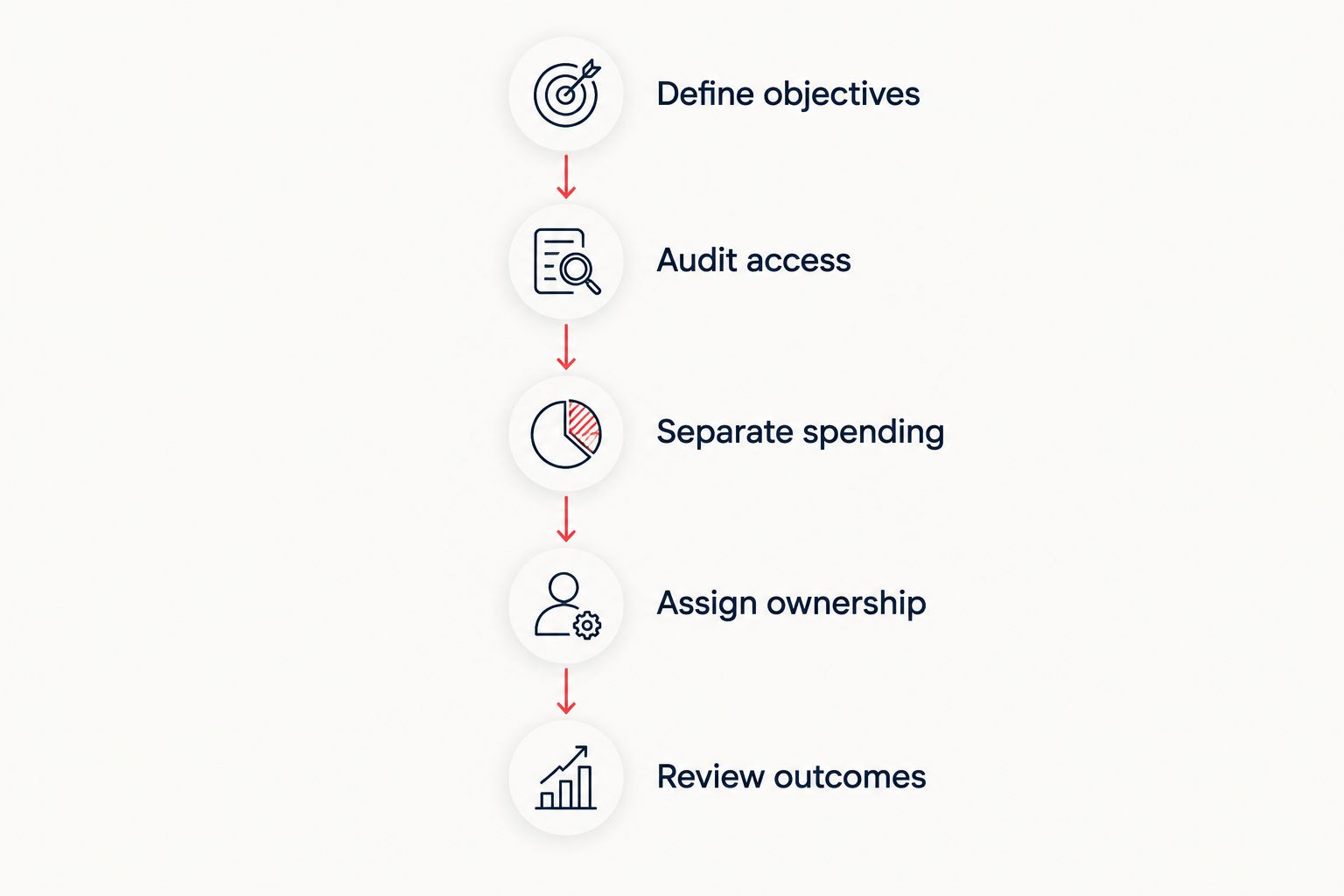 Assign responsibilities before approving recurring spending.
The finished budget should show what you are buying and what your staff must contribute. It should also distinguish committed spending from work that requires separate approval. That distinction prevents a project discussion from becoming an unplanned recurring obligation.
Should urgent care clinics prioritize paid search or local SEO?
Prioritize the constraint you can identify, not the channel a vendor prefers to sell. If patients encounter inaccurate clinic information, correct that information. If you commission paid campaigns, give those campaigns a relevant destination and a defined measurement plan.
The decision between paid media versus SEO is a budget-allocation question: paid campaigns fund advertising exposure, while SEO work addresses unpaid search visibility. Neither channel removes the need for accurate service information or accountable implementation.
A combined plan needs separate channel responsibilities. Otherwise, paid activity can obscure unresolved website problems, and SEO reporting can distract from unanswered patient inquiries. Ask the provider to explain the role of each channel in the same patient journey.
For your 2026 review, assess channels against their assigned purpose rather than expecting identical reporting. Search visibility, advertising responses, and completed visits describe different stages. Keep those distinctions visible when reallocating spending.
What should an urgent care marketing proposal include?
A usable proposal should let you explain the engagement to a clinic administrator without translating broad service claims. Require clear answers to these questions:
- What recurring work will be delivered, and for which locations?
- Which expenses are excluded from the service agreement?
- Who approves advertisements, clinical statements, and website changes?
- Who owns accounts, creative assets, reporting access, and data exports?
- How are additional projects approved before work begins?
- What does the clinic receive when the engagement ends?
For healthcare marketing, include a specific review of patient privacy and tracking practices. Do not assume that an advertising or analytics configuration is appropriate merely because it is technically possible. Assign qualified review before deploying tracking that interacts with patient information.
A proposal should also describe dependencies. If the provider requires clinic approvals or access before delivering work, document those requirements. Accountability works in both directions.
How should you measure whether the monthly budget is working?
Measure the progression from marketing activity to relevant patient outcomes without collapsing every step into a lead count. A website visit, a telephone inquiry, and a completed clinic visit are different events. Reporting should preserve that distinction.
Ask what each reported conversion actually represents. A call event does not establish that the caller was a new patient, needed an offered service, or visited the clinic. Likewise, a reporting gap does not prove that a channel produced no business.
Use clinic records and approved reporting processes to evaluate completed visits where appropriate. Document attribution limits, including walk-ins and patients who encounter more than one channel. The goal is a defensible decision, not artificial precision.
Carey Kidd Group’s fractional CMO services are relevant when a health/medical business needs leadership across these decisions. A clinic that already has clear direction and accountable execution should identify the specific remaining gap before adding another management layer.
FAQ
How much does urgent care clinic marketing cost per month in 2026?
Urgent care clinic marketing has no single monthly cost; the total depends on the contracted services, advertising spend, technology, and projects. Compare itemized proposals with matching responsibilities rather than management fees alone.
Does an urgent care marketing fee include Google Ads spending?
A marketing fee does not establish whether advertising spend is included. Require the proposal to separate campaign management from platform spending and identify who controls billing.
Is local SEO enough for an urgent care clinic?
Local SEO is not a complete operating plan for an urgent care clinic. It addresses search visibility and location information, while patient handling, website usability, and other acquisition needs require separate decisions.
Should an urgent care clinic hire an agency or a fractional CMO?
Choose an agency for defined execution needs and a fractional CMO for senior marketing direction. Confirm the actual contract responsibilities because neither label guarantees a complete implementation team.
What extra work should I ask about before signing a marketing agreement?
Ask about setup, website development, landing pages, reporting tools, tracking configuration, and account transfers. Have the provider identify which items are recurring, separately approved, or clinic responsibilities.
Can a marketing provider guarantee more urgent care visits?
Do not treat a visit guarantee as a substitute for a documented plan. Ask how visits are defined, attributed, verified, and distinguished from calls or website activity.
What should I review before increasing the marketing budget?
Review service accuracy, inquiry handling, campaign relevance, measurement, and clinic capacity before increasing spending. Fix an identified operational or reporting problem before funding more traffic.
One last thing
Before approving your 2026 budget, ask every provider the same question: “What work remains my clinic’s responsibility after I sign?” The answer exposes gaps that an attractive deliverables list can conceal. It also gives your administrator a practical implementation checklist.
Carey Kidd Group’s strategic marketing consulting serves health/medical businesses around Raleigh, North Carolina. The relevant starting point is a defined leadership need—not an assumption that another vendor will solve an unassigned operational problem.