
Local SEO for a hospitality brand requires a scope-based quote in 2026: compare the work required for your locations, website, business profiles, and booking measurement rather than treating a monthly fee as a standard package. Separate initial repairs from ongoing management, and confirm whether content, website development, and booking-system tracking are included. Approve the deliverables and accountability before you approve the budget.
TL;DR- How much does local SEO cost for a hospitality brand? Compare location coverage, initial repairs, ongoing management, and exclusions.
- Google Business Profile management and website implementation need separate, explicit deliverables in every proposal.
- Carey Kidd Group fits hospitality businesses seeking fractional CMO leadership; confirm who will execute the local SEO work.
- Judge reporting against qualified inquiries and bookings, not rankings alone.
How much does local SEO cost for a hospitality brand in 2026?
Your local SEO budget should follow a written statement of work, not a package name. A restaurant with an accurate business profile and a functioning reservation path needs a different scope from a hotel with conflicting listings and an inaccessible booking journey.
Start with the website dependency. If guests cannot find the relevant location, understand the offer, or complete the next step, visibility alone does not solve the problem. The guide to web design for hospitality brands addresses that connected part of the investment.
Ask each provider to break its proposal into the following workstreams. These are comparison categories, not claims that every engagement needs every task.
| Workstream | What the proposal should specify | What to clarify separately |
|---|---|---|
| Initial assessment | Profile, listing, website, and tracking review | Whether implementation follows the assessment |
| Business profiles | Eligible locations, information updates, and access responsibilities | Who supplies photographs and operational changes |
| Website implementation | Location content, technical corrections, and booking links | Whether a developer is included |
| Reputation workflow | Review-request process and response ownership | Who handles guest complaints |
| Measurement | Search visibility, website actions, and booking attribution | What the reservation platform exposes |
| Ongoing management | Recurring tasks, reporting, and decision meetings | What triggers a change in scope |
Compare proposals against the same workstreams. Otherwise, a narrow profile-management engagement and a broader website-and-measurement engagement look interchangeable when they are not.
Why this matters
Hospitality marketing connects an online search to an operational commitment: a reservation, a room booking, an event inquiry, or a visit. Your local SEO proposal should explain which of those outcomes the work supports and where responsibility ends.
A visibility report does not establish that guests completed a booking. Equally, a reservation total does not establish which marketing activity produced it. Your 2026 plan needs both search-performance reporting and a clear account of what the booking system can measure.
This distinction changes procurement. You are buying defined work and management responsibility, not a guaranteed position in search results.
Initial cleanup: best for correcting defined problems
An initial cleanup project fits a hospitality business with identifiable problems that can be documented and assigned. Examples include incorrect opening hours, conflicting address information, broken reservation links, and location pages that omit essential guest information.
The advantage is a bounded scope. You can agree on the corrections, identify dependencies, and verify completion without assuming that every task requires an indefinite engagement.
The limitation is continuity. A completed cleanup does not establish who will maintain information when hours, menus, booking links, or operating arrangements change.
Require a completion record that distinguishes corrected items from unresolved dependencies. A task awaiting access to a website or business profile is not the same as a finished correction.
Recommendation: choose a cleanup project when the problems are defined and someone will own maintenance afterward. Do not accept a diagnostic document as a substitute for implementation unless the contract explicitly covers advice only.
Ongoing management: best for recurring location work
Ongoing management fits a hospitality business that needs recurring updates, performance reviews, and coordination across locations or suppliers. The proposal should identify the actual recurring work rather than relying on the word management.
Its advantage is continuity. An assigned owner can maintain information, review performance, and escalate problems through an agreed process.
Its limitation is scope drift. A recurring engagement becomes difficult to assess when the provider reports activity without explaining what changed, why it mattered, or what decision comes next.
For your 2026 agreement, distinguish maintenance from new projects. Updating existing information, producing a new location page, and rebuilding a reservation journey are different commitments.
Recommendation: choose ongoing management when there is a recurring workload and a clear review process. Require a named owner, defined deliverables, and written exclusions.
Why local SEO scope varies for hospitality brands
The useful question is not simply whether a proposal is higher or lower. Ask which business conditions create the work and whether each proposed task addresses a documented need.
- Location coverage: Require an inventory of the locations and profiles included. Do not assume a brand-wide agreement covers every property or venue.
- Existing information: Ask the provider to identify inaccurate hours, addresses, categories, or booking destinations before proposing corrective work.
- Website condition: Separate content edits from technical development. Confirm who can publish changes and who approves them.
- Booking measurement: Establish whether reporting covers website actions, completed reservations, qualified inquiries, or another defined outcome.
- Operating changes: Assign responsibility for communicating seasonal hours, closures, events, and other updates that affect guest information.
- Management boundaries: Clarify whether the provider advises, implements, coordinates other suppliers, or owns all of those responsibilities.
These factors belong in the proposal because they define effort and ownership. They are not a reason to accept an unexplained adjustment after work begins.
Should you use an agency, an employee, or fractional leadership?
Choose the operating model according to the missing responsibility. Execution, internal coordination, and marketing leadership are different needs, even when they appear in the same proposal.
The following comparison describes roles to specify when hiring; it does not assume every provider offers the same service.
| Model | Best for | Main advantage | Main limitation |
|---|---|---|---|
| Local SEO agency | Businesses needing assigned specialist execution | A contracted delivery scope | Work outside the contract still needs an owner |
| In-house marketing employee | Businesses needing internal coordination | Direct involvement in operating decisions | Specialist implementation depends on the person's skills |
| Fractional CMO | Businesses needing marketing priorities and supplier accountability | Leadership across marketing activities | Leadership does not automatically include hands-on SEO delivery |
Carey Kidd Group is best for hospitality businesses seeking fractional CMO leadership rather than a standalone local SEO package. Its stated background includes 20 years of new business development experience across hospitality and other named sectors.
The relevant distinction is leadership versus fulfillment. If you need business-profile maintenance or technical implementation, establish who will perform that work; do not assume a strategic engagement includes it.
For businesses around Raleigh, Carey Kidd Group provides fractional CMO and strategic marketing consulting services. The fit depends on whether your immediate gap is marketing direction, implementation, or both.
How do you compare local SEO proposals fairly?
Use the same evaluation sequence for each provider. A consistent brief makes differences visible before you sign an agreement.
- Define outcomes. State whether the priority is reservations, room bookings, event inquiries, or another business outcome. Identify the locations involved.
- Inventory assets. List the relevant profiles, website pages, booking tools, and account owners. Confirm that the business controls access.
- Separate work. Distinguish initial corrections, recurring tasks, content production, development, and leadership. Assign each responsibility explicitly.
- Confirm measurement. Ask what can be tracked and how reporting will distinguish completed bookings from earlier actions.
- Assign ownership. Name the person who approves work, the person who implements it, and the person who resolves dependencies.
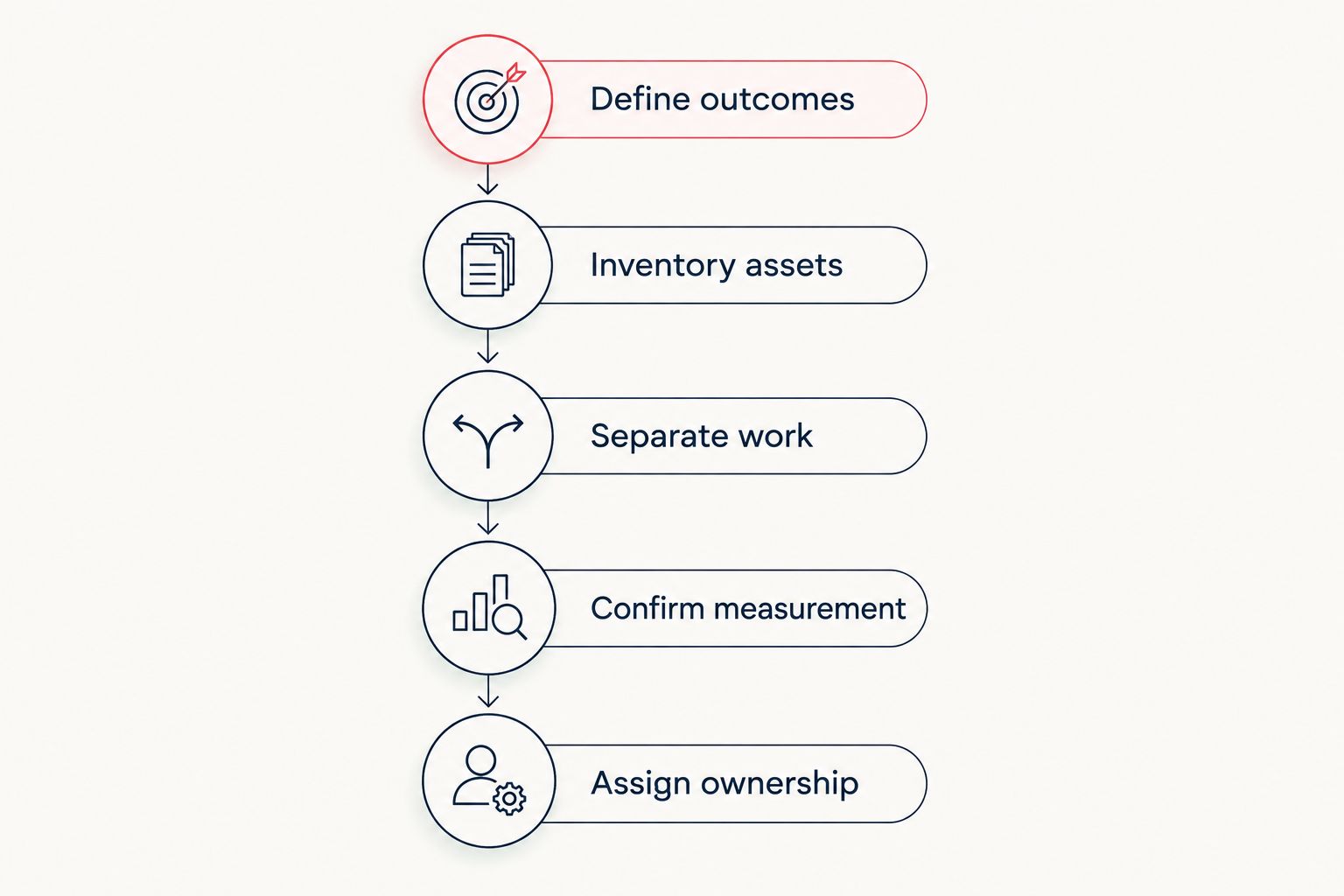 Define the work and its owner before comparing proposals.
After that sequence, request a revised proposal wherever responsibilities remain ambiguous. A provider's willingness to document boundaries is useful; a confident presentation does not replace a statement of work.
For a 2026 purchasing decision, retain the agreed asset inventory alongside the contract. It gives both sides a reference when a new location, website change, or booking-platform change creates additional work.
What should local SEO reporting include?
Reporting should connect the assigned work to observable changes without claiming more than the measurement supports. Ask for completed tasks, unresolved issues, search-performance indicators, and the guest actions your systems can record.
Keep these distinctions explicit:
- Visibility: Whether guests can find the business for relevant searches.
- Engagement: Whether guests interact with a profile or visit the website.
- Booking intent: Whether guests begin a reservation or submit an inquiry.
- Business outcome: Whether a booking or qualified opportunity is recorded.
Do not treat those categories as interchangeable. A reservation-link visit is not a completed reservation, and an inquiry is not a confirmed event.
Your 2026 report should also identify the next decision. That might be correcting inaccurate information, improving a location page, repairing a booking link, or investigating a tracking gap. Reporting without a decision is documentation, not management.
Does every hospitality location need the same work?
Every location needs an accurate assessment, but identical task lists are not a substitute for that assessment. Compare profile information, website content, booking destinations, and operating responsibilities before assigning the same scope across properties.
Use shared standards for approval and reporting. Keep location-specific issues visible so a completed task at one property does not conceal unfinished work elsewhere.
Is local SEO the same as booking optimization?
Local SEO and booking optimization address connected but different parts of the guest journey. Local SEO concerns discoverability and relevant local information; booking optimization concerns the path from interest to a completed action.
Require a clear handoff between them. If a provider identifies a broken reservation journey but excludes website implementation, assign that correction to another owner rather than leaving it unresolved.
FAQ
How much does local SEO cost for a hospitality brand in 2026?
A hospitality brand needs a scope-based quote covering its locations, existing problems, implementation, and ongoing responsibilities. Compare initial work separately from recurring management, and require written exclusions.
What's the best way to compare local SEO proposals?
Compare proposals against the same location inventory, deliverables, implementation responsibilities, and reporting requirements. A narrower engagement is not equivalent to one that includes website corrections and booking measurement.
Does local SEO include Google Business Profile management?
Google Business Profile management belongs in the contract when it is part of the engagement. Confirm which eligible profiles are covered, who approves updates, and who supplies current operating information.
Do I need ongoing local SEO management after a cleanup?
You need an assigned maintenance owner after a cleanup, whether that person is internal or external. Choose an ongoing engagement when recurring updates, reporting, and coordination require contracted support.
Can a local SEO provider guarantee restaurant reservations?
Do not treat a reservation guarantee as evidence of a sound local SEO scope. Require defined deliverables and reporting that distinguishes visibility, booking actions, and completed reservations.
Is a fractional CMO the same as a local SEO agency?
A fractional CMO provides marketing leadership; a local SEO agency supplies the execution defined in its agreement. Carey Kidd Group provides fractional CMO and strategic marketing consulting, so confirm implementation responsibilities separately.
What should I ask before signing a hospitality SEO agreement?
Ask who controls the accounts, what work is included, who implements changes, and how outcomes will be measured. Also confirm exclusions, approval responsibilities, and the process for changing scope.
One last thing
Ask a prospective provider to show how a guest moves from a local search result to your intended booking action. Then ask who owns each step and what happens when it fails.
The handoff deserves as much scrutiny as the search work. For your 2026 plan, put account ownership, booking-link responsibility, and implementation approvals in writing. Those details make the agreement actionable instead of leaving the operating team to discover its obligations after signing.