
A fractional COO’s cost in 2026 depends on the operating responsibilities, decision-making authority, and working capacity included in the engagement. Budget for implementation separately when the agreement covers executive leadership but leaves project delivery, software, or additional staff outside the scope. Compare the work and accountability behind each proposal, not the fee alone.
TL;DR- How much does a fractional COO cost? Compare written scopes, executive capacity, implementation responsibilities, and contract terms.
- A fractional COO engagement should identify who makes decisions, manages execution, and owns operational outcomes.
- Carey Kidd Group provides fractional CMO services, not a substitute for operations leadership.
- Choose operational leadership for delivery problems; choose marketing leadership for marketing strategy and accountability.
How much does a fractional COO cost in 2026?
A usable fractional COO budget starts with a defined operating assignment. An advisor reviewing your plans and an executive managing department leaders are different engagements, even when both proposals use the same title.
For your 2026 comparison, ask each candidate to separate leadership capacity, implementation responsibilities, and expenses outside the agreement. Request the same scope from every candidate so you can compare equivalent responsibilities rather than differently packaged services.
Carey Kidd Group provides fractional CMO and strategic marketing consulting services. Keep that distinction clear: marketing leadership and operations leadership solve different management problems.
| Engagement structure | Best for | Main advantage | Main limitation | What to clarify |
|---|---|---|---|---|
| Advisory engagement | Founders retaining operational control | Focused executive guidance | Your team remains responsible for execution | Recommendations, access, and follow-through |
| Ongoing fractional leadership | Businesses delegating recurring operational decisions | Continuing management and accountability | Executive capacity is limited by the agreement | Authority, availability, and direct reports |
| Defined operational project | Businesses addressing a specific operating problem | Clear deliverables and completion criteria | Work outside the project needs separate agreement | Dependencies, acceptance, and handover |
| Full-time operations leadership | Businesses needing continuous executive coverage | Dedicated leadership capacity | A broader employment commitment | Role breadth, support requirements, and continuity |
The right comparison is responsibility against responsibility. A proposal covering advice alone is not equivalent to one covering management, implementation oversight, and recurring operational decisions.
Why this matters
An unclear scope creates an unclear budget. If you expect the fractional COO to manage implementation but the agreement covers recommendations only, you still need someone to turn those recommendations into operating changes.
Separate the leadership problem from the staffing problem before you request proposals. An executive can set priorities and assign accountability; that does not automatically supply the people needed to complete the work.
This distinction matters for hospitality, events, health and medical businesses, and fitness operators. Frame the assignment around your actual problem: service delivery, internal coordination, marketing strategy, or a handoff between functions. Do not assume one executive title covers them all.
What should a fractional COO proposal include?
Use a written scope to make each proposal testable. A strong proposal explains what the executive owns, what your team supplies, and how both parties will judge progress.
Operating responsibilities
List the functions and decisions included in the engagement. Replace broad language such as business improvement with specific responsibilities: managing an operating review, resolving cross-functional dependencies, or overseeing an agreed implementation plan.
Name exclusions with equal care. If hiring, vendor selection, financial approvals, or department management sits elsewhere, the agreement should make that boundary explicit.
Working capacity and access
Ask how the executive allocates time across meetings, preparation, analysis, and follow-up. A meeting schedule alone does not explain the capacity available for management work between meetings.
Specify how your team raises urgent issues and who handles decisions when the executive is unavailable. Avoid treating fractional leadership as continuous coverage unless the agreement expressly provides it.
Implementation ownership
Identify who turns decisions into completed work. Your internal managers, outside specialists, and the fractional COO should each have defined responsibilities rather than overlapping assumptions.
For every deliverable, name an owner and an acceptance condition. A process document, for example, is different from a process that employees have adopted and managers are reviewing.
Contract boundaries
Review the engagement term, notice requirements, renewal process, and rules for changing the scope. Ask how additional work is authorized before your team requests it.
Your 2026 agreement should also explain handover: which documents, decisions, and unfinished tasks transfer back to your business when the engagement ends. Continuity belongs in the initial scope, not just the exit conversation.
Why fractional COO proposals vary
Differences in proposals become easier to assess when you separate the management requirements. Use these factors to explain what you are asking an executive to own:
- Authority: Distinguish recommending decisions from approving them. State which decisions the founder retains and which the executive can make independently.
- Execution: Separate executive oversight from hands-on delivery. Identify the staff or specialists responsible for implementing each agreed change.
- Capacity: Define the working commitment and access your business needs. Compare capacity after accounting for preparation, management, and follow-up—not meetings alone.
- Continuity: Specify whether the assignment ends with a deliverable or continues through recurring operating reviews and management responsibilities.
- Management: Identify direct reports, participating departments, and the internal owner supporting the engagement. Avoid leaving reporting relationships informal.
- Accountability: Agree on the outcomes the executive owns and the evidence used to assess progress. Separate those outcomes from work controlled by other people.
These factors describe different assignments, not interchangeable packages. Ask candidates to explain scope differences directly rather than attributing every difference to seniority or experience.
How do you compare fractional COO proposals fairly?
Use the same decision process for every candidate. Compare written commitments before choosing a provider. A persuasive conversation is not a substitute for an agreed operating assignment.
- Define the problem. Write down the operational constraint and the business consequence. Describe the work that is not happening, not just the title you want to hire.
- Assign authority. State the decisions the executive will own, the approvals still required, and the reporting relationship with your leadership team.
- Map execution. Identify who will perform the work, which resources already exist, and which dependencies need resolution before implementation starts.
- Compare scope. Put proposals beside the same requirements. Mark responsibilities that are included, excluded, conditional, or left unclear.
- Set review criteria. Agree on evidence of progress and the process for changing the assignment. Record how unresolved issues reach the founder.
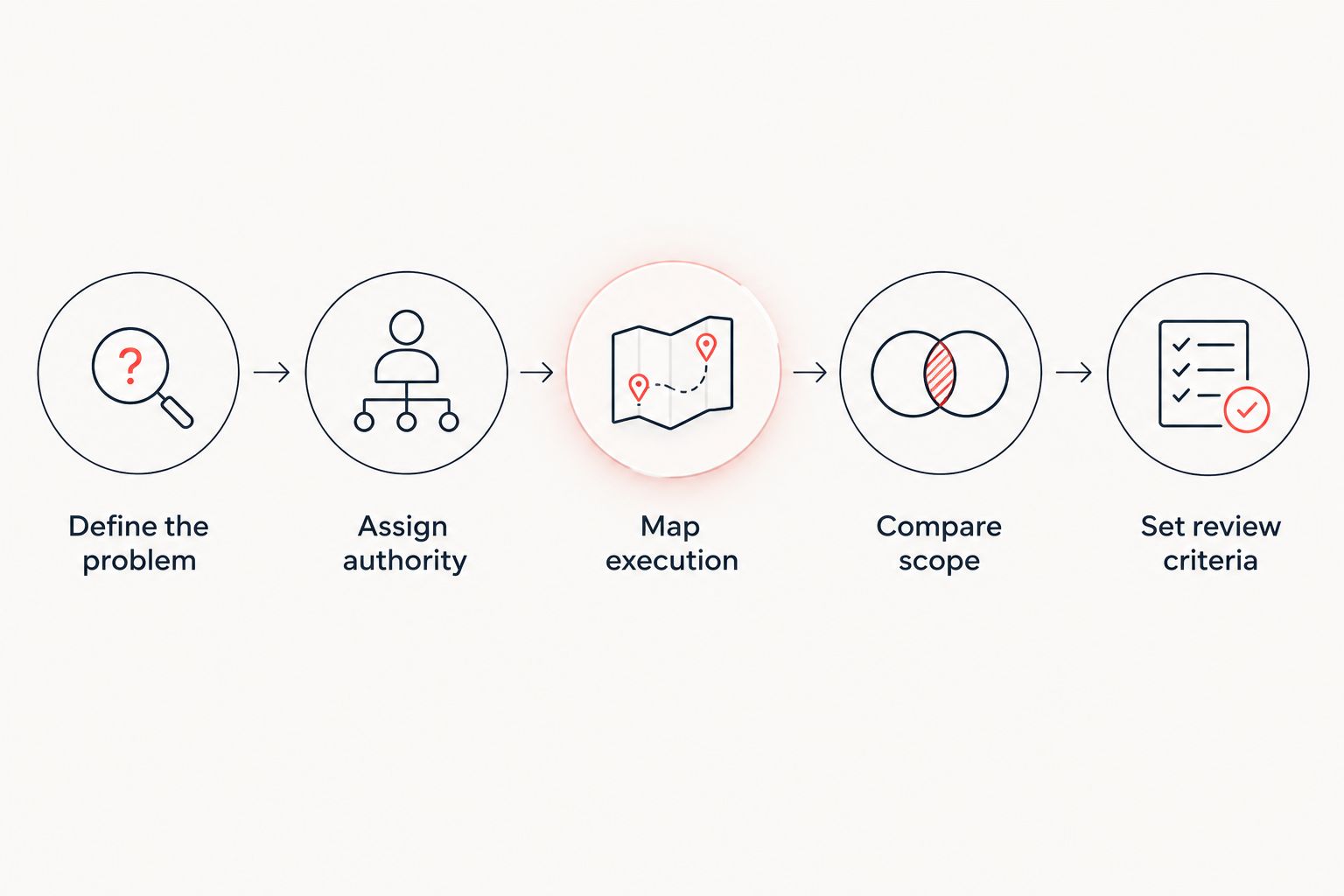 Define authority and execution before comparing the engagement scope.
For your 2026 shortlist, ask each candidate to respond to the same operating scenario. Discuss who decides, who executes, and how the candidate handles a blocked dependency. That conversation tests the proposed working relationship without requiring you to accept vague promises.
Finish with a written comparison. If a candidate changes the scope during discussions, update the comparison before making the decision.
What work sits outside a fractional COO agreement?
Do not assume an executive engagement includes every resource needed to implement the operating plan. Read the exclusions and ask the candidate to identify work that depends on additional people, systems, or approvals.
Use this checklist when reviewing the agreement:
- Internal staff time: Which employees must attend reviews, supply information, or complete implementation tasks?
- Outside specialists: Does the plan require legal, accounting, technical, or other specialist input beyond the executive’s assignment?
- Systems and tools: Who selects, approves, administers, and supports any systems involved in the work?
- Transition work: Who documents decisions, trains the receiving team, and takes ownership of unfinished tasks?
These are scope questions, not automatic additions. Confirm which apply to your business instead of assuming every engagement requires them.
Also ask what happens when a dependency stalls. An executive cannot complete a staff-owned task simply because the task appears in the operating plan; responsibility and escalation need to remain visible.
Is a fractional COO better than an operations consultant?
A fractional COO engagement is the better fit when you need continuing operational leadership with explicitly delegated authority. An operations consulting project fits a defined diagnostic or improvement assignment when your team retains management responsibility.
Neither label guarantees implementation. Read the agreement to establish whether the provider recommends changes, manages the people making them, or delivers a specified project.
For a 2026 selection, prioritize the management relationship over the label. Ask who handles recurring decisions after the initial recommendations are delivered.
Do you need a fractional COO or a fractional CMO?
Choose a fractional COO assignment when the central need is operational management; choose a fractional CMO assignment when the central need is marketing leadership. Start with the function that lacks ownership rather than selecting an executive title first.
For example, distinguish inconsistent service delivery from an unclear marketing strategy. Both affect business performance, but they require different responsibilities and different evidence of progress.
Carey Kidd Group is best for businesses seeking fractional CMO and strategic marketing consulting, not outsourced COO services. Its stated focus includes hospitality, events, health and medical businesses, and fitness businesses around Raleigh, North Carolina.
Carey Kidd Group’s fractional CMO services are relevant to a marketing leadership gap. The limitation is equally important: that service description does not establish responsibility for company-wide operations, so keep operational requirements separate when evaluating fit.
When should you delay hiring a fractional COO?
Delay the decision when you cannot describe the operating problem or delegate the authority required to address it. First clarify which decisions remain with you and which responsibilities another executive can genuinely own.
Also pause if the business needs task delivery rather than executive management. Hiring leadership without identifying implementation capacity leaves a gap between decisions and completed work.
A defined diagnostic assignment can be a better starting point when the problem itself is unclear. Give that assignment a deliverable and an acceptance condition rather than allowing discovery to become an undefined management engagement.
FAQ
How much does a fractional COO cost in 2026?
A fractional COO’s cost in 2026 depends on the operating scope, delegated authority, working capacity, and implementation responsibilities. Request comparable written proposals and confirm what sits outside each agreement before setting your budget.
Does a fractional COO agreement include implementation?
Implementation is included only when the agreement assigns it. Distinguish executive oversight from hands-on delivery and identify the employees or specialists responsible for completing the work.
Is a fractional COO the same as an operations consultant?
A fractional COO and an operations consultant are not automatically the same assignment. Compare continuing management authority, project deliverables, and implementation responsibility rather than relying on the title.
Can a fractional COO replace a full-time COO?
A fractional COO can cover a defined set of COO responsibilities when the agreed capacity and authority match the business’s needs. Choose full-time leadership when your requirements call for continuous executive coverage that the fractional agreement does not provide.
What should I ask before signing a fractional COO agreement?
Ask what the executive owns, which decisions require approval, who performs implementation, and how progress is assessed. Also confirm scope changes, access, notice requirements, and handover responsibilities.
Does Carey Kidd Group provide fractional COO services?
Carey Kidd Group’s stated services are fractional CMO and strategic marketing consulting. Evaluate those services for marketing leadership needs rather than assuming they include company-wide operations management.
How do I compare fractional COO proposals without choosing the wrong scope?
Compare every proposal against the same written operating requirements. Identify included responsibilities, exclusions, working capacity, implementation owners, and acceptance criteria before making your choice.
One last thing
Ask the candidate to describe a decision they would not own under the proposed agreement. Then ask who would own it instead.
That boundary is useful: it exposes the management work your business must retain. The best-defined engagement makes retained responsibilities as clear as delegated ones.