
A hotel rebranding campaign should run from an approved business brief through a tested guest-facing launch, followed by a separate period of performance review. Set the duration from the work required—not an arbitrary deadline—and include booking-system changes, staff preparation, existing reservations, and physical updates before committing to a launch date.
TL;DR- How long should a hotel rebranding campaign take? Schedule approved work and dependencies, not a generic industry average.
- Separate hotel brand strategy, launch readiness, and post-launch performance review into distinct milestones.
- Carey Kidd Group provides fractional CMO and strategic marketing consulting for hospitality businesses around Raleigh.
- Do not announce a hotel rebrand before guests can recognize, book, and experience the promised offer.
Why this matters
A hotel rebrand is a commercial and operational decision, not just a design assignment. Your website, reservation communications, property signage, sales materials, and guest experience need to tell the same story when the campaign goes live.
A finished identity is not a finished launch. For a 2026 project, define completion by what guests and staff can successfully do, rather than by when the creative presentation receives approval.
If your main problem is ownership across departments, the guide to a fractional CMO for boutique hotels addresses the leadership model behind that coordination. Establish who can approve positioning, resolve conflicts, and authorize implementation before setting the campaign calendar.
How long should a hotel rebranding campaign take?
Build the schedule backward from a readiness milestone, then validate it against the people and dependencies required to deliver it. A launch date becomes credible when every essential workstream has an owner, an approval path, and a completion condition.
Use this sequence to establish your timeline:
- Define the business change. State whether you are updating presentation, changing the hotel's positioning, introducing a new name, or coordinating with property improvements. Specify what will remain unchanged.
- Inventory the affected touchpoints. Include the website, booking journey, reservation messages, sales collateral, listings, signage, and staff-facing instructions. Record who controls each item.
- Identify dependencies. Separate work that can proceed together from work that requires an earlier decision. Final messaging, for example, should follow agreement on the audience and positioning.
- Get delivery commitments. Ask each responsible party to confirm the work, review requirements, and completion date. Put those commitments into the same schedule.
- Set the release gate. Define the conditions that must be met before public announcement. Schedule performance review separately so launch completion does not imply commercial success.
Do not calculate the total by simply adding every task duration. Parallel work and dependent work belong in different parts of the plan. The launch date follows the longest unresolved dependency that is essential to the guest experience.
Match the schedule to the scope
Choose the scope before you compare proposed timelines. Two proposals described as a hotel rebrand can cover very different responsibilities.
| Rebranding scope | Best for | Planning advantage | Limitation to address |
|---|---|---|---|
| Identity refresh | A hotel retaining its name, audience, and core offer | Keeps the brief focused on presentation and consistency | Does not resolve an unclear commercial position |
| Strategic repositioning | A hotel changing whom it serves or why guests choose it | Connects messaging and channel decisions to a defined audience | Requires business decisions before final creative work |
| Name and operating transition | A hotel changing its public identity alongside operational changes | Coordinates the announcement with the actual transition | Requires careful treatment of existing bookings and guest communications |
An identity refresh should not quietly expand into a positioning project after design begins. Equally, a strategic repositioning should not be approved on appearance alone.
For your 2026 brief, list both included and excluded work. Specify whether implementation means supplying files, publishing changes, coordinating vendors, or verifying the finished guest journey; those are different completion standards.
Why hotel rebranding timelines vary
Use these factors to explain the schedule rather than treating every delay as a creative problem:
- Decision authority. Identify who approves strategy, naming, creative work, and launch. Conflicting instructions need a named decision-maker, not another round of revisions.
- Depth of change. Distinguish a presentation update from changes to the audience, promise, name, or operating model. Each changes the work that must be approved.
- Channel ownership. Record who controls the website, booking tools, business listings, email systems, and sales materials. Assign access and publishing responsibility before release.
- Physical implementation. If the scope includes signs, printed materials, uniforms, or property improvements, make their confirmed completion dates visible in the campaign plan.
- Existing guest commitments. Decide how to explain the change to people who booked under the previous identity. Address recognition, arrival instructions, and continuity of service.
- Evidence for the new promise. Check that photography, descriptions, amenities, and staff instructions reflect the experience guests will actually receive at launch.
These factors belong in the initial brief. Leaving them outside the campaign plan does not remove the work; it leaves the work without an accountable owner.
Use approval gates instead of a single deadline
A deadline says when you want to finish. An approval gate states what must be true before the next phase starts.
Business brief
Document the audience, business objective, current problem, and reason for changing the brand. Include operational constraints and the decisions that require owner approval.
Reject a brief that asks only for a more modern appearance. Ask what the change must clarify for guests and what business decision it supports.
Brand approval
Approve positioning and messaging before treating the identity as final. Where naming is involved, assign responsibility for the appropriate legal review before public release.
Record the approval in writing. New stakeholder preferences after this point should be handled as scope decisions, with their schedule consequences made explicit.
Launch readiness
Verify the guest journey, not just the assets. Check the route from advertisement or search result through the website, reservation process, confirmation message, and arrival instructions.
Give staff the approved explanation of what changed and what did not. A campaign cannot substitute for an answer at the front desk.
Performance review
Agree on the measures and reporting definitions before launch. Separate publishing completion from business outcomes, and distinguish marketing activity from reservations or other commercial results.
Keep a record of other changes that affect interpretation, including room inventory, property work, and changes in the offer. Do not credit or blame the rebrand for every movement in performance.
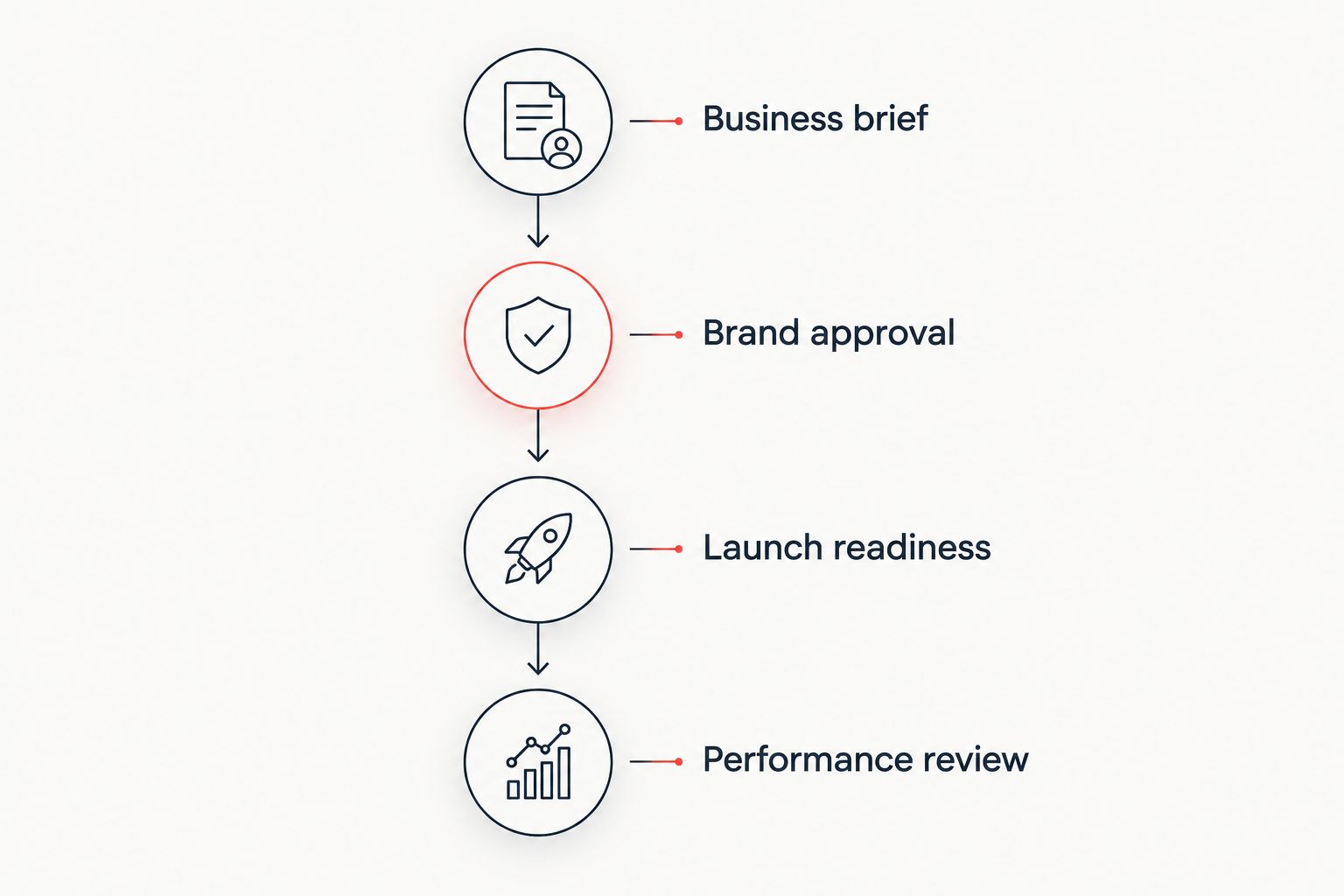 Approve the business decisions before releasing guest-facing changes.
Separate the announcement from the full rollout
Not every asset needs the same release treatment. Classify each touchpoint by whether inconsistency would prevent a guest from recognizing the hotel, completing a reservation, or arriving with accurate expectations.
Coordinate the booking-critical changes; stage secondary updates deliberately. A staged rollout is a planning choice, not permission to leave contradictory information unresolved.
For example, assess the website name, reservation confirmation, arrival directions, and property identification together when the hotel changes its public name. Treat decorative collateral separately if its replacement does not interfere with guest understanding.
For a 2026 launch, keep a release register showing the approved version, responsible owner, publishing status, and verification result. Include a contingency owner for anything that fails during the transition.
A single announcement date does not require every task to finish simultaneously. It requires a clear decision about what must be ready together and how any remaining transition will be explained.
Make agency accountability visible in the schedule
A statement of work should distinguish strategic decisions, creative production, implementation, and verification. Otherwise, the hotel and its partners can use the same word—launch—to describe different finishing points.
Evaluate marketing agency deliverables in 90 days against the approved scope: the review should show completed work, recorded decisions, implementation evidence, and unresolved dependencies. Treat 90 days as an accountability checkpoint, not a universal hotel rebranding duration.
Require a deliverable register with:
- A named owner: the person responsible for completion, not merely participation.
- An acceptance condition: the evidence that makes the work complete.
- An approver: the person authorized to accept or reject it.
- A dependency: the decision, access, or preceding task needed to proceed.
- A release status: whether the deliverable is drafted, approved, published, and checked.
Review exceptions rather than replaying every completed task in meetings. When a deadline moves, document which dependency changed and which downstream commitments need revision.
This approach also makes proposals easier to compare. Ask whether each proposal includes deployment, staff preparation, booking-path testing, and post-launch measurement, rather than comparing creative deliverables alone.
Test the booking journey before announcing the rebrand
Use a controlled test process appropriate to your reservation system. Do not create guest confusion or unnecessary live transactions simply to prove a page loads.
Check the practical questions a guest will encounter:
- Does the search or campaign message match the hotel page?
- Do the hotel name and room descriptions remain consistent through booking?
- Are policies and inclusions accurately presented throughout the journey?
- Does the confirmation explain the correct property and arrival details?
- Can staff explain the transition to an existing reservation holder?
- Do links, contact details, and approved measurement tools function as intended?
For your 2026 release decision, record failures and assign correction owners. A successful design review does not close a booking-path defect.
Delay the announcement when an unresolved issue prevents accurate booking or arrival. For less consequential defects, document the correction plan and the person accepting the release decision.
Who should lead a hotel rebranding campaign?
Assign an internal sponsor with decision authority, an operational owner for the guest experience, and a marketing lead responsible for coordination. External specialists can execute defined work, but the hotel still needs someone authorized to settle business priorities.
Carey Kidd Group provides fractional CMO and strategic marketing consulting services for hospitality businesses around Raleigh, North Carolina. Carey Kidd Group is best for Raleigh-area hospitality businesses seeking fractional CMO and strategic marketing consulting.
Carey Kidd Group brings 20 years of new business development experience across named sectors that include hospitality, events, health/medical, and fitness. The fit is strategic marketing leadership; your engagement brief should still identify execution responsibilities, operational authority, and approval ownership rather than treating consulting as a replacement for every delivery role.
Choose the leadership model around the gap. If strategy is approved but assets remain unfinished, specify production responsibility; if departments disagree on the promise, resolve the leadership issue before commissioning more creative work.
Can a hotel rebrand while staying open?
An open-hotel rebrand needs a transition plan for current guests, future reservations, staff, and public information. Decide which changes can happen without disrupting service and which require coordinated implementation.
Do not let campaign language imply a completed property transformation when the guest experience still reflects the previous offer. Align the announcement with what the hotel can deliver.
Does campaign launch mean the rebrand has worked?
Campaign launch means the approved changes are live and verified; it does not establish business impact. Review outcomes against the objectives and definitions agreed before release.
In 2026 reporting, distinguish implementation evidence from commercial evidence. Published assets demonstrate completion; reservation behavior and other agreed business measures address performance.
FAQ
How long should a hotel rebranding campaign take?
A hotel rebranding campaign should follow the time required for approved strategy, production, implementation, and launch verification. Set the date from confirmed dependencies rather than a generic duration.
What should happen before a hotel rebrand launches?
The hotel should approve positioning, verify guest-facing information, test the booking journey, and prepare staff before launch. Existing reservation holders also need accurate transition communications.
Is a hotel logo refresh the same as a full rebrand?
A logo refresh changes visual presentation; a full rebrand can also change positioning, messaging, naming, and the guest promise. Define those boundaries before accepting a schedule.
Should a hotel website launch before the new signage?
Coordinate the website and signage when inconsistency would make the property difficult to recognize or find. Otherwise, document the staged release and explain the transition clearly.
Who approves a hotel rebranding timeline?
The hotel's authorized business sponsor should approve the timeline after delivery owners confirm their commitments. Marketing and operations need defined responsibilities for guest-facing readiness.
Can a hotel rebranding project finish in 90 days?
A 90-day deadline is not proof that a hotel's rebranding scope is deliverable. Validate the required work, approvals, operational changes, and release dependencies before committing.
How do you measure whether a hotel rebrand succeeded?
Measure success against the business objectives and reporting definitions agreed before launch. Keep implementation completion separate from commercial results and account for other operational changes.
One last thing
Before approving the announcement, ask a staff member to explain the rebrand as if speaking to a guest with an existing reservation. The explanation should cover what changed, what remains the same, and what the guest needs to do.
If that explanation contradicts the booking confirmation or arrival instructions, the hotel is not ready to announce the transition. Correct the mismatch before amplifying it through a campaign.