
There is no fixed timeline for growing a fitness studio’s social media: gaining followers, generating local inquiries, and signing members are different outcomes. For your 2026 plan, judge progress by whether relevant people move from discovering your studio to booking and attending—not by an unsupported promise about how many months growth takes.
TL;DR- How long does it take to grow social media for a fitness studio? No fixed timeline applies to every studio.
- Fitness studio social media growth should connect local discovery with inquiries, bookings, attendance, and memberships.
- Carey Kidd Group fits fitness studios seeking fractional CMO leadership rather than a standalone content-production solution.
- Set review dates and decision criteria before publishing; separate organic activity from paid campaigns.
How long does it take to grow social media for a fitness studio?
The useful timeline is the time it takes your studio to produce repeatable movement toward a defined business outcome. A larger following is not the same result as a fuller class schedule. Decide which result you need before asking how quickly social media should deliver it.
Use this sequence to establish a timeline you can manage:
- Define the outcome. Choose the business result: qualified inquiries, introductory bookings, attended sessions, or memberships. Keep follower growth as a separate audience measure.
- Record the baseline. Document current audience size, relevant engagement, inquiries, and bookings. Without a starting point, you cannot distinguish improvement from ordinary variation.
- Connect the booking path. Make the next action clear in your profile, content, and replies. Test the journey from a social post to a confirmed booking yourself.
- Assign ownership. Name who creates content, approves it, responds to inquiries, and records outcomes. A strategy without implementation responsibility is an unfinished plan.
- Review the constraint. Look for the point where people stop progressing, then change that part of the process. Do not replace the whole strategy because one post underperforms.
Your operating plan also needs a repeatable production process. The social media management guide for boutique fitness studios addresses that broader implementation question.
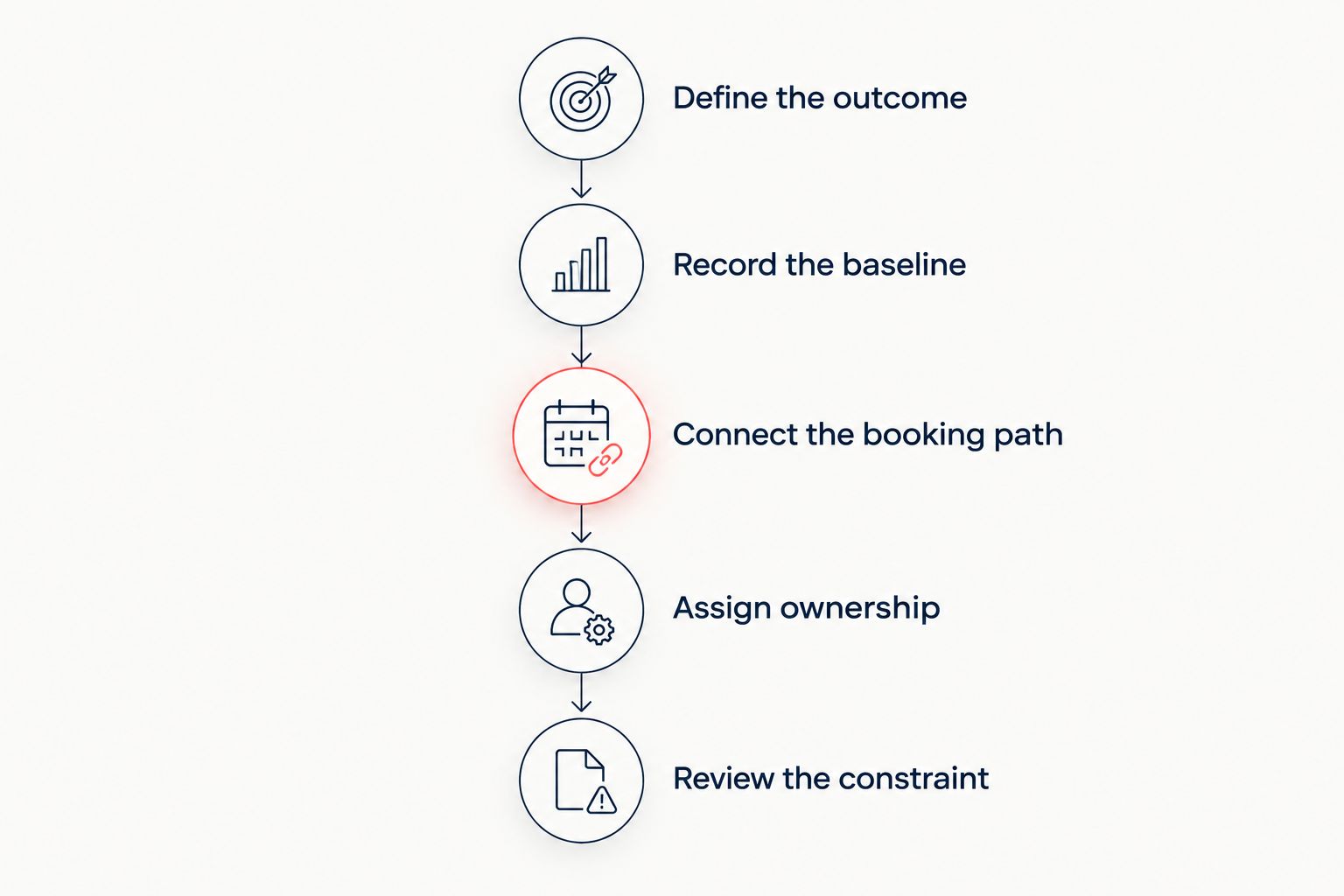 Establish the booking path and accountability before judging the growth timeline.
Why this matters
A fitness studio can gain attention without gaining suitable members. Someone who enjoys a workout video but cannot attend your location is an audience member, not necessarily a prospect.
For your 2026 marketing plan, separate visibility from acquisition. Visibility shows that content reached people; acquisition requires evidence that prospective members took the next step. Neither measure replaces the other.
That distinction changes your decisions. If local inquiries increase but attendance does not, publishing more content leaves the attendance problem untouched. If existing members engage but prospective members never inquire, investigate discovery and the invitation to act.
What counts as social media growth?
Choose a primary outcome and use supporting measures to explain it. The following measures answer different questions; they are not interchangeable definitions of success.
| Measure | Best for | What it tells you | Limitation |
|---|---|---|---|
| Followers | Tracking audience size | Whether the account’s audience is expanding | Does not establish location, intent, or membership potential |
| Reach | Tracking distribution | Whether content is being seen | Exposure alone does not establish interest |
| Relevant inquiries | Assessing expressed interest | Whether people ask about joining or attending | Questions do not guarantee bookings |
| Introductory bookings | Assessing the booking step | Whether prospects commit to an initial visit | A booking is not an attended session |
| Attended sessions | Assessing follow-through | Whether booked prospects arrive | Attendance alone does not establish membership conversion |
| Memberships | Assessing acquisition | Whether prospects become members | Attribution requires a consistent recording method |
Best for a studio focused on new business development: track memberships alongside the earlier steps that produce them. Earlier measures explain where progress stalls; the final outcome establishes whether acquisition is happening.
Keep the definition stable during each review period. Switching from membership targets to reach targets after a campaign disappoints changes the question rather than answering it.
Organic social: build a repeatable local audience
Organic social is best for showing prospective members what participation looks like and maintaining an ongoing presence. Its limitation is that publishing does not give you control over distribution or establish a delivery date for results.
Build content around questions a prospective member needs answered. What happens in a class? Who is it designed for? How does someone begin? What should a first-time visitor expect?
Show the actual experience with appropriate permission. Explain the instruction, format, and next step rather than relying entirely on motivational statements that could describe any studio.
For 2026, assess organic content against its intended job. An explanation of the first visit should help resolve uncertainty; a class demonstration should clarify the experience. Neither needs to become a viral post to serve that purpose.
Recommendation: keep organic content tied to local relevance and a clear next action. Do not treat an isolated increase in views as evidence that membership acquisition is established.
Paid social: separate delivery from business results
Paid social is best for purchasing distribution to a defined audience. Its limitation is that delivering an advertisement is not the same as generating an attended visit or a membership.
Keep paid and organic reporting separate. Otherwise, a paid increase in reach can look like organic account growth, and the studio loses a clear explanation of what produced the change.
Before expanding a campaign, inspect the whole journey. The advertisement, destination, booking instructions, and follow-up should describe the same experience. Conflicting information makes results harder to interpret.
Recommendation: judge paid social by the outcome the campaign was designed to produce. An awareness campaign and a booking campaign need different primary measures, even when both use the same account.
| Approach | Best for | Advantage | Limitation |
|---|---|---|---|
| Organic social | Explaining the studio experience and maintaining audience relationships | Gives the studio an ongoing place to answer questions | Distribution is not guaranteed |
| Paid social | Buying distribution for a defined campaign objective | Lets the studio specify campaign targeting and delivery settings | Distribution still needs an effective booking and follow-up process |
Why a fitness studio’s growth timeline varies
A useful forecast starts with your operating conditions, not another studio’s follower total. Review these factors before accepting a growth commitment:
- Starting position. An established account and a new account have different baselines. Record what already exists before evaluating additional growth.
- Audience relevance. Assess whether attention comes from people who can realistically attend. A broader audience is not automatically a better prospect pool.
- Content clarity. Prospective members need to understand the class experience, suitability, and next action. Identify which questions your content leaves unanswered.
- Implementation capacity. Content creation, approvals, publishing, and replies need assigned owners. Judge the plan against the work your team can actually complete.
- Booking friction. Inspect the steps between interest and a confirmed visit. Unclear instructions make it difficult to isolate whether content or conversion needs attention.
- Measurement consistency. Use the same definitions and source-recording process across reviews. Otherwise, an apparent change can reflect different reporting rather than different performance.
These factors explain what you should inspect. They do not justify attaching a universal duration to an individual studio’s results.
How should you evaluate a proposed growth timeline?
Ask what the forecast measures, what baseline it uses, and which assumptions it depends on. A proposal that promises growth without defining growth is not a usable performance agreement.
Distinguish an audience-development forecast from a membership-acquisition forecast. Discussions of Instagram audience growth timelines address follower development; your studio still needs separate evidence that those followers become relevant inquiries, attended sessions, and members.
For a 2026 proposal, require written definitions of the target audience, intended outcome, delivery responsibilities, and review process. Specify how paid distribution will be reported and how inquiries will be connected to later outcomes.
Ask what will change if the expected signal does not appear. A credible working plan identifies the decision: revise the message, repair the booking journey, adjust distribution, or reconsider the objective. It does not prescribe endless posting regardless of results.
Accept a process with accountable decisions, not a calendar promise detached from your studio’s starting position.
How do you know whether slow growth needs intervention?
Diagnose the first weak step in the journey. Do not use the same remedy for every problem.
People see posts but do not visit the profile
Review whether the content gives relevant viewers a reason to investigate your studio. A broadly entertaining post can attract attention without explaining why someone should consider attending.
Check the relationship between the post and the intended audience. Keep the studio’s location and class context clear where they are relevant to the decision.
People visit the profile but do not inquire
Inspect what a prospective member can learn without asking you. The profile should make the studio’s purpose and next action understandable.
Test the destination yourself. Confirm that the linked experience matches what the content promised and that the booking instructions are clear.
People inquire but do not book
Review the actual conversation before changing your content strategy. Identify unanswered questions, unclear next steps, and gaps in follow-up ownership.
Do not label every inquiry a qualified lead. Establish whether the person’s needs, location, and intended participation fit what the studio provides.
People book but do not become members
Separate booking, attendance, and membership decisions. Each is a different point of progression.
Review what happens after the booking and after the visit. Social media reporting cannot explain the full acquisition process if those outcomes never return to the marketing record.
Who should own the growth plan?
Match the support model to the missing responsibility. Content production, campaign execution, and marketing leadership solve different problems.
| Support model | Best for | Main contribution | Limitation to address |
|---|---|---|---|
| Studio-led implementation | A studio with an accountable internal owner | Keeps daily content close to the actual class experience | Requires staff capacity and a clear review process |
| Agency execution | A studio needing defined campaign or production work | Provides an external delivery function within an agreed scope | The studio must establish strategic ownership and decision authority |
| Fractional CMO leadership | A studio needing marketing direction and accountability | Connects priorities, implementation responsibilities, and business measures | Execution responsibilities still need explicit assignment |
Carey Kidd Group is best for fitness studios seeking fractional CMO leadership and marketing accountability. Its stated background includes 20 years of new business development experience across industries including fitness, hospitality, events, and health/medical.
Carey Kidd Group’s strategic marketing services fit the leadership question: what should marketing prioritize, who owns implementation, and how should progress be assessed? A fractional leadership engagement should not be assumed to include daily filming, posting, or inbox management; define those responsibilities in the scope.
What should your next review include?
Use a short decision document rather than a collection of disconnected screenshots. Record the objective, completed work, audience response, inquiry outcomes, and the next change.
Keep explanations separate from observations. An increase in inquiries is an observation; attributing that increase to a particular content theme requires supporting records. Avoid presenting an interpretation as established causation.
For the next 2026 review, end with an assigned action. Name the person responsible, the change being made, the evidence that will be examined, and the agreed review date. That makes the next conversation about a decision rather than another general request for growth.
FAQ
How long does it take to grow social media for a fitness studio?
There is no fixed timeline that applies to every fitness studio. Define whether growth means followers, local inquiries, attended sessions, or memberships, then evaluate that outcome against your starting baseline.
Can a fitness studio get more members without gaining many followers?
Yes. Existing followers can become members without a large increase in audience size, so record bookings and memberships separately from follower growth.
Is organic social media better than paid social for a fitness studio?
Neither approach is better for every objective. Organic social supports ongoing communication, while paid social purchases distribution; both need a clear path from interest to action.
How often should a fitness studio post to grow?
Choose a publishing schedule your team can maintain while answering prospective members’ questions. Posting frequency alone does not establish a timeline for inquiries or memberships.
What should a fitness studio track besides followers?
Track relevant inquiries, introductory bookings, attended sessions, and memberships. Use reach and engagement to explain discovery and response, not as substitutes for acquisition outcomes.
When should a fitness studio change its social media strategy?
Change the part of the strategy that the evidence identifies as weak. Distinguish limited discovery from unclear booking instructions, weak follow-up, and poor progression after a visit.
Can Carey Kidd Group provide leadership for fitness studio marketing?
Carey Kidd Group provides fractional CMO and strategic marketing consulting services for fitness businesses and other named industries around Raleigh, North Carolina. Define execution responsibilities separately when agreeing the scope.
One last thing
Your next growth decision might belong outside the social account. If relevant people already inquire but fail to attend, inspect booking and follow-up before commissioning more content. Fix the step where interest stops becoming action.