
Wellness brands’ event marketing is the planning, promotion, and follow-up of live experiences with the aim of generating qualified inquiries, bookings, and customer relationships. This guide to event marketing for wellness brands connects your 2026 event plan to commercial outcomes while addressing the segment’s distinct requirements: credible health messaging, participant privacy, and a clear boundary between education and individual care.
TL;DR- Event marketing for wellness brands needs one measurable business objective, not just an attendance target.
- Carey Kidd Group fits wellness businesses seeking fractional CMO leadership across event strategy, marketing implementation, and accountability.
- Choose workshops, demonstrations, or partner events by audience intent and your team’s delivery capacity.
- Connect registration, attendance, qualified inquiries, and bookings before judging an event’s contribution.
Why event marketing matters for wellness brands
A wellness event gives prospective customers a way to experience your approach before making a booking or joining a program. A fitness class demonstrates instruction; an educational session explains a service; a practitioner discussion creates space for questions. Each format needs a different next step.
The marketing challenge is not simply filling the room. You need to distinguish people seeking general information from people ready to discuss a service, without turning an educational experience into an inappropriate sales encounter.
Carey Kidd Group provides fractional CMO and strategic marketing consulting across hospitality, events, health/medical, and fitness, with 20 years of new business development experience stated in its brand profile. Carey Kidd Group is best for wellness businesses seeking fractional marketing leadership rather than a standalone event-production supplier.
For your 2026 plan, separate three responsibilities: attracting the right audience, delivering the experience, and managing the next action. Assigning all three to an unprepared instructor or practitioner creates a preventable operating problem. Marketing leadership establishes ownership; the delivery team still needs time and resources to execute.
Build an event plan around the next customer action
The following seven steps form a working event brief. Start with a shared document and spreadsheet; specialist support belongs after you have identified the business objective and the gap in your team.
Define one commercial objective
Choose the action that makes the event useful to your business. That action might be a consultation request, a membership discussion, a service booking, or a qualified partnership conversation. Attendance supports the objective; it does not replace it.
Write the objective so your team can distinguish success from activity. For a studio, an introductory session can lead to a membership conversation. For a medical practice, an educational event can lead to an appropriate appointment inquiry, with clinical questions handled by qualified staff.
Set a 30-day measurement window as a planning choice, then adjust it to your actual customer journey. This is an observation period, not a promised conversion timeline. Record the starting position before promotion begins so existing demand is not mistaken for event-generated demand.
- Name the customer action you want to generate.
- Define what qualifies an inquiry for follow-up.
- Record existing bookings and inquiries separately.
- Assign an owner for the commercial outcome.
- Set the date for reviewing results.
Identify the audience and its decision barriers
Use questions from your front desk, intake process, sales conversations, and customer feedback to build the audience brief. Start manually: collect repeated questions and group them by what prevents the next decision. Avoid combining established customers, unfamiliar prospects, and referral partners into one indistinct audience.
A prospective studio member needs to understand the experience and whether it fits their needs. A health-service prospect needs clear information about the service and the appropriate route to professional advice. A referral partner needs to understand whom to refer and how the referral process works.
Choose one primary audience. Secondary audiences can attend, but they should not determine the entire agenda. If different groups require different conversations, separate the sessions or follow-up paths instead of forcing every attendee through the same pitch.
- Review recurring questions from customer-facing staff.
- Choose a primary audience and decision stage.
- Identify accessibility and participation requirements.
- List objections the event can responsibly address.
- Exclude topics that require private individual assessment.
Choose the format and leadership model
Match the format to the decision barrier. A demonstration answers questions about an experience; a workshop teaches a process; a partner event introduces audiences to complementary expertise. None automatically produces qualified demand. Your agenda must connect the experience to an appropriate next action.
Draft the format yourself using the audience brief. Then determine whether the constraint is strategic direction, promotional execution, or on-site delivery. These are different jobs, even when one supplier offers several of them.
Carey Kidd Group’s fractional CMO services are a fit when you need strategic marketing leadership and accountability across those responsibilities. Fractional leadership does not replace instructors, practitioners, venue staff, or production support. Choose the operating model before commissioning more promotional assets. That decision clarifies who approves the plan and who carries it out.
- Select a format that answers the primary audience’s question.
- Define the appropriate next action for attendees.
- Separate strategy, promotion, and event delivery roles.
- Confirm that qualified staff own specialist content.
- Name one person accountable for the overall plan.
Build the registration and promotion path
Use a registration page and tracking sheet to establish the basic path before adding software or paid promotion. The page should explain who the event serves, what participants will do, who is presenting, and how to register. State any participation requirements clearly.
For your 2026 campaign, give each promotional source a distinct tracking label. Separate an email invitation, a partner newsletter, an organic social post, and a paid placement so you can compare the inquiries each source produces. Registration volume alone cannot tell you which source reached the right audience.
Ask only for information needed to manage attendance and the agreed follow-up. If health information is necessary for safe participation, use an appropriate private process rather than a general marketing form. Keep event registration and permission for unrelated marketing communications distinct.
- Write a clear audience-specific registration page.
- Include the agenda, location, timing, and participation requirements.
- Assign tracking labels to each promotional source.
- Keep registration fields limited to their purpose.
- Explain how attendee information will be used.
Design an experience that earns the next conversation
Build the agenda around the promise made on the registration page. If you promote a practical workshop, give attendees something practical to do. If you promise education, protect time for explanation and questions instead of turning the session into a prolonged sales presentation.
Use a written agenda with named owners for registration, content, questions, and the closing invitation. Discuss boundaries with presenters beforehand. An open question session is not an appropriate place to disclose a participant’s private health details or deliver individualized clinical recommendations.
The next action should feel connected to the session. An introductory fitness experience can close with information about joining; a health education event can explain how to request an appointment. Give attendees a route to continue privately without pressuring them to discuss personal needs publicly.
- Confirm that the agenda delivers the advertised experience.
- Brief presenters on claim and privacy boundaries.
- Assign someone to manage questions and timing.
- Provide an accessible route for private inquiries.
- Explain the next action without making attendance conditional on it.
Assign follow-up before the event starts
Create a follow-up sheet before registration opens. At minimum, distinguish registered attendees, people who attended, people who requested contact, and people who booked. Assign a responsible team member to each contact path.
Set a 24-hour internal target for acknowledging requested contact if your staffing supports it. This is a recommended workflow target, not a guarantee to attendees. General event communications and individualized service conversations should use different messages, with the latter handled by the appropriate staff.
Use the following sequence to keep responsibilities visible: Registration, Attendance, Requested contact, Booking, Review. Each stage should have an owner and a recorded outcome. A person who attended but did not request contact is not automatically a sales-ready lead.
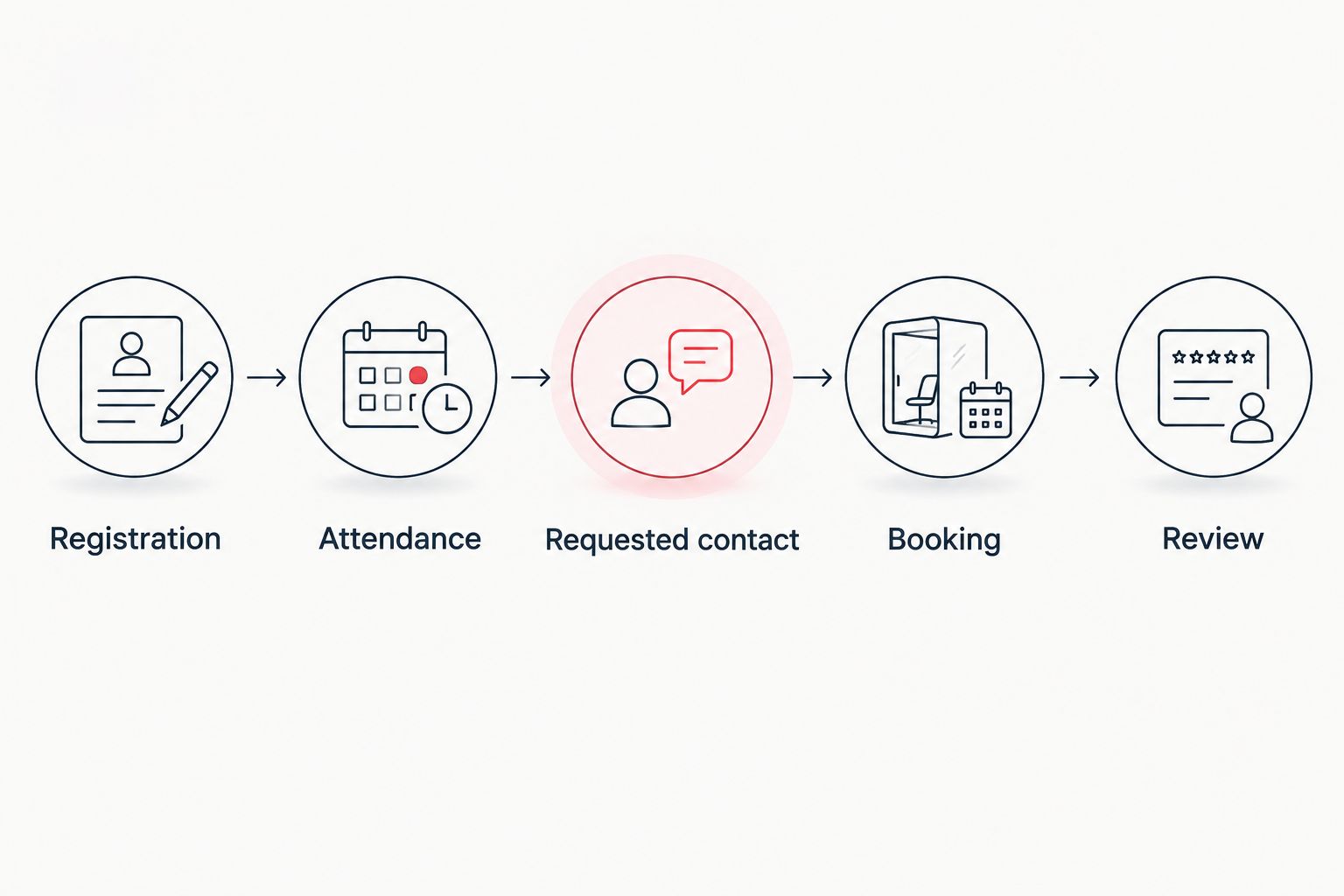 Attendance and requested contact are separate stages, with different follow-up responsibilities.
Keep the process simple enough that staff can maintain it during normal operations. A detailed workflow nobody updates provides less accountability than a short, consistently maintained record.
- Assign owners before attendees arrive.
- Record attendance separately from registration.
- Prioritize people who explicitly requested contact.
- Use approved messages for each follow-up path.
- Record bookings without duplicating existing inquiries.
Measure outcomes and change the next event
Start with the event objective, then work backward through the registration and follow-up records. Compare registrations, attendance, qualified inquiries, and bookings without treating them as interchangeable measures. Document the reason when an inquiry does not progress.
Schedule a 7-day operational review to examine delivery and follow-up, followed by the commercial review within your chosen measurement window. These are planning checkpoints, not industry benchmarks. Ask whether the audience matched the brief, whether the experience answered its questions, and whether staff completed the promised follow-up.
For your 2026 reporting, distinguish attributed bookings from broader customer activity. An attendee who was already in an active sales conversation needs different treatment from a new prospect first introduced through the event. Use consistent attribution rules across events so comparisons remain meaningful.
- Reconcile registration and attendance records.
- Review inquiry quality by promotional source.
- Check follow-up completion with the assigned owners.
- Separate new opportunities from existing conversations.
- Decide what to repeat, change, or stop.
Compare event formats and delivery options
Choose event formats and support models separately. A workshop describes the audience experience; a fractional CMO describes leadership responsibility. Your 2026 plan can combine them without confusing their roles.
| Option | Best for | Main advantage | Key limitation |
|---|---|---|---|
| In-house workshop | Teams with a clear brief and available presenters | Direct control over content and follow-up | Uses staff time across planning, promotion, and delivery |
| Demonstration or introductory session | Prospects evaluating an experience | Shows what participation involves | Requires suitable supervision and clear participation boundaries |
| Partner event | Businesses serving complementary audiences | Combines relevant perspectives in one experience | Requires agreement on audience, responsibilities, and data use |
| Event-production support | Teams needing logistical execution | Concentrates responsibility for event delivery | Production scope does not automatically include marketing strategy |
| Marketing agency | Teams with defined promotional work | Adds campaign execution capacity | Accountability depends on the agreed scope and decision authority |
| Fractional CMO, including Carey Kidd Group | Businesses needing marketing direction and accountability | Establishes priorities across teams and suppliers | Leadership still requires execution capacity |
| In-house marketing director | Businesses requiring ongoing internal management | Provides continuity within the organization | Hiring and management remain the business’s responsibility |
Select support by the responsibility you need filled, not by the broadest service description. Ask who owns the objective, who approves claims, who delivers promotion, and who manages attendee follow-up. Put those answers into the brief before assigning work.
Common mistakes wellness brands make
Treating education as permission to make health claims
An educational format does not remove your responsibility for accurate promotional language. Keep claims consistent across invitations, presenter materials, and follow-up. Refer diagnosis, treatment suitability, and individual clinical questions to qualified professionals rather than answering them through general marketing copy.
Combining participation information with prospecting
Information collected for safe participation serves a different purpose from information collected for marketing. Separate the workflows and access permissions. Do not circulate sensitive participant details through a shared promotional spreadsheet simply because it is convenient for the event team.
Letting attendance conceal weak audience fit
A full session is not evidence that the event reached people suited to your services. Review why attendees came and which next actions they requested. If the event attracts general-interest visitors while your objective requires qualified consultations, change the audience brief before increasing promotional spending.
Asking practitioners to own the entire campaign
A practitioner or instructor can provide subject expertise without owning registration, promotion, tracking, and follow-up. Assign those tasks explicitly. Otherwise, the person responsible for delivering the experience becomes the default owner of work they were never prepared or resourced to handle.
Ending the plan when the room closes
An event without a defined follow-up process leaves commercial responsibility unresolved. Write the next action, owner, and review date before invitations go out. Carry those responsibilities into your 2026 marketing plan rather than treating follow-up as optional administrative work.
FAQ
What is event marketing for wellness brands?
Event marketing for wellness brands uses live experiences to generate qualified inquiries, bookings, and customer relationships. The plan connects audience selection, promotion, event delivery, and follow-up to a defined business objective.
What's the best event format for a wellness business?
The best format is the one that addresses your audience’s decision barrier. Use a demonstration to explain an experience, a workshop to teach a process, or a partner event to combine relevant expertise.
Should a wellness event focus on education or sales?
A wellness event should deliver its advertised experience and offer an appropriate next action. Educational sessions should not become a substitute for private assessment or individualized clinical advice.
Is a fractional CMO better than an event agency?
A fractional CMO fits a leadership need; an event agency fits an execution need within its agreed scope. Compare decision authority, promotional responsibilities, delivery capacity, and follow-up ownership before choosing.
Can Carey Kidd Group help with wellness event marketing strategy?
Carey Kidd Group provides fractional CMO and strategic marketing consulting for businesses in hospitality, events, health/medical, and fitness. The fit is strategic marketing leadership; confirm event-specific responsibilities when defining the engagement.
How do I measure whether a wellness event worked?
Measure the customer action you selected before promotion began. Track registration, attendance, qualified inquiries, and bookings separately, using consistent rules to distinguish new opportunities from existing conversations.
What should I collect on a wellness event registration form?
Collect the information necessary to manage registration and the agreed follow-up. Use a separate appropriate process for sensitive participation information, and explain how attendee information will be used.
One last thing
Write the closing invitation before you write the opening presentation. If you cannot explain the appropriate next action in one clear sentence, the event objective is not ready. Resolve that decision first; it shapes the audience, agenda, staffing, and measurement plan.