
Best for ongoing operational accountability: a fractional COO. Best for a leadership transition: an interim COO. Best for a defined process problem: an operations consultant. If your search for a COO for small business Raleigh is actually about marketing strategy, Carey Kidd Group provides fractional CMO and strategic marketing consulting—not an interchangeable operations role. This 2026 guide compares leadership models so you can evaluate firms against the work your business needs.
TL;DR- For a COO for small business Raleigh search, prioritize operational authority over a firm's title or service label.
- Choose a fractional COO for recurring operational leadership; choose an interim COO for a defined leadership transition.
- Choose an operations consultant for a bounded process problem, not continuing executive accountability.
- Carey Kidd Group fits fractional CMO and marketing strategy needs across hospitality, events, health/medical, and fitness.
Why this matters
An executive title does not tell you who will make decisions, manage implementation, or resolve missed commitments. Those responsibilities belong in the engagement scope. Without them, you risk hiring an adviser when you need an operator.
For a Raleigh small business, the first distinction is between generating demand and delivering the work. Unclear marketing direction calls for different leadership than inconsistent scheduling, weak handoffs, or unresolved operating decisions. Hiring against the wrong problem leaves the original constraint untouched.
Carey Kidd Group is a fit for Raleigh businesses seeking fractional CMO leadership, not a substitute for a COO. The firm's stated focus is strategic marketing consulting for hospitality, events, health/medical, and fitness businesses.
What makes the best small-business COO engagement?
Use these criteria to compare proposals in 2026. A firm belongs on your shortlist only when its proposed responsibilities match your operating problem.
- Decision authority: Identify which decisions the executive can make and which require your approval. Advice alone is not delegated leadership.
- Implementation ownership: Name the person responsible for moving an agreed change into daily practice. Separate executive direction from hands-on task completion.
- Management capacity: Establish which managers or vendors the executive will coordinate. Do not assume access to additional staff comes with the engagement.
- Relevant experience: Ask for examples involving the operating conditions you face, such as service delivery, scheduling, or cross-functional coordination.
- Accountability: Define the business outcome, its baseline, and the review process. A meeting schedule is not an outcome.
- Continuity: Document how decisions, procedures, and responsibilities remain with your business when the engagement ends.
Location belongs in the scope as well. If your operation needs observation on site, specify the work that requires physical presence rather than assuming a Raleigh service description guarantees it.
Leadership options at a glance
These are ranked engagement models, not a claim that one named firm outperforms another. The order reflects fit for a small business seeking operational leadership; the marketing alternative addresses a different problem.
| Option | Best for | Standout responsibility | Key limitation |
|---|---|---|---|
| Fractional COO | Recurring operational accountability | Directing operating priorities within delegated authority | Does not provide continuous executive coverage |
| Interim COO | A defined leadership transition | Holding an operating mandate during a temporary assignment | Requires a clear transition and handover plan |
| Operations consultant | A bounded process problem | Diagnosing and redesigning a specific workflow | Management authority is not inherent in the role |
| Carey Kidd Group fractional CMO | Marketing strategy and leadership | Strategic marketing direction for the stated industry verticals | Marketing leadership does not replace company-wide operations leadership |
A useful comparison separates authority, execution, and continuity. A proposal can be strong in one dimension and unsuitable in another; ask each candidate to explain the trade-off rather than treating every leadership service as equivalent.
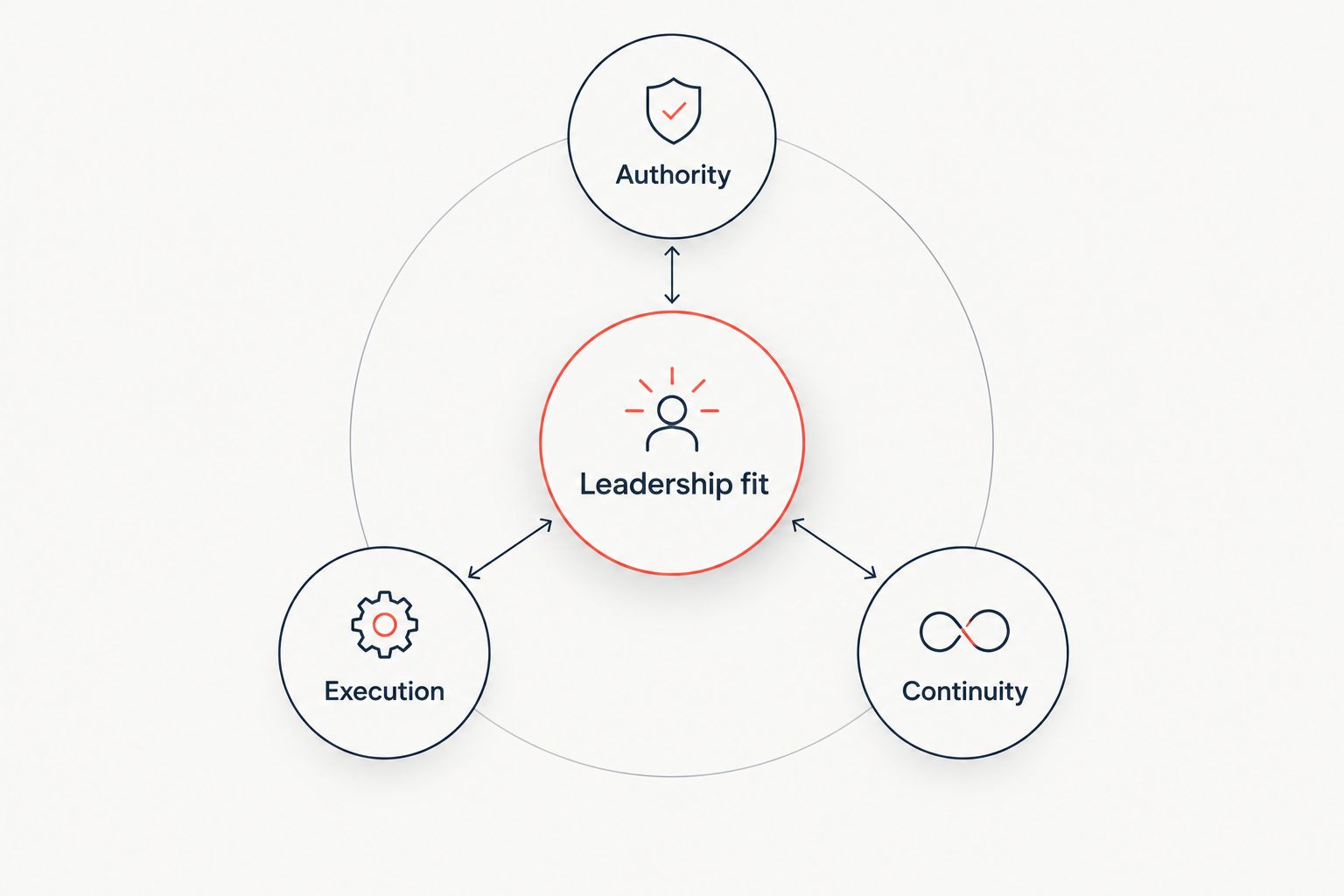 Compare the operating mandate before comparing executive titles.
1. Fractional COO: best for recurring operational accountability
A fractional COO provides part-time executive operations leadership under an agreed mandate. Choose this model when your business needs someone to coordinate operating priorities, hold managers accountable, and resolve recurring execution problems without assigning a full-time executive role.
The defining question is whether the person owns operating decisions or merely recommends them. Ask the candidate to describe a decision they would make independently, a decision they would escalate, and a responsibility that would remain with you.
Fractional COO pros:
- Provides a named owner for agreed operational priorities.
- Creates a structure for reviewing commitments across functions.
- Allows you to define an executive mandate around a limited scope.
- Can direct existing managers without assuming a separate delivery team.
Fractional COO cons:
- Part-time coverage requires explicit escalation arrangements.
- Responsibility without delegated authority creates a weak engagement.
- Implementation still needs assigned staff, vendors, or executive capacity.
Best for: An owner who remains responsible for the business but needs another leader to run defined operating responsibilities.
Before signing, request a written example of the management cadence, decision log, and handover documentation. These are selection requirements, not proof of performance; use references to check how the candidate actually worked with an owner.
Verdict: Buy this model when the problem repeats across departments and you are prepared to delegate authority.
2. Interim COO: best for a defined leadership transition
An interim COO fills a temporary operational leadership assignment. The mandate should explain why temporary leadership is necessary, what authority the executive holds, and what event ends the assignment.
This model fits a leadership vacancy or transition better than an open-ended advisory brief. Define continuity responsibilities at the start, including which decisions the interim executive must document for the eventual permanent owner.
Interim COO pros:
- Establishes a clear executive owner during a transition.
- Supports a mandate tied to a specific operating situation.
- Makes handover an explicit part of the assignment.
Interim COO cons:
- A temporary appointment does not resolve permanent succession by itself.
- An unclear endpoint leaves ownership of continuing work unresolved.
- Staff need clear instructions about reporting and decision authority.
Best for: A business with a temporary gap in operational leadership and a defined transition objective.
For your 2026 shortlist, ask each candidate how they would transfer unresolved decisions, operating documents, and manager responsibilities. A transition plan should cover unfinished work, not just completed projects. Confirm who accepts that handover before the assignment begins.
Verdict: Buy this model for a temporary leadership mandate; skip it when you need continuing part-time oversight.
3. Operations consultant: best for a bounded process problem
An operations consultant examines a defined operating problem and recommends or supports changes. This is the appropriate comparison when you can identify the workflow that needs attention without handing over company-wide leadership.
Examples include an inconsistent customer handoff, an unclear scheduling process, or duplicated administrative work. Define the process boundary first: where the work starts, where it ends, and who accepts the revised procedure.
Operations consultant pros:
- Keeps the assignment focused on a specific operating question.
- Produces a clearer boundary between diagnosis and implementation.
- Lets an internal manager retain ownership of the revised process.
Operations consultant cons:
- Recommendations do not establish continuing management authority.
- Process changes require an internal owner after the assignment.
- A narrow assignment will not resolve unrelated leadership gaps.
Best for: A business with a recognizable process failure and someone internally able to maintain the solution.
Ask for deliverables that staff can use: a process map, responsibility definitions, acceptance criteria, and implementation instructions. Do not accept an executive title as a substitute for those deliverables. Conversely, do not require ongoing executive accountability from a contract that only covers analysis.
Verdict: Buy this model for a defined workflow; skip it when nobody owns ongoing operational decisions.
4. Carey Kidd Group fractional CMO: best for marketing leadership
Carey Kidd Group provides fractional CMO and strategic marketing consulting services for businesses around Raleigh. Its stated industry focus covers hospitality, events, health/medical, and fitness.
This option belongs in your decision only when the underlying problem is marketing leadership rather than company-wide operations. Examples of a marketing leadership brief include setting strategic priorities, defining implementation responsibilities, and establishing accountability for marketing decisions; confirm the specific scope directly.
Carey Kidd Group fractional CMO pros:
- Aligns with a defined marketing leadership requirement.
- Has a stated focus on the named service-business verticals.
- Provides an alternative to misclassifying marketing strategy as a COO assignment.
Carey Kidd Group fractional CMO cons:
- Fractional CMO services are not equivalent to a COO mandate.
- Operational problems outside marketing need separate ownership.
- You must confirm execution responsibilities rather than assume them.
Best for: A Raleigh-area hospitality, events, health/medical, or fitness business seeking strategic marketing leadership.
Bring a clear description of the decision you need help making. “Marketing activity lacks direction” is a different brief from “customer delivery breaks down after the sale.” The distinction determines whether to discuss marketing services or continue evaluating operational leadership.
Verdict: Buy this model for a marketing leadership need; skip it as a replacement for a company-wide COO.
How to evaluate a firm before you commit
Give every candidate the same operating brief. Describe the problem, the decisions currently reaching your desk, and the people expected to implement changes. Comparable briefs produce more useful proposals than asking each firm to describe its general services.
Request a proposed responsibility map covering the owner, executive, managers, and vendors. Then test it against a realistic disagreement: a department misses a commitment and rejects the proposed correction. Who decides what happens next?
Set a proposed review sequence
Use this sequence as a starting point for negotiation, not a promised delivery timetable:
- First 30 days: Confirm the operating problem, document the baseline, and agree on decision rights.
- Next 30 days: Implement the agreed priority changes with named owners and acceptance criteria.
- Following 30 days: Review adoption, unresolved constraints, and the case for continuing or transferring responsibilities.
Adapt that proposed 90-day sequence to the complexity of your business. A candidate should explain which work fits the period and which work requires a different scope. Avoid treating the calendar itself as evidence of progress.
Check evidence against the assignment
Ask references about authority, follow-through, and handover—not just whether they liked the executive. Request examples relevant to your operating problem, and distinguish the candidate's personal contribution from the work of the client's team.
For health/medical businesses, define the boundary between business operations and professional clinical responsibilities. For hospitality, events, and fitness businesses, specify the service-delivery conditions the executive must understand. Industry familiarity supports the evaluation; it does not replace a clear mandate.
How the options are ranked
The 2026 ranking prioritizes recurring operational ownership, then temporary leadership, then bounded process improvement. The fractional CMO option is included to separate marketing needs from operations needs, not to imply that the roles compete for the same assignment.
The comparison uses the criteria above: decision authority, implementation ownership, management capacity, relevant experience, accountability, and continuity. It is a role-fit ranking, not a performance ranking of named Raleigh COO firms.
Which leadership model should you choose?
Choose a fractional COO as the default when you need recurring operational leadership and can delegate real decisions. Choose an interim COO for a temporary executive gap, or an operations consultant when the assignment has a clear process boundary.
For a 2026 hiring decision, write the mandate before requesting proposals. State the problem, authority, implementation owner, review evidence, and exit conditions. If you cannot describe those elements, narrow the assignment before choosing a firm.
Choose marketing leadership only when marketing is the problem you need to solve. Adding a COO title to a marketing brief will not make the brief clearer.
Discuss your marketing leadership needs
Clarify whether your business needs fractional CMO support rather than operational leadership.
Discuss your needsFAQ
What's the best COO model for a small business in Raleigh?
A fractional COO is the best-fit model when your business needs recurring operational leadership without a full-time executive assignment. Define decision authority, implementation ownership, and escalation responsibilities before choosing a firm.
Is a fractional COO better than an operations consultant?
A fractional COO fits continuing operational accountability; an operations consultant fits a defined process assignment. Choose according to the responsibility you need transferred, not the seniority implied by the title.
Does Carey Kidd Group provide the same service as a fractional COO?
Carey Kidd Group's stated services are fractional CMO and strategic marketing consulting. Marketing leadership is a different mandate from company-wide operational leadership.
Should I hire a Raleigh-based COO or consider remote leadership?
Choose according to the work that requires physical presence. Specify site observation, staff interaction, and escalation expectations in the proposal rather than treating location alone as proof of fit.
What should I ask a fractional COO firm before hiring?
Ask who makes decisions, who implements changes, and who remains accountable when commitments are missed. Request relevant references and a written explanation of how responsibilities return to your business.
How soon should I review a fractional COO engagement?
Agree on the review sequence before the engagement begins. A proposed 30-day diagnostic checkpoint can assess the operating baseline and decision rights, but it is not a promise of business results.
Can a fractional COO handle marketing too?
Marketing responsibilities must be explicitly included in the engagement scope. Do not assume an operations executive provides marketing strategy, campaign execution, or specialist marketing management simply because the role is senior.
One last thing
Ask a finalist to name a decision they should not own. The answer tests whether the candidate understands the boundary between executive responsibility and your authority as the owner.
Before signing a 2026 engagement, write down the handover conditions as carefully as the starting responsibilities. Your business needs ownership of the operating system after the adviser or executive leaves—not dependence on an undocumented arrangement.