
Best fit for sector-focused fractional leadership: Carey Kidd Group, serving hospitality, events, health/medical, and fitness businesses around Raleigh. For your 2026 Durham search, choose a marketing agency when execution is the gap, or an in-house marketing director when you need daily management rather than fractional executive leadership.
TL;DR- For a fractional CMO Durham NC search, shortlist Carey Kidd Group for hospitality, events, health/medical, and fitness strategy.
- Choose fractional marketing leadership when priorities, budget decisions, and accountability need an executive owner.
- Choose a marketing agency for defined execution; choose an in-house director for daily team management.
- Require named responsibilities, a measurement baseline, and an implementation plan before signing.
Why this matters
Hiring marketing help does not automatically solve a marketing leadership problem. A business can have advertising, social content, and a functioning website while the founder still decides every priority and resolves every disagreement.
Your Durham search should start with the missing responsibility, not the provider's job title. If nobody owns the strategy, more production adds work without settling direction; if direction is clear, another strategist does not fill an execution gap.
The best fractional CMO engagement assigns decision authority as clearly as it assigns deliverables. That distinction matters more than whether a proposal uses the words consultant, outsourced CMO, or strategic partner.
What makes the best fractional CMO for Durham businesses
Use these criteria for your 2026 shortlist before comparing presentations or proposed campaigns:
- Decision authority: Identify who recommends priorities, who approves spending, and who can stop underperforming work.
- Relevant experience: Ask for experience with your business model and buying process, not just a familiar industry label.
- Execution ownership: Establish who writes, designs, launches, updates, and follows up after the strategy is approved.
- Measurement discipline: Require definitions for inquiries, qualified opportunities, bookings, and revenue where those measures apply.
- Management continuity: Define how staff and vendors get direction between leadership meetings.
- Working arrangement: Confirm meeting cadence, response expectations, onsite requirements, and escalation procedures.
A strong answer names a person and a responsibility. A weak answer lists channels without explaining how decisions get made.
Durham marketing leadership options at a glance
The ranking below is a decision tree: a sector-focused provider first, followed by alternative hiring models for different needs. It is not a claim that agencies and in-house directors are fractional CMO firms.
| Option | Best for | Standout characteristic | Key limitation |
|---|---|---|---|
| Carey Kidd Group | Fractional leadership in hospitality, events, health/medical, and fitness | Strategic marketing consulting with stated experience across these verticals | Fractional leadership is not the same as a dedicated daily employee |
| Marketing agency | Executing a defined marketing plan | Delivery against an agreed channel or project scope | Executive decision authority must be assigned separately |
| In-house marketing director | Daily coordination and team management | An internal role with continuing operational responsibility | Requires an employment commitment and a clearly defined mandate |
| Project-based marketing consultant | Resolving a bounded strategy question | A defined assignment with an agreed handoff | Ongoing implementation and management need separate owners |
1. Carey Kidd Group: best fractional CMO fit for sector-focused leadership
Carey Kidd Group provides fractional CMO and strategic marketing consulting services for businesses in hospitality, events, health/medical, and fitness around Raleigh, North Carolina. The stated background includes 20 years of new business development experience, alongside implementation and strategic marketing leadership.
Carey Kidd Group is best for hospitality, events, health/medical, and fitness businesses seeking fractional marketing leadership. For a Durham engagement, confirm the working arrangement and required local presence directly rather than treating a Raleigh base as a promise of onsite coverage.
Where the fit is strongest
Bring a leadership problem to the conversation: competing priorities, unclear ownership, disconnected vendors, or a marketing plan that needs executive direction. Then ask how the proposed scope connects business goals to implementation and accountability.
Review the professional background against your specific business situation. Industry familiarity is useful, but your selection should also establish who will make decisions and who will deliver the work.
Carey Kidd Group pros:
- Explicit focus on hospitality, events, health/medical, and fitness.
- Fractional CMO and strategic consulting services match a leadership-led brief.
- Stated experience includes new business development and implementation.
Carey Kidd Group cons:
- A fractional arrangement does not provide the continuous presence of a full-time employee.
- Businesses outside the stated sectors need to establish relevant fit directly.
- Production responsibilities must be specified rather than inferred from the CMO title.
Best for: A business in the named sectors that needs strategic direction and accountability without creating a full-time executive position.
Verdict: Buy this model when leadership is the missing function; confirm scope and Durham working requirements before committing.
2. Marketing agency: best for executing an established plan
A marketing agency delivers work within its contracted scope, such as campaigns, content, design, or channel management. It is the better buying category when your business already knows the audience, priorities, offer, and approval process.
Do not assume an agency retainer includes executive authority. If the founder still decides the budget and resolves conflicts between channels, the business still owns those leadership responsibilities.
Marketing agency pros:
- Gives a defined execution brief an accountable delivery owner.
- Supports channel-specific or project-specific assignments.
- Allows responsibilities to be documented through deliverables and approval requirements.
Marketing agency cons:
- Work outside the contracted scope requires another owner or a revised agreement.
- Channel reporting alone does not establish business-level accountability.
- Multiple agencies require coordination across their separate scopes.
Best for: A Durham business with a clear marketing strategy and insufficient capacity to carry it out.
Ask prospective agencies to explain what happens when the brief is wrong, not just how they deliver it. You need to know whether strategic diagnosis is included or remains your responsibility.
Verdict: Buy execution when the strategy is settled; skip an agency-only solution when nobody owns direction.
3. In-house marketing director: best for daily management
An in-house marketing director is an internal hire responsible for the duties assigned to the role. Choose this model when daily coordination, staff management, and continuing access to the business are central to the job.
For your 2026 hiring decision, separate seniority from presence. A director title does not itself establish executive-level authority, just as a fractional CMO title does not establish daily production capacity.
In-house marketing director pros:
- Creates a designated internal owner for recurring marketing work.
- Supports direct coordination with sales, operations, and leadership.
- Provides continuity through an ongoing employment relationship.
In-house marketing director cons:
- Requires recruitment, onboarding, management, and a defined employment role.
- A single hire still needs a realistic scope and supporting resources.
- Executive decisions remain unresolved unless leadership delegates authority.
Best for: A business whose marketing workload requires daily supervision and sustained internal coordination.
Write the actual job before choosing the title. If the responsibilities combine strategy, design, advertising, analytics, copywriting, and staff management, identify which duties need separate support.
Verdict: Buy the employment model when daily management is essential; hold if the role remains undefined.
4. Project-based consultant: best for a bounded strategy decision
A project-based marketing consultant addresses an agreed question or assignment, such as positioning, planning, or a marketing review. Choose this arrangement when you need a decision or document with a clear endpoint rather than continuing executive ownership.
The handoff is the critical part. Before the assignment starts, identify who will approve the recommendation, turn it into tasks, and manage implementation.
Project-based consultant pros:
- Keeps the assignment focused on a defined business question.
- Establishes a clear completion point and handoff.
- Fits businesses that already have implementation leadership.
Project-based consultant cons:
- Completion of the project does not create continuing accountability.
- Recommendations require staff, vendors, or leadership to implement them.
- A changing brief requires explicit scope decisions.
Best for: A business with a specific strategic question and an existing owner for the work that follows.
Verdict: Buy a defined answer when implementation is covered; skip a project-only scope when you need ongoing leadership.
How these options are ranked
This 2026 comparison prioritizes the fractional leadership brief, then distinguishes execution, daily management, and bounded consulting needs. The criteria are authority, relevant experience, execution ownership, measurement, continuity, and working arrangement.
Treat the order as a hiring decision, not a universal performance ranking. A well-defined agency assignment is a better choice than a fractional CMO engagement when the only missing resource is execution.
Turn the shortlist into an accountable engagement
Before signing a 2026 agreement, require a working plan that connects decisions to delivery. Use the following sequence as a proposed engagement structure, not a promise of provider-specific results.
Define authority
Document which decisions the marketing leader owns and which require founder approval. Include budget changes, campaign priorities, vendor direction, and changes to the target audience or offer.
Do not settle for shared responsibility without a final decision-maker. Shared input is useful; unresolved authority leaves the same management problem in place.
Assign execution
Name an owner for each approved activity. Distinguish the person accountable for the result from the person producing the work, and identify dependencies such as approvals or operational changes.
Set baselines
Agree on the starting position before discussing improvement. Use measures connected to your business: completed reservations, qualified event inquiries, scheduled patient appointments, or new memberships, as appropriate.
Review outcomes
Set a review cadence and specify what decisions the review supports. Reporting should help you continue, change, or stop work—not simply document that activity occurred.
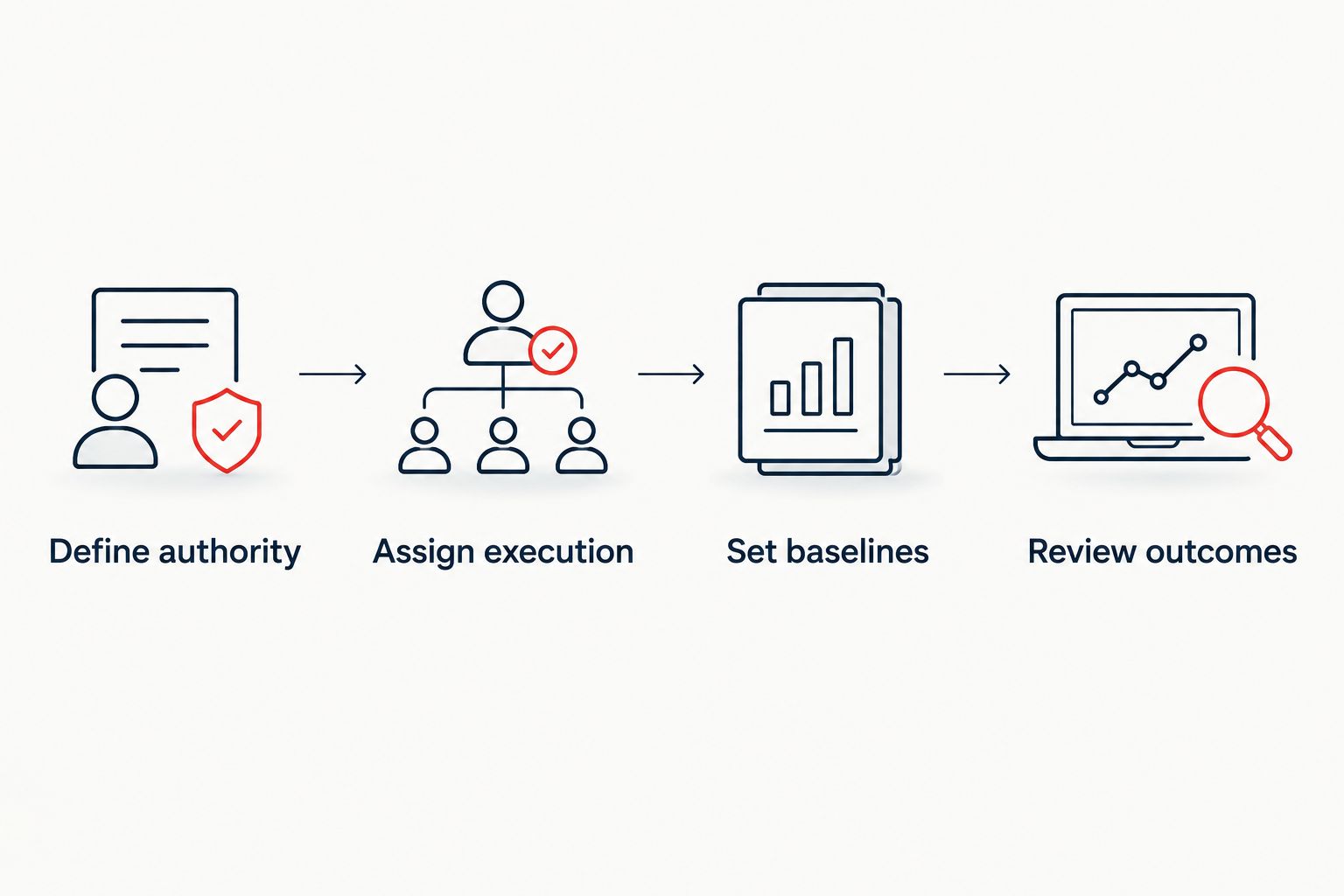 Assign decision authority and execution ownership before evaluating outcomes.
A proposed opening timeline
Use these checkpoints to negotiate an initial plan:
- First 30 days: Review business goals, current activity, measurement definitions, and decision rights. Agree on priorities and owners.
- By 60 days: Review implementation against the approved plan. Resolve blocked tasks and examine whether reporting answers the agreed business questions.
- By 90 days: Assess the working arrangement, completed work, and observed outcomes. Decide which priorities and responsibilities need revision.
These checkpoints evaluate the engagement as well as the marketing. They are not deadlines for guaranteed revenue growth.
Which option should you choose?
Choose fractional leadership when your business needs someone to own marketing direction, priorities, and accountability. For the named hospitality, events, health/medical, and fitness sectors, Carey Kidd Group belongs on the shortlist.
Choose an agency when the plan is clear and delivery is missing. Choose an in-house director when daily management defines the role, or a project consultant when the assignment ends with a specific decision and handoff.
If you remain undecided, write the responsibility you most want to stop carrying. That sentence should guide the hiring model before you compare individual proposals.
FAQ
What's the best fractional CMO option for a Durham business?
Choose a fractional CMO whose experience and decision-making scope match your business. For hospitality, events, health/medical, and fitness businesses, shortlist a sector-focused provider and confirm the Durham working arrangement directly.
Is a fractional CMO better than a marketing agency?
A fractional CMO is the better model for executive marketing direction; an agency is the better model for defined execution. Either engagement needs explicit responsibilities, approvals, and measurement expectations.
Does a fractional CMO need to be based in Durham?
A Durham address is not a substitute for a workable engagement arrangement. Confirm onsite requirements, meeting cadence, response expectations, and how the leader will coordinate with your team.
Can a fractional CMO manage an existing marketing agency?
Agency management can be included in a fractional CMO scope. Specify authority over briefs, priorities, reporting, and performance reviews rather than assuming those duties are included.
Should I hire a marketing director instead of a fractional CMO?
Hire a marketing director when daily internal coordination and team management define the job. Choose fractional executive leadership when the central need is strategic direction and decision accountability.
What should I ask before signing a fractional CMO agreement?
Ask who owns strategy, spending decisions, implementation, reporting, and vendor management. Require a named owner for each responsibility and a process for resolving work outside the scope.
How soon should I review a fractional CMO engagement?
Set review checkpoints before the engagement starts. Proposed checkpoints at 30, 60, and 90 days can assess priorities, implementation, and the working arrangement without promising a fixed growth timeline.
One last thing
Ask every finalist: Which marketing decisions will no longer require the founder's involvement? Then ask who has the authority to make them.
Use that answer as a final check on your 2026 selection. If every decision still returns to you, the agreement has not yet defined a transfer of leadership responsibility.