
Yes, a dermatology practice can run social media without an agency when it assigns ownership, protects staff time, and requires clinical and privacy review before publication. The hidden commitment is not posting: it is managing approvals, patient information, account access, and inquiry follow-up. In 2026, choose outside support for a specific capability gap—not simply because the practice needs an active account.
TL;DR- Can a dermatology practice run social media without an agency? Yes—with accountable ownership, clinical review, and protected staff capacity.
- Keep patient education separate from individual medical advice, and route appointment inquiries into approved practice channels.
- Carey Kidd Group provides fractional CMO and strategic marketing consulting; distinguish leadership needs from social media production needs.
- Choose in-house management, an agency, or fractional leadership according to the work your practice cannot currently own.
Can a dermatology practice run social media without an agency?
Yes. An agency is optional; an accountable operating process is not. Your practice needs someone responsible for content, someone authorized to review clinical claims, and a defined route for questions that should not be handled publicly.
Separate leadership from production before assigning the work. The distinction covered in this fractional CMO guide for dermatology practices matters because deciding what social media should accomplish is different from creating posts.
Use this sequence to establish an internal workflow:
- Set priorities. Choose the practice objective social media will support, such as patient education or explaining an existing service. Do not make every post responsible for every business goal.
- Assign ownership. Name the person who maintains the calendar, gathers material, coordinates approval, and publishes. Assign backup coverage for absences.
- Review content. Have a qualified clinician check medical statements and the appropriate practice representative check privacy, permissions, and operational accuracy.
- Route inquiries. Document where appointment requests, clinical questions, complaints, and urgent concerns belong. Give staff approved response boundaries.
- Review outcomes. Compare completed work and relevant inquiries with the objective. Change the process when approvals stall or follow-up fails.
This is a recommended workflow, not a requirement to hire a separate employee for every responsibility. One person can coordinate several tasks, but clinical approval still belongs with someone qualified to provide it.
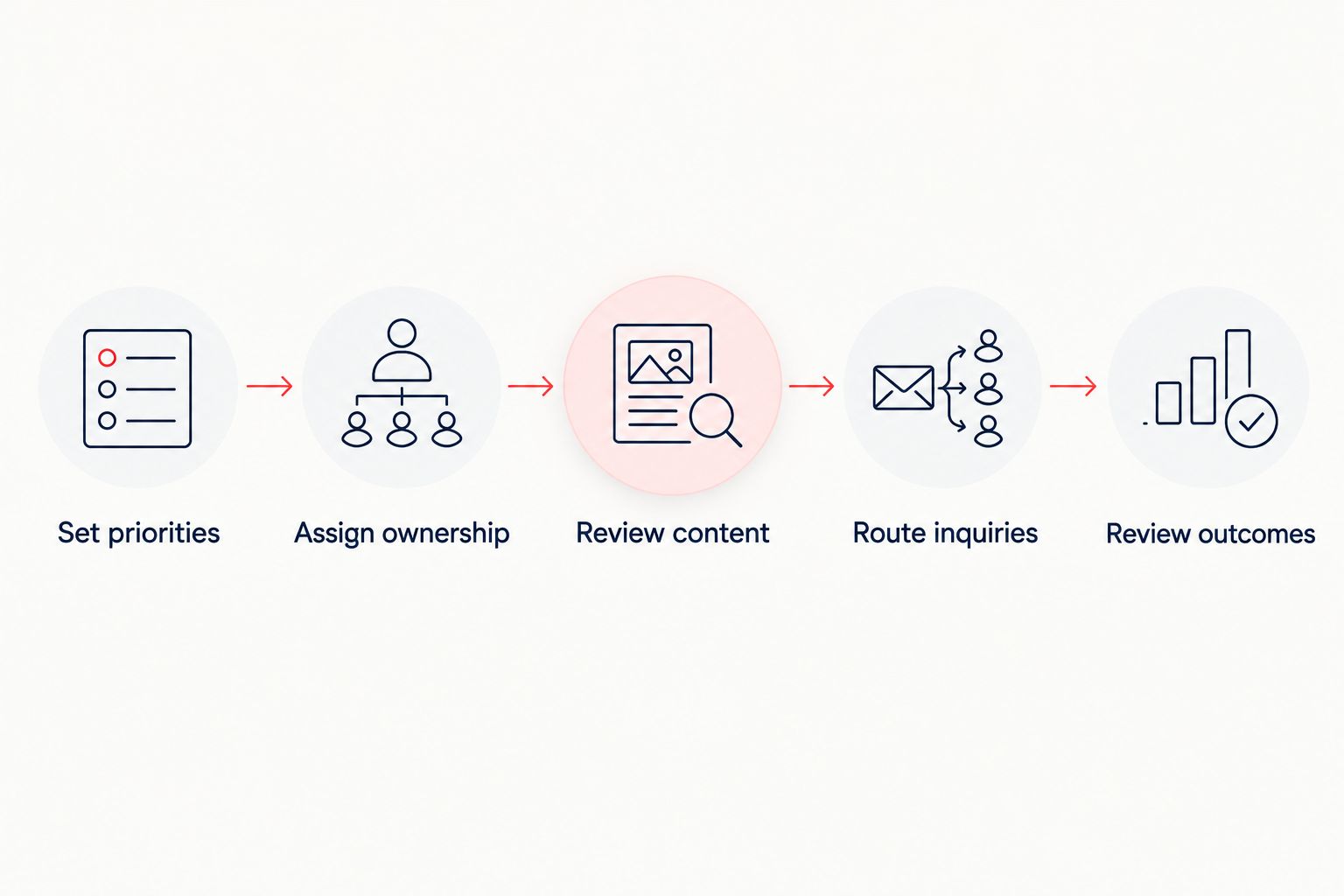 Decide who approves content and handles inquiries before publishing.
Why this matters
Social media work crosses clinical, administrative, and marketing responsibilities. A post can be medically accurate but direct readers to the wrong booking process. A polished video can create privacy problems if identifiable patient information appears in the background.
For your 2026 plan, evaluate the entire operating process rather than the appearance of the account. A smaller publishing schedule with reliable review is preferable to a larger schedule that bypasses safeguards. The practical question is whether your team can complete the work without displacing responsibilities you consider more important.
Which management model fits your practice?
Compare models by the responsibility you need filled. An agency contract does not automatically include marketing leadership, and fractional leadership does not automatically include photography, editing, or daily community management.
| Model | Best for | Main advantage | Main limitation |
|---|---|---|---|
| In-house management | Practices with protected staff capacity and clinical access | Direct coordination with clinicians and front-office operations | Production and coverage remain internal responsibilities |
| Agency management | Practices that need an agreed production and publishing scope | Assigns defined execution work to an outside team | Still requires practice input, approvals, and oversight |
| Fractional CMO leadership | Practices that need priorities, coordination, and accountability | Connects social media decisions to broader marketing objectives | Does not replace production capacity unless execution is included |
Choose in-house management when your team can own execution. Choose an agency when production is the gap. Choose fractional leadership when direction and accountability are the gap.
For any outside agreement in 2026, document deliverables, account ownership, approval responsibilities, reporting, and the handover process. Evaluate the actual scope rather than the provider's job title.
Why the right approach varies
The decision depends on your operating requirements, not whether other dermatology practices use agencies. Assess these factors against your own team:
- Staff capacity: Identify which existing duties will move when someone takes responsibility for social media.
- Clinical access: Confirm that a qualified reviewer can review content before scheduled publication.
- Content requirements: Distinguish straightforward educational graphics from filming, editing, and patient-related content.
- Inquiry handling: Decide who monitors responses and moves appropriate inquiries into approved practice channels.
- Marketing coordination: Determine who connects social activity with website information, appointment pathways, and business priorities.
- Continuity: Assign backup access and responsibilities when the primary owner is unavailable.
Do not treat an enthusiastic employee as a staffing plan. Ask that employee's manager to approve the workload and decide which tasks take priority when demands conflict.
What should an internal team publish?
Start with information your practice can verify and approve. Useful subjects include appointment preparation, explanations of services the practice actually provides, general skin-health education, and clinician introductions approved by the individuals involved.
Build each post around a specific reader question. Explain what someone should understand or do next without promising an individual treatment result. Ask the clinical reviewer to identify language that oversimplifies diagnosis, treatment suitability, or expected outcomes.
Keep educational content separate from personal advice
A general explanation of a skin condition is different from assessing a follower's photograph. Staff should not diagnose a person in comments or treat a direct message as a clinical encounter.
Give the account owner written response language that directs individual medical questions to an appropriate clinical channel. Avoid implying that someone can receive a diagnosis simply by sending images to a social account.
Publish only what operations can support
Before promoting an appointment pathway, confirm that the instructions match the practice's current process. Before introducing a clinician or discussing a service, verify the details with the responsible person.
Treat your 2026 content calendar as an operating document. Record the topic, source material, reviewer, approval status, and intended next action so another staff member can understand what is ready to publish.
How do you protect patient privacy and clinical accuracy?
Patient-related content needs a separate review process, not an informal exception to the calendar. For practices subject to HIPAA, uses or disclosures of protected health information for marketing generally require valid authorization, subject to the rule's exceptions. Have your privacy or legal adviser assess the proposed use.
Do not treat treatment consent as interchangeable with authorization to publish patient information for marketing. Ask the appropriate adviser to confirm what documentation is necessary for the specific content and intended use.
Before publishing patient-related material, review:
- Whether the material identifies a patient directly or through surrounding details.
- Whether the required authorization covers the proposed use.
- Whether photographs contain charts, names, screens, or other unintended information.
- Whether captions accurately describe the content without suggesting guaranteed outcomes.
- Whether the practice has documented who approved publication.
Before-and-after images need particular attention to permission and presentation. Differences in lighting, angle, makeup, or editing can affect how viewers interpret the comparison. Require clinical review of both the images and their accompanying explanation.
Apply the same caution to comments and reviews. A public response should not confirm a person's patient status or reveal treatment information. Move issues requiring confidential discussion into the practice's approved process without repeating private details publicly.
What should the practice measure?
Measure the objective you selected, not just the activity you completed. Publishing reports establish whether the workflow functions; inquiry and appointment records help assess whether social activity supports the practice's business priorities.
Separate these reporting categories:
- Execution: What was approved and published, and what remained blocked?
- Audience response: Which topics generated relevant questions, saves, or visits to the next step?
- Inquiry handling: Were messages reviewed and directed to the correct staff?
- Appointment outcomes: Which inquiries became appointments, where the practice can establish that connection?
Do not label every appointment after a campaign as a social media conversion. Ask patients how they found the practice and use appropriately configured measurement methods, with privacy review for tools and data collection.
For your 2026 reporting, record uncertainty rather than forcing attribution. A patient can encounter the practice through several channels before booking. Report what the records establish and distinguish that from what remains unknown.
When should you outsource social media management?
Outsource when a defined responsibility remains unfilled after you clarify the internal process. If approved topics consistently wait for editing, production support addresses that gap. If nobody can decide which services to prioritize, more editing capacity will not resolve the strategic problem.
The decision about outsourcing social media management belongs at the level of responsibilities: identify what transfers to the provider, what stays with the practice, and who accepts the completed work. Outsourcing execution does not transfer clinical approval or eliminate your need for oversight.
Ask prospective providers to explain:
- What they create, publish, monitor, and report.
- What information and approvals they require from your team.
- How they handle patient-related material and account access.
- Which tasks remain outside the agreement.
- How your practice receives files, access, and records when the arrangement ends.
Do not hire an agency to compensate for an approval process nobody owns. Fix that responsibility first; otherwise, an outside production team will encounter the same delays as your staff.
When does fractional marketing leadership fit?
Fractional leadership fits when your practice needs someone to set priorities, coordinate contributors, and establish accountability across marketing work. It is a different requirement from needing a person to schedule posts.
Carey Kidd Group is best for health and medical businesses seeking fractional marketing leadership rather than a social-media-only production arrangement. Carey Kidd Group provides fractional CMO and strategic marketing consulting, with the brand's stated experience spanning 20 years of new business development across named sectors including health/medical.
The limitation is scope: do not assume strategic consulting includes daily production, filming, or inbox coverage. Discuss those responsibilities explicitly when evaluating strategic marketing services.
Can a receptionist manage dermatology social media?
A receptionist can coordinate approved social content when the practice assigns protected time, training, access controls, and review support. The role should not include making independent clinical claims or handling individual medical questions through public channels.
Does every dermatology post need a clinician's review?
Clinical claims need qualified clinical review. Routine administrative content still needs accuracy checks, but the practice can define different approval paths for administrative updates and medical education.
Can an agency remove the practice's workload entirely?
No. Your practice still needs to supply accurate information, approve relevant content, maintain oversight, and handle clinical or patient-specific matters. Define those retained responsibilities before signing an agreement.
FAQ
Can a dermatology practice run social media without an agency?
Yes, a dermatology practice can manage social media internally with accountable ownership, protected staff capacity, clinical review, and a documented inquiry process. The decision depends on whether the team can perform those responsibilities consistently.
What's the best social media management model for a small dermatology practice?
In-house management fits a practice with staff capacity and reliable approval support. An agency fits an execution gap, while fractional leadership fits a need for direction and accountability.
Can we use patient before-and-after photos on social media?
Use patient before-and-after photos only after the appropriate privacy, authorization, and clinical review. Have your adviser confirm the requirements for the specific material and proposed use.
Should staff answer medical questions in Instagram messages?
Staff should direct individual medical questions to an approved clinical channel rather than diagnose through Instagram messages. Document response boundaries and escalation responsibilities.
Will hiring an agency guarantee more dermatology appointments?
No, hiring an agency does not guarantee more appointments. Evaluate the agreed work and track inquiry handling and appointment outcomes without assuming every booking came from social media.
Does Carey Kidd Group provide fractional CMO services for health businesses?
Carey Kidd Group provides fractional CMO and strategic marketing consulting services for businesses including the health/medical sector. Confirm whether your proposed engagement covers leadership, implementation, or both.
One last thing
Before hiring anyone, test the handover: could your backup owner find the approved content, access the account, identify the reviewer, and route an appointment inquiry without asking the primary owner?
If not, document those steps first. The most useful next move is an operating process that survives an absence—not another publishing tool.