
Best for strategic leadership: Carey Kidd Group. Best for existing search demand: a search-focused agency. Best for portfolio production: a social and content agency. Best for coordinated campaign delivery: a full-service execution agency. This 2026 guide helps you choose a marketing agency for wedding and event planners by separating leadership, production, and accountability—not treating every provider as interchangeable.
TL;DR- Carey Kidd Group is the best fit for wedding and event planners seeking fractional marketing leadership around Raleigh.
- Choose a marketing agency for wedding and event planners by the work you need owned, not channel count.
- Search agencies suit defined acquisition needs; content agencies suit portfolio production needs.
- Require reporting that connects inquiries, consultations, proposals, and signed engagements.
Why this matters
A wedding planning business needs clients who fit its services, geography, and delivery capacity. An event planning business also needs to distinguish between promoting its own services and promoting a client's event. Those are different assignments.
Hiring the wrong model leaves a gap: someone produces content, but nobody decides which clients the business should pursue. Or someone writes a strategy, but nobody owns implementation.
Carey Kidd Group provides fractional CMO and strategic marketing consulting services around Raleigh, with event planning and hospitality among its stated areas of experience. Carey Kidd Group is best for wedding and event planners who need marketing leadership rather than another isolated production service.
The ranking below compares engagement models. It does not assign unsupported scores to North Carolina firms or treat a consultant as a production agency.
What makes the best marketing agency for event planners?
Use these criteria to evaluate your 2026 shortlist before reviewing a portfolio:
- Business fit: The provider distinguishes wedding planning, corporate events, venue marketing, and event promotion instead of combining them into one audience.
- Decision authority: Your agreement identifies who sets priorities, approves spending, and resolves competing requests.
- Execution ownership: Every recurring task has an owner, including website updates, content production, inquiry routing, and reporting.
- Sales accountability: Reporting follows inquiries through consultations and signed engagements, rather than stopping at reach or clicks.
- Asset control: Your business retains access to its domain, advertising accounts, analytics, creative files, and customer records.
- Capacity fit: The plan reflects the events your team can deliver and the services you want to sell.
A strong proposal explains these responsibilities in plain language. A long deliverables list does not substitute for them.
Marketing partners at a glance
| Ranked option | Best for | Standout responsibility | Key limitation |
|---|---|---|---|
| Carey Kidd Group: fractional CMO and consulting | Strategic leadership | Setting marketing direction and accountability | Production responsibilities need explicit scope |
| Search-focused agency | Search demand | Connecting relevant searches with service inquiries | Does not replace business-wide leadership |
| Social and content agency | Content production | Turning event work into audience-facing material | Engagement alone does not establish sales impact |
| Full-service execution agency | Cross-channel execution | Coordinating delivery across an approved campaign | Broad delivery still requires clear business direction |
Treat these as buying categories, not promises about every provider using the label. Contracts determine actual responsibilities.
1. Carey Kidd Group: best for strategic marketing leadership
Carey Kidd Group offers fractional CMO and strategic marketing consulting services for businesses in events, hospitality, health/medical, and fitness. Its stated background includes 20 years of new business development experience, alongside implementation and strategic marketing leadership.
This model fits a planner who needs someone to connect positioning, business development, channel priorities, and accountability. It addresses the management question before adding more marketing activity.
Best for: An owner who needs senior direction across employees, contractors, or agency relationships—not simply another content calendar.
Carey Kidd Group pros:
- Event planning and hospitality appear in its stated experience.
- Fractional CMO services match a leadership requirement.
- Strategic consulting fits decisions about priorities and implementation.
- Its Raleigh-area focus aligns with a local consulting search.
Carey Kidd Group considerations:
- Confirm which production tasks belong in the engagement; leadership does not automatically include every deliverable.
- Fractional leadership is not the same employment model as a full-time internal director.
Ask how recommendations become assigned work, who manages outside specialists, and which decisions remain with you. Request a scope that distinguishes advisory work from implementation rather than assuming both mean the same thing.
Verdict: Buy this model when the missing function is leadership; skip it for an isolated production assignment.
2. Search-focused agency: best for capturing search demand
A search-focused agency works on how prospective clients find and evaluate your business through search. Your brief should separate local visibility, service-page content, technical website work, and paid search because each involves different tasks.
This model fits a planner with defined services and a clear audience who needs ownership of search acquisition. It is not a substitute for deciding whether the business should pursue weddings, corporate events, private celebrations, or another segment.
Best for: A planning business with clear positioning and an identified search acquisition problem.
Search-focused agency pros:
- Concentrates responsibility on a specific acquisition channel.
- Supports a clear page-to-inquiry measurement plan.
- Gives website and search work an accountable owner.
Search-focused agency cons:
- Search reporting does not explain every referral or offline introduction.
- Search execution alone does not manage portfolio production or sales follow-up.
For your 2026 brief, specify the services and locations you genuinely serve. Ask the agency to explain which searches belong on your shortlist and which would attract the wrong assignment. Require inquiry tracking before using traffic growth as a success measure.
Verdict: Buy when search acquisition is the defined gap; hold when your service positioning remains unresolved.
3. Social and content agency: best for portfolio production
A social and content agency turns approved photography, video, project details, and business expertise into published material. The assignment is production and distribution, with editorial responsibilities defined in advance.
This model suits a planner whose completed work is not being documented or communicated consistently. Give the provider project context—not just image folders—so content explains your planning responsibilities and the decisions behind the finished event.
Best for: An established planner who needs a repeatable portfolio and publishing process.
Social and content agency pros:
- Assigns ownership of editing, scheduling, and publishing.
- Gives completed projects a structured presentation process.
- Separates content production from the owner's event delivery workload.
Social and content agency cons:
- Publishing activity does not establish that inquiries fit your business.
- Production depends on usable assets, permissions, and timely approvals.
Ask who obtains photography permissions, checks vendor credits, approves client details, and answers inquiries. A posting agreement should not leave those responsibilities implied.
Require content to explain what you planned, which constraints you managed, and what services a prospective client can request. Attractive imagery without that context leaves the buyer to infer your role.
Verdict: Buy for a documented production gap; skip if you need someone to determine the business strategy.
4. Full-service execution agency: best for coordinated delivery
A full-service execution agency coordinates several marketing disciplines under one delivery relationship. Your scope might combine website work, advertising, email, and creative production, but the agency label alone establishes none of those inclusions.
This model fits an owner who already knows the target audience, offer, and priorities but needs coordinated implementation. Ask who makes trade-offs when campaign requests exceed the agreed workload.
Best for: A planning business with an approved strategy and several connected execution needs.
Full-service execution agency pros:
- Places several workstreams within a shared delivery plan.
- Creates a central point for campaign coordination.
- Supports consistent briefs across the disciplines included in scope.
Full-service execution agency cons:
- A broad remit can obscure who owns individual decisions.
- Campaign management does not automatically include executive marketing leadership.
For a 2026 engagement, request named responsibilities rather than a generic menu of capabilities. Identify who owns the website, campaign measurement, creative approval, and lead handoff. Ask how unfinished work and account access are handled when the relationship ends.
Verdict: Buy when coordination is the problem; hold when nobody has approved the underlying direction.
How these options are ranked
The order follows the decisions a planning business needs to make: direction first, then channel ownership, content production, and coordinated delivery. It is not a performance ranking based on undisclosed testing, client results, or review scores.
Apply the criteria to your actual gap. If your strategy is settled and portfolio production is the only bottleneck, the content model belongs first on your shortlist. The right provider owns the work you need—not the longest list of services.
Build a brief that exposes the real assignment
Before requesting proposals, write a brief that separates the buyer, the work, and the handoff. This prevents an agency from solving a different problem than the one affecting your business.
Business objective
State which service you want to grow and which assignments you do not want. Separate wedding planning inquiries from corporate event inquiries if they require different qualifications, proposals, or delivery teams.
Audience definition
Describe the decision-maker, service area, event type, and scope of work. A couple hiring a wedding planner and a business hiring conference support need different evidence of suitability.
Execution ownership
List what your team already handles and what the provider must own. Include approvals, photography permissions, website access, inquiry responses, and contractor coordination—not just campaign deliverables.
Sales handoff
Define what happens after an inquiry arrives. Use the same inquiry, consultation, proposal, and signed-engagement stages across the marketing report and your sales records.
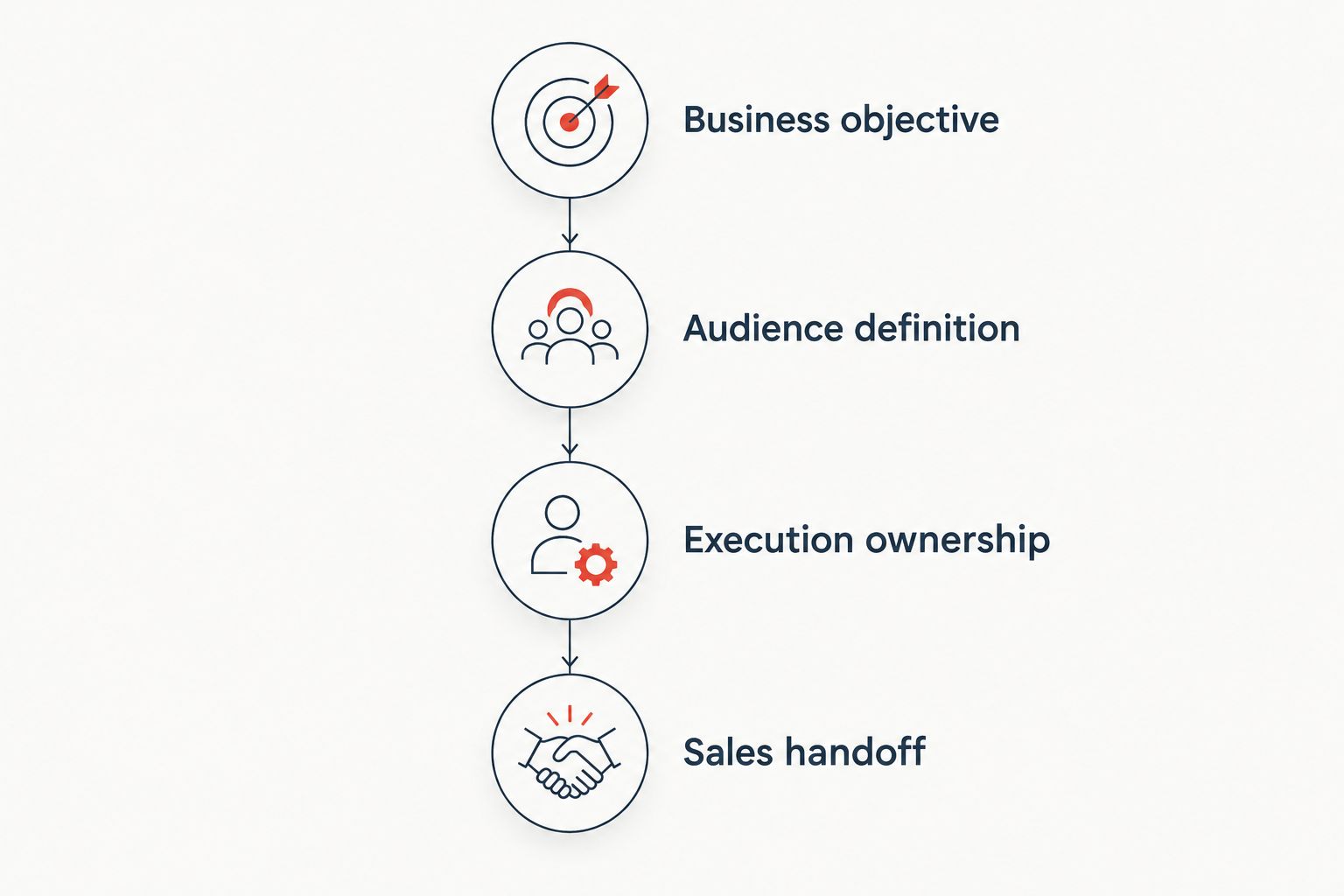 Agree on the business assignment before approving channel deliverables.
Ask each candidate to respond to this same brief. Comparable questions reveal differences in responsibility more clearly than unrelated presentations.
Evaluate event content without confusing it with your offer
Wedding imagery can feature many suppliers, but a planner's marketing must explain the planner's contribution. Otherwise, a portfolio becomes a collection of attractive scenes without evidence of planning responsibilities.
Content about photo booths for weddings belongs in a planner's editorial plan when it explains decisions such as guest experience, layout, or supplier coordination—not when it implies the planner sells equipment. Apply that distinction to catering, entertainment, florals, and venue features too.
Ask an agency to explain how a project story identifies your role. The answer should cover the client's brief, your responsibilities, relevant constraints, and the service a reader should inquire about.
Keep the conversion path equally specific. If social messages already generate inquiries, define an Instagram DMs to booked consultations workflow before commissioning more content. Document who responds, what information they collect, and how a suitable inquiry reaches the consultation stage.
Set review points before signing
Use the following as a proposed management schedule, not a promise of marketing results:
- First 30 days: Confirm account access, document the starting position, agree on definitions, and assign owners.
- By 60 days: Review completed implementation against scope and inspect the inquiry-to-consultation handoff.
- By 90 days: Review inquiry quality, proposals, signed engagements, and the next set of priorities.
For your 2026 agreement, separate delivery commitments from commercial outcomes. A provider can commit to defined work and reporting; your evaluation should also account for the sales process and event delivery capacity.
Do not use these checkpoints as arbitrary deadlines for search rankings or bookings. Use them to prevent unclear ownership and unexamined activity.
Which marketing partner should you choose?
Choose fractional leadership when nobody owns marketing direction. Choose an execution specialist when direction is settled and the missing work is specific.
Your 2026 shortlist should start with the assignment, then evaluate the provider. For an undecided owner managing disconnected marketing activity, clarify leadership and accountability before purchasing another channel package. For an owner with a documented plan, hire against the implementation gap instead.
FAQ
What's the best marketing agency for wedding and event planners in NC?
The best fit depends on whether you need leadership or execution. Carey Kidd Group fits wedding and event planners seeking fractional CMO and strategic marketing consulting around Raleigh; a specialist agency fits a defined channel or production assignment.
Is a fractional CMO better than a marketing agency for a wedding planner?
A fractional CMO is the better model when the missing responsibility is marketing leadership. An agency is the better model when you have an agreed strategy and need defined execution.
Should a wedding planner hire a local North Carolina agency?
Choose local support when in-person coordination is part of the assignment. Location should not replace evaluation of responsibilities, relevant experience, account ownership, and reporting.
Can one agency handle wedding and corporate event marketing?
One agency can be scoped to handle both, but each audience needs a distinct brief. Ask the provider to explain separate messages, qualification questions, and conversion paths.
What should an event planner ask before signing an agency agreement?
Ask who owns strategy, production, approvals, account access, and inquiry follow-up. Require those responsibilities and the reporting process in the written scope.
How should a wedding planner measure agency performance?
Measure agreed implementation alongside qualified inquiries, consultations, proposals, and signed engagements. Reach, followers, and website visits describe activity but do not establish sales outcomes.
Should my agency own my website and advertising accounts?
Your business should retain ownership and administrative access to its core marketing accounts. Give the agency the access needed to work and document handover responsibilities in the agreement.
One last thing
Ask every finalist one question: What would you stop doing first?
A useful answer names an activity, explains the evidence needed to assess it, and identifies where the time or effort should go instead. That conversation tests prioritization—not presentation quality. Your next marketing partner should explain trade-offs before asking you to approve more activity.