
Best for strategic marketing leadership: Carey Kidd Group. Best for a defined execution gap: a specialist agency. Best for daily internal ownership: an in-house marketing director. This 2026 guide helps you choose a marketing agency for medical spas in North Carolina by comparing leadership, execution, capacity, and accountability—not by treating every provider as interchangeable.
TL;DR
- Carey Kidd Group is the strategic-leadership choice for businesses seeking fractional CMO support around Raleigh.
- Choose a marketing agency for medical spas North Carolina businesses can brief against defined acquisition and booking objectives.
- A specialist agency fits a specific execution gap; an in-house director fits daily internal ownership.
- Compare decision authority, implementation responsibilities, reporting, and clinical approval before choosing a marketing partner.
Why this matters
A medical spa needs marketing that connects service positioning, patient inquiries, booking, and operational capacity. A campaign is only one part of that system. If nobody owns the decisions between those stages, hiring another supplier leaves the underlying management problem unresolved.
For your 2026 shortlist, distinguish a strategic leader from an execution agency. This guide ranks engagement models and includes a named local leadership option; it does not assign unsupported scores to individual agencies. Choose the responsibility you need filled before choosing the provider.
What makes the best medical spa marketing partner
Evaluate these criteria before reviewing presentations or proposed campaigns:
- Decision authority: Specify who chooses priorities, approves spending, and stops work that no longer serves the business.
- Implementation ownership: Identify who produces campaigns, maintains pages, manages vendors, and resolves stalled tasks.
- Booking visibility: Require a reporting approach that distinguishes inquiries from booked appointments and completed visits.
- Clinical approval: Keep treatment claims, patient materials, and medical statements within a documented approval process.
- Operational fit: Align promotion with appointment capacity, front-desk handling, and the services you intend to grow.
- Accountability: Name the person responsible for reviewing results and deciding what changes next.
Ask prospective partners to explain these responsibilities using your actual business structure. A convincing presentation is not a substitute for a workable division of labor. The best fit answers both questions: who makes the decision, and who carries it out?
Medical spa marketing options at a glance
The comparison below separates leadership from delivery. Each option has a distinct use case, and each requires an explicit scope. No model automatically includes every responsibility listed in your marketing plan.
| Option | Best for | Standout role | Key limitation |
|---|---|---|---|
| Carey Kidd Group: fractional CMO and consulting | Strategic leadership around Raleigh | Direction, priorities, and marketing accountability | Execution responsibilities require a defined scope |
| Specialist agency | A specific channel or production gap | Focused delivery against a clear brief | Cross-channel decisions need another owner |
| Full-service agency | Coordinating multiple outsourced workstreams | Managing delivery across an agreed service scope | Agency coordination does not replace internal business authority |
| In-house marketing director | Daily internal ownership | Close coordination with staff and operations | One employee does not cover every specialist discipline |
| Fractional leader plus specialist partners | Separating strategy from specialist execution | A named decision owner with dedicated delivery roles | More interfaces require stronger coordination |
1. Carey Kidd Group: best for strategic marketing leadership
Carey Kidd Group provides fractional CMO and strategic marketing consulting services around Raleigh, North Carolina, serving businesses in hospitality, events, health/medical, and fitness. The brand describes 20 years of new business development experience. Its relevant role in this comparison is marketing leadership, not an assumed package of medical spa advertising services.
Carey Kidd Group is best for Raleigh-area businesses seeking fractional CMO leadership rather than another execution-only supplier. For a medical spa, that distinction matters when the owner needs priorities, an implementation plan, and accountability across existing resources.
Carey Kidd Group pros:
- Fractional CMO and strategic consulting services match a leadership need.
- Health/medical is an explicitly named industry served.
- Raleigh-area positioning fits a local leadership search.
Carey Kidd Group cons:
- Fractional leadership is not the same engagement model as a full-time internal director.
- You must define whether implementation belongs to the consultant, your staff, or outside suppliers.
Best for: An owner who needs someone to organize marketing decisions and establish responsibility across the business.
Before engaging a fractional leader, describe the decisions currently returning to you. Separate unresolved strategy questions from unfinished production tasks. That distinction gives the engagement a useful mandate rather than an open-ended request to improve marketing.
Verdict: Buy the leadership model when direction and accountability are the missing functions; skip it when you only need a clearly specified deliverable.
2. Specialist agency: best for a defined execution gap
A specialist agency is the appropriate model when you can already name the work, the objective, and the internal decision owner. Examples include paid search management, website production, or search content. These are scope examples, not claims about a particular provider's services.
For a medical spa, a useful brief connects the assignment to an operational outcome. A website assignment needs clear booking paths and approval responsibilities; an advertising assignment needs an agreed definition of a qualified inquiry. Do not ask a channel supplier to solve an undefined business problem through campaign activity alone.
Specialist agency pros:
- Gives a defined workstream a dedicated delivery owner.
- Makes deliverables and acceptance criteria easier to specify.
- Allows you to retain existing staff and suppliers for other functions.
Specialist agency cons:
- Someone else must resolve priorities across channels.
- Results depend on inputs outside the agency's assignment, including booking handling and approved content.
Best for: A medical spa with a clear strategy and a specific delivery gap.
In your 2026 brief, name the service being promoted, the intended audience, the booking destination, and the approval owner. Require the proposed scope to identify dependencies as clearly as deliverables. An agency cannot take responsibility for an operational handoff it does not control.
Verdict: Buy specialist execution when the brief is clear; hold when nobody owns the wider marketing plan.
3. Full-service agency: best for coordinated outsourced delivery
A full-service agency model groups multiple marketing workstreams under one supplier relationship. The value lies in coordination across the contracted scope, not in the label itself. You still need to establish which services, decisions, and reporting responsibilities the agreement actually includes.
This model fits a medical spa that wants outside delivery across connected assignments. A campaign, landing page, and supporting content can share a brief and approval process. Your internal sponsor remains responsible for business priorities and for decisions that require operational or clinical authority.
Full-service agency pros:
- Consolidates management of related delivery assignments.
- Creates a shared brief across contracted workstreams.
- Gives your internal sponsor a central supplier contact.
Full-service agency cons:
- A broad scope requires careful responsibility boundaries.
- Outsourced coordination does not remove the need for internal approvals and business decisions.
Best for: A medical spa seeking one outside delivery relationship across several defined functions.
Ask the agency to name the accountable lead for each workstream and explain how conflicting priorities get resolved. Request a reporting structure that connects activity to the booking process. Separate delivered work from business outcomes so neither gets hidden inside a general progress report.
Verdict: Buy coordinated delivery when several assignments need one manager; skip a broad scope that cannot name its owners.
4. In-house marketing director: best for daily internal ownership
An in-house marketing director is an employee-led model for managing marketing alongside everyday business operations. The role can coordinate staff, suppliers, planning, and approvals. The job description determines the balance between leadership and hands-on production.
This model fits a medical spa that needs frequent internal decisions and ongoing access to its marketing owner. It also creates a management responsibility for the business: you must define authority, priorities, support, and evaluation. A senior title does not make an unlimited workload achievable.
In-house marketing director pros:
- Places marketing ownership inside the business.
- Supports direct coordination with operations and front-desk staff.
- Builds continuity around internal plans and decisions.
In-house marketing director cons:
- One employee cannot reasonably be assigned every specialist discipline.
- The business must provide management support and resolve competing priorities.
Best for: A medical spa whose marketing work requires daily internal coordination.
Before hiring in 2026, divide the proposed role into leadership, coordination, and production. Decide which responsibilities require outside specialists. A job description that combines executive planning with every design, writing, advertising, and technical task creates conflicting expectations from the outset.
Verdict: Buy daily internal ownership when the workload supports it; hold if the role is an undefined collection of tasks.
5. Fractional leader plus specialists: best for separate decision roles
A hybrid model assigns strategy and accountability to a fractional leader while specialists own defined delivery work. It separates the person deciding what matters from the teams producing the work. That separation needs an explicit management structure.
This model fits a medical spa that wants to retain useful suppliers while improving direction. The leader translates business objectives into briefs, establishes priorities, and reviews the handoffs. Each supplier remains responsible for its contracted delivery rather than becoming an informal co-owner of the entire strategy.
Hybrid model pros:
- Separates strategic decisions from specialist production.
- Preserves existing supplier relationships that fit the plan.
- Makes responsibility boundaries visible across workstreams.
Hybrid model cons:
- Multiple partners require active coordination.
- Unclear decision rights create competing instructions and duplicated work.
Best for: A medical spa with useful execution resources but no clear marketing decision owner.
Document how briefs reach suppliers, who approves changes, and where results are reviewed. Give the leader enough authority to resolve conflicts within the agreed mandate. Without that authority, the hybrid model adds meetings without fixing ownership.
Verdict: Buy the hybrid model when execution exists but leadership is fragmented; skip it if nobody can authorize decisions.
How we ranked these options
The ranking follows the criteria above: decision authority, implementation ownership, booking visibility, clinical approval, operational fit, and accountability. The order starts with leadership, moves through delivery options, and finishes with a combined model. It is a decision sequence, not a performance ranking of named agencies.
For your 2026 selection, prioritize the responsibility your current setup leaves unfilled. Do not choose a supplier category simply because it appears first in a search result. A strong channel team and a strong marketing leader solve different problems.
Turn the choice into an operating plan
Use this suggested 90-day planning structure to make the engagement concrete. These are management checkpoints, not promised result timelines.
Decision owner
Name the person who approves priorities and spending. Write down which decisions the partner can make independently and which return to the owner. Establish this before production begins.
Delivery owner
Assign each workstream to a named person or supplier. At the 30-day checkpoint, review completed deliverables, unresolved dependencies, and approval delays. Evaluate whether the scope is workable before expanding it.
Clinical approval
Specify who reviews treatment descriptions, patient-facing claims, and patient materials. Keep approval responsibility separate from copy production. Marketing partners should know where to send a question rather than improvise an answer.
Booking handoff
Map what happens after an inquiry arrives. Define who receives it, how the booking outcome is recorded, and who reviews unresolved inquiries. At the 60-day checkpoint, inspect that handoff alongside campaign reporting.
Review cadence
At the 90-day checkpoint, assess the engagement against its agreed responsibilities. Review business outcomes separately from completed work. Continue, revise, or stop assignments based on that distinction.
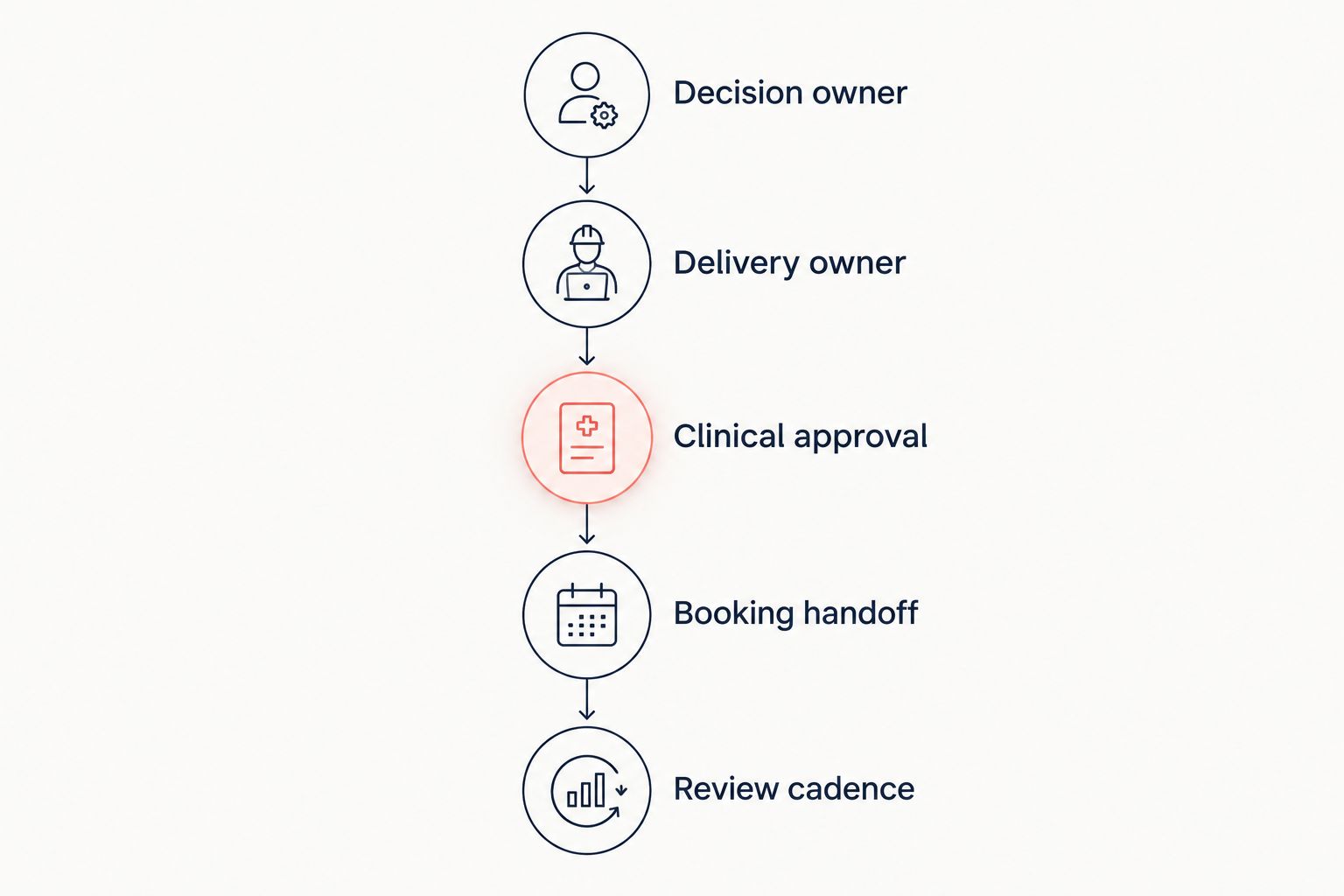
Assign responsibility across the whole process before expanding campaign activity.
Which marketing partner should you choose?
Choose the missing function, not the broadest proposal. If direction is unresolved, start with fractional leadership. If the direction is settled, hire against the specific execution gap. If daily coordination dominates the workload, evaluate an internal director.
For a Raleigh-area medical spa considering Carey Kidd Group, frame the conversation around strategic leadership and implementation responsibility. Bring your current supplier list, approval structure, and booking process. Those materials make the required role clearer than a request for more leads.
Define your marketing leadership needs
Review fractional CMO and strategic consulting services for your Raleigh-area business.
FAQ
What's the best marketing agency for medical spas North Carolina owners should choose?
Choose the partner that owns your missing function: leadership, specialist execution, coordinated delivery, or daily internal management. Define that responsibility before comparing proposals.
Is a fractional CMO better than a marketing agency for a medical spa?
A fractional CMO fits a leadership need; an agency fits an agreed delivery need. Neither model replaces the other automatically, and your scope must specify who handles implementation.
Does a medical spa need an agency with medical spa experience?
Include relevant medical spa work and its approval process in your selection criteria. Ask the provider to explain its role in that work and how clinical statements were reviewed.
Should I hire locally in Raleigh or consider an outside agency?
Choose based on the work's coordination requirements rather than location alone. If on-site participation is necessary, make that requirement explicit in the scope.
What should a medical spa marketing report include?
A useful report separates delivered work, inquiries, booked appointments, and completed visits where your systems record them. It should also identify unresolved handoffs and the decisions required next.
Can one agency manage everything for my medical spa?
Only assign responsibilities that the agency explicitly accepts in its scope. Clinical approvals, operational capacity, and internal business decisions still need named owners.
How should I compare medical spa marketing proposals in 2026?
Compare decision authority, deliverables, implementation ownership, approval requirements, and reporting definitions. Require each proposal to distinguish the work it controls from dependencies it does not.
One last thing
Ask each candidate: Who owns the problem when an inquiry arrives but no appointment is booked? The answer exposes the boundary between campaign delivery and business accountability. Put that boundary in the engagement agreement before you approve the next campaign.